About Plecturocebus ornatus (Gray, 1866)
Coat Texture
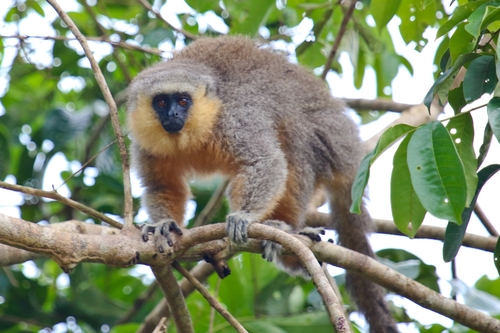
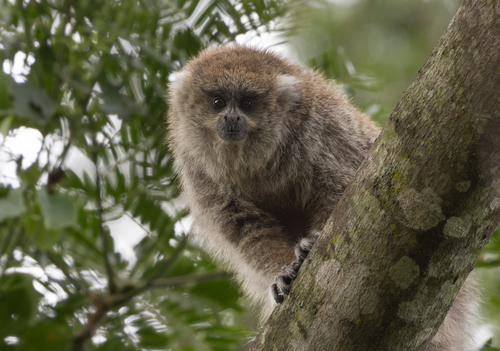
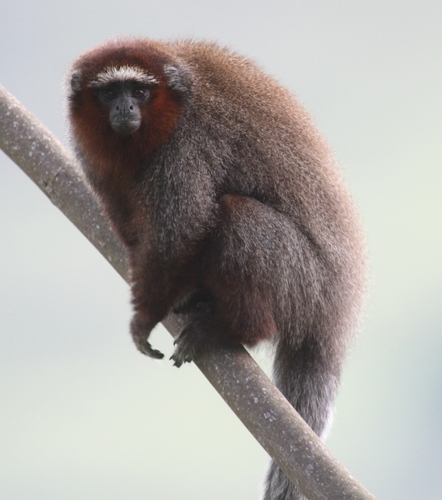
The ornate titi (Plecturocebus ornatus) has a thick, dense, fluffy coat.
Facial and Limb Coloration
Its ears and forehead are white, while its hands and feet are grey.
Body and Tail Coloration
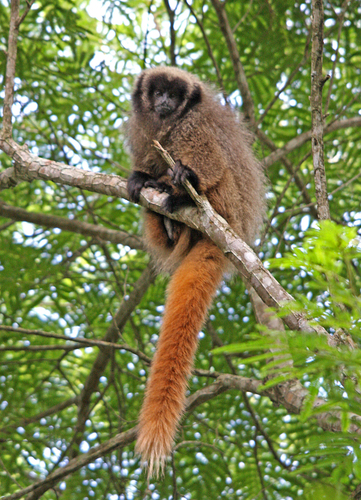
The rest of its body is bright chestnut red, except for its tail, which is dark reddish-brown or black with a white tip.
Tail Length
Like most titi species, its tail is longer than its body.
Sexual Dimorphism and Size
Males and females do not differ significantly in appearance, though females are generally larger: the average male body length is 633 mm, and the average female body length is 752 mm.
Geographic Range
This species is endemic to Colombia, where it occurs in Cundinamarca Department (Medina) ranging north to the lower Upa and Meta rivers, and south into Meta Department along the base of the Cordillera Oriental and the Sierra de la Macarena, extending to the Guayabero River and upper Guaviare river.
Preferred Forest Habitat
It primarily inhabits the tropical and subtropical levels of forest, and prefers areas with dense vegetation such as thickets, tangles, thorny underbrushes, and wet or waterlogged sites.
Sleeping Site Characteristics
Ornate titis sleep in vine tangles on small tree branches, usually at least 15 m (49 ft) above the ground.
Habitat Disturbance Tolerance
Like other members of the moloch group, the ornate titi tolerates seasonal flooding and habitat disturbance, and is commonly found in human-disturbed forest areas, even thriving in highly disturbed habitats.
Habitat Fragmentation Threat
Despite this tolerance, ongoing expansion of human settlements has reduced both the size and quality of the species' habitat, leaving its remaining range severely fragmented.
Occupied Area Decline
The total occupied area is currently approximately 20,000 km², representing a 30% decline over the past 24 years.
Conservation Listings
It has been listed as Vulnerable by the IUCN since 1994, and is included in Appendix II of CITES.
Population Trend
Habitat loss has also affected population density, which is recorded at 5 individuals per square kilometer, and the species has an overall decreasing population trend.
Mating System
Ornate titis are monogamous.
Infant Care
Infant care is primarily provided by the father; infants are only passed to the mother to feed.
Birthing Period
Births occur between December and March, with the smallest infants born between December and January.
Gestation Length
The average gestation period is 128 days, or 4.2 months.
Lactation Diet Adaptation
Observations note that female ornate titis increase their protein intake during lactation, primarily by eating more insects.