About Chiropotes albinasus (I.Geoffroy Saint-Hilaire & Deville, 1848)
Common Name & Distinguishing Traits
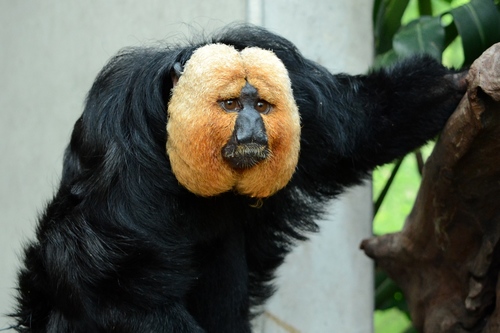
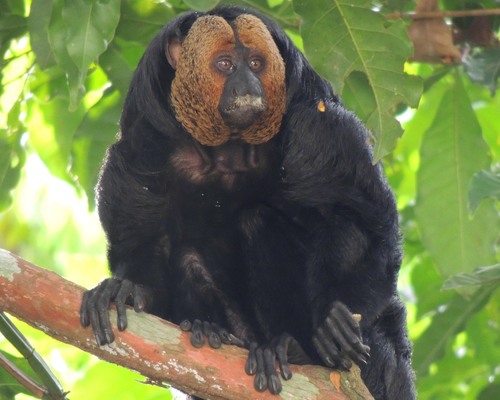
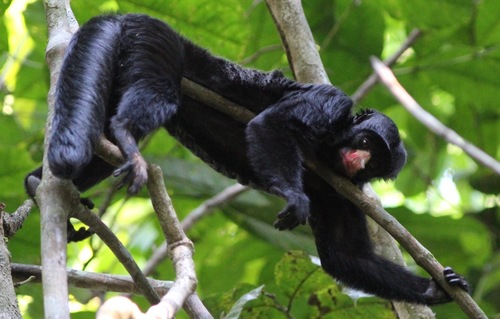
Chiropotes albinasus, commonly called the white-nosed saki, has three distinctive common physical features: a beard, two hair tufts on the head, and a long bushy tail. These traits make it easy to distinguish from other species in the genus Chiropotes.
Body Fur
Most of its body is covered in entirely black, silky fur, which contrasts sharply against its reddish-pinkish noses and lips.
Nose Coloration
The common name can be misleading: while this species has white hairs on its nose, the underlying nose skin is a more visible bright mixture of red and pink.
Sexual Dimorphism
Males and females share the same core physical features, but females can be told apart by the shorter, thinner hair on their head tufts and beards.
Key Body Structures
Two of this species' most important body structures are its tail and teeth.
Tail Function by Age
The function of the tail changes as the animal matures. Juveniles use their tail to swing across forest canopies, but adult tails become non-prehensile and are only used for balance.
Adult Tail Use
The tail supports the white-nosed saki during suspensory behavior, most often while feeding.
Tooth Structure & Function
Its teeth have a canine-like appearance, and help the species break through tough outer coverings of the foods it eats, such as hard-shelled fruits and seeds.
Distribution Drivers
This species' distribution is shaped by its ability to survive and adapt to drastic environmental changes. It can tolerate difficult environmental shifts for long periods before needing to relocate.
Amazon Distribution Range
White-nosed sakis are mostly distributed across the southeastern and south-central regions of the Amazon Rainforest, which extends into Brazil.
Southern Amazon Dominance
They are dominant in the southern Amazon, as they share the eastern Amazon with the Uta Hicks bearded saki, creating competition that reduces food availability.
Brazil Specific Observations
They have also been observed in the southwestern area of the Dos Marmelos River in Brazil.
Habitat Food Requirements
As a primary consumer, the white-nosed saki relies on habitats with an adequate food supply. Because its diet overlaps closely with other Chiropotes species, it is rarely found in habitats where it would need to coexist and compete for food.
Terra Firma Ecosystem Habitat
It mainly occurs in terra firma ecosystems within the Amazon, where its preferred food source—immature seeds—is readily available.
Preferred Forest Type
This species favors undisturbed primary terra firma forests that have experienced little to no human activity. These forests are known for having poor soils, but this does not cause problems for the white-nosed saki.
Foraging Group Behavior
It lives in this ecosystem because it can easily organize foraging groups to locate the food it needs.
Canopy Preference
While habitat choice is mainly driven by food availability, the species also prefers the shaded upper canopies that are characteristic of primary terra firma forests, and it spends most of its daily life in these upper canopies.
Uncommon Habitat Observations
White-nosed sakis have also been found living and moving through mountain savanna forests at high elevation, though this occurrence is uncommon.
Reproduction Research Status
Reproduction in this species remains under-researched, similar to many aspects of its communication. Most existing observations were made when individuals were held in captivity, rather than in their natural habitat, which contributes to this gap in research.
Breeding Seasonality
Existing observations confirm that the white-nosed saki is a seasonal breeder. Most births have been recorded during two windows per breeding season: the early months of February and March, and the later months of August and September.
Gestation & Litter Size
The gestation period, the time between conception and birth, lasts approximately 5 months. Females typically give birth to a single infant per year.
Parental Care
After birth, the mother provides almost all parental care, supplying the infant with food and carrying it with her wherever she travels.