About Pinus roxburghii Sarg.
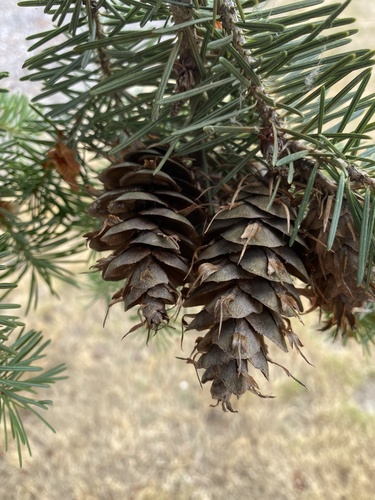
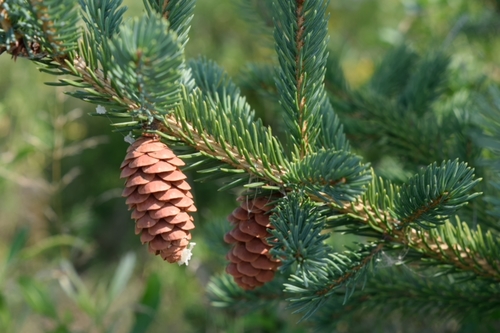
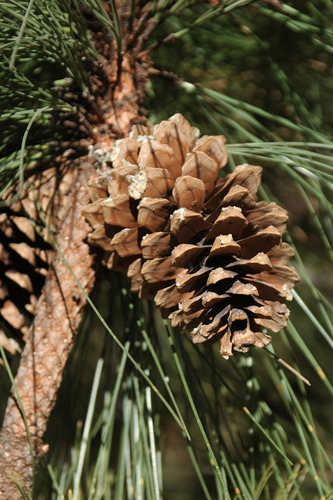
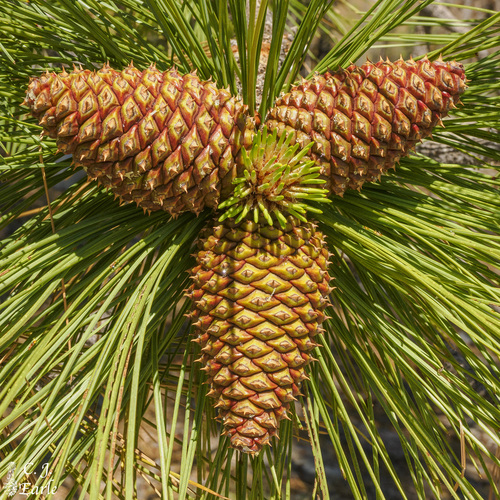
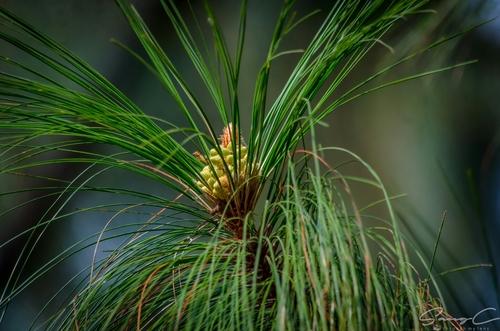
Pinus roxburghii Sarg. is a large tree that reaches 30–50 metres (98–164 feet) tall, with a trunk diameter up to 2 m (6+1⁄2 ft), and exceptionally up to 3 m (10 ft). Its bark is red-brown, thick and deeply fissured at the trunk base, and thinner and flaky in the upper crown. The leaves are needle-like, borne in fascicles of three, very slender, 20–35 centimetres (8–14 inches) long, and a distinct yellowish green. The cones are ovoid conic, 12–24 cm (4+1⁄2–9+1⁄2 in) long and 5–8 cm (2–3 in) broad at the base when closed. They start green, and ripen to a glossy chestnut-brown when they are 24 months old. They open slowly over the following year or so, or after being heated by a forest fire, to release their seeds, opening to 9–18 cm (3+1⁄2–7 in) broad. The seeds are 8–9 millimetres (5⁄16–3⁄8 in) long, with a 40 mm (1+1⁄2 in) wing, and are wind-dispersed. The native range of Pinus roxburghii extends from Tibet (China) and Afghanistan through Pakistan, across northern India (in Jammu and Kashmir, Himachal Pradesh, Uttarakhand, Sikkim and Arunachal Pradesh), Nepal and Bhutan, to Myanmar. It generally grows at lower altitudes than other pines in the Himalayas, occurring from 500–2,000 m (1,600–6,600 ft), and occasionally up to 2,300 m (7,500 ft). Other Himalayan pines include P. wallichiana (blue pine), P. bhutanica (Bhutan white pine), P. armandii (Chinese white pine), P. gerardiana (chilgoza pine), P. densata (Sikang pine) and P. kesiya (Khasi pine). Owing to its shallow roots, Pinus roxburghii is linked to soil erosion, particularly in the Himalayas. Fallen needles from this tree increase soil acidity, which prevents most other vegetation from growing around it. The accumulating carpet of needles on the forest floor under these trees creates unfavourable conditions for many common plants and trees to grow. The most common trees that can grow in this environment are Rhododendron, banj oak (Quercus leucotrichophora) and trees from the family Ericaceae (known locally as eonr and lodar). This may be due to the relative fire immunity that the thick bark of these species provides. The Himalayan nettle (Girardinia diversifolia) is another plant that grows well under this tree. The caterpillars of the moth Batrachedra silvatica are only known to feed on chir pine. The white-bellied heron (Ardea insignis), a large critically endangered heron, is known to roost in chir pine. Chir pine is widely planted for timber in its native area, and is one of the most important trees for forestry in northern Pakistan, India and Nepal. For local building purposes, this tree's wood is the least preferred, as it is the weakest and most prone to decay when compared with other conifers. However, in most low altitude regions, there is no other available conifer option, though other non-conifer tree species grow at lower altitudes in these tropical latitudes. When this pine species reaches a large girth, its bark forms flat patches that can be broken off in chunks around 52 cm² (8 sq in) by 51 mm (2 in) thick. The bark has a layered structure like plywood, but the individual layers have no grain. Local people use this easily carvable bark to make useful items such as vessel lids. Blacksmiths in the region also use this bark exclusively as fuel for their furnaces. Old trees that die from fire or drought undergo a change in their wood as resin crystallizes inside the heartwood. This process makes the wood brightly coloured, in various shades from translucent yellow to dark red, very aromatic, and gives it a brittle, glassy feel. This form of wood, called jhukti by locals, is very easy to ignite because it never gets wet or waterlogged. Local people use it for starting fires and even for lighting, as a small piece burns for a long time due to its high resin content. Among all the conifer species in the area, only Pinus roxburghii produces this ideal jhukti wood. Every autumn, dried needles of this tree form a dense carpet on the forest floor. Local people gather these needles into large bundles to use as cattle bedding year-round. Green needles are also used to make small hand brooms. In the Jaunsar-Bawar region of Uttarakhand, where the tree is called salli in the local dialect, local people have many uses for it. It is also occasionally planted as an ornamental tree in parks and gardens of hot dry areas, where its heat and drought tolerance is valued.