About Pinus jeffreyi Balf.
Scientific Name and Common Name
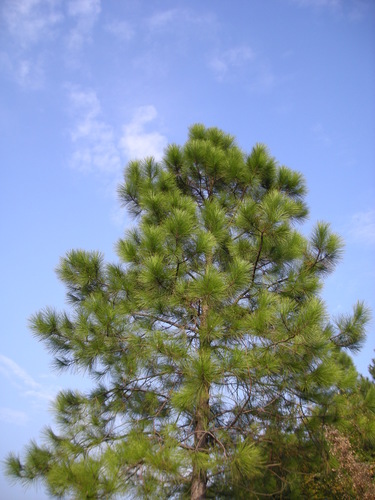
Pinus jeffreyi Balf., commonly known as Jeffrey pine, is a large coniferous evergreen tree.
Tree Height
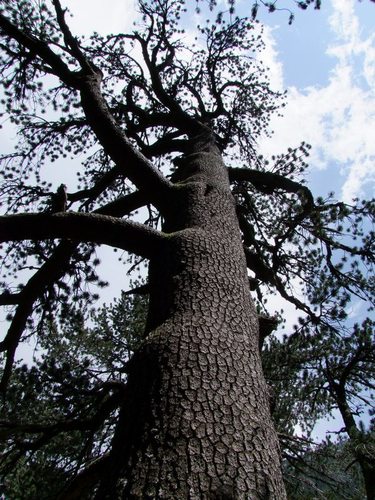
It typically grows 25 to 40 meters (82 to 131 feet) tall, and rarely reaches up to 53 meters (174 feet) tall; trees growing at or near tree line stay smaller in size.
Leaf Characteristics
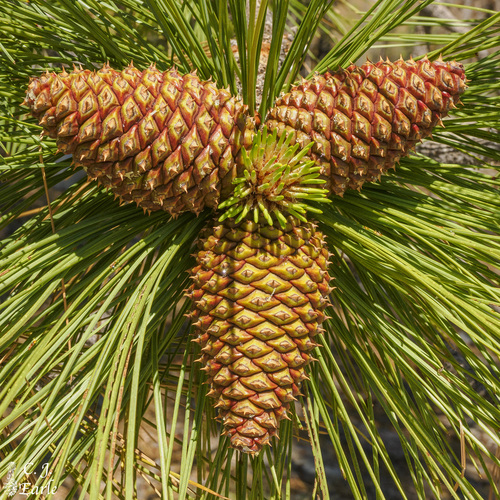
Its leaves are needle-like, produced in bundles of three, are stout and glaucous gray-green, and measure 12 to 28 centimeters (4+3⁄4 to 11 inches) long.
Cone Traits
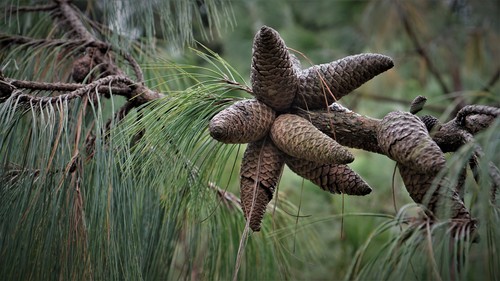
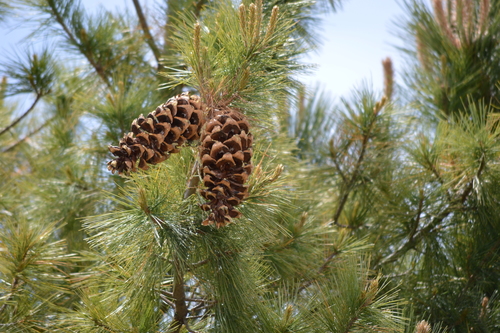
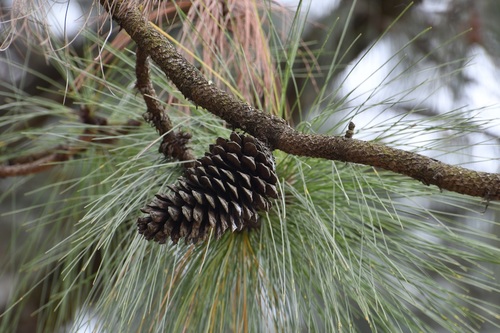
Its cones are 12 to 30 centimeters (4+3⁄4 to 11+3⁄4 inches) long; they are dark purple when immature and ripen to pale brown, with thinly woody scales that bear a short, sharp inward-pointing barb.
Seed Characteristics
The brownish seeds are 10 to 12 millimeters (3⁄8 to 1⁄2 inch) long, with a large wing that measures 15 to 25 millimeters (5⁄8 to 1 inch) long.
Taxonomic Relationship to Ponderosa Pine
Jeffrey pine is closely related to, and similar in appearance to, Pinus ponderosa (ponderosa pine).
Cone Scale Barb Distinction
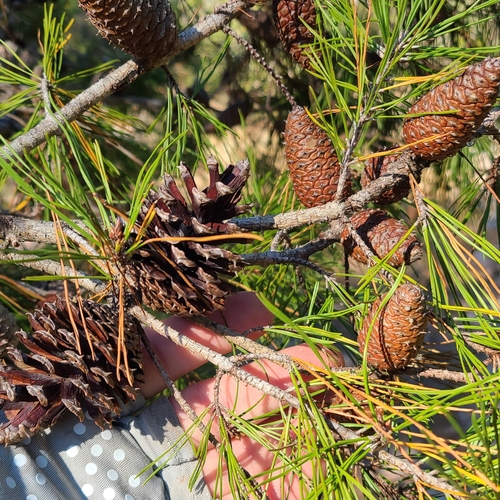
A key way to distinguish the two species is by the barbs on their cone scales. The sharp barbs on P. jeffreyi cone scales point inward, so the cone feels smooth when rubbed across the palm of the hand; P. ponderosa cone scale barbs point outward, so they feel sharp and prickly to the palm.
Distinction Mnemonic
The mnemonic 'gentle Jeffrey' and 'prickly ponderosa' is commonly used to remember this difference.
Needle and Cone Distinctions
Other distinguishing characteristics include P. jeffreyi's glaucous, less bright green needles compared to P. ponderosa, plus its stouter, heavier cones with larger seeds and inward-pointing barbs.
Bark Distinction
P. jeffreyi can also be told apart by its relatively smaller scales of reddish-brown bark, compared to the larger orangish bark plates of ponderosa pine.
Scent Profile
The scent of P. jeffreyi is variously described as similar to vanilla, lemon, pineapple, violets, apple, and most commonly butterscotch.
Scent Detection
This scent can be detected by breaking off a shoot or needles, or by smelling the resin between the bark's plates.
Resin Composition
The scent is linked to the very unusual composition of the tree's resin, where the volatile component is almost entirely pure n-heptane.
Common Nickname
Because of this trait, the species is sometimes called the gasoline tree.
Octane Rating System Origin
The easy availability of pure n-heptane from this tree became the basis for the modern octane rating system in the late 1920s.
Largest Known Specimen Identity
The largest known specimen by trunk volume is the Eureka Valley Giant, located in Stanislaus National Forest.
Largest Specimen Dimensions
Its trunk holds 129 cubic meters (4,600 cubic feet) of wood, it stands 59 meters (194 feet) tall, and has a trunk diameter of 2.5 meters (8 feet 2 inches).
Species Distribution
Pinus jeffreyi occurs from southwestern Oregon south through much of California, mainly on the eastern side of the Sierra Nevada, to northern Baja California in Mexico.
Altitude Range
It is a high-altitude species: in the northern part of its range, it grows widely at 1,500 to 2,100 meters (4,900 to 6,900 feet) altitude, and grows at 1,800 to 2,900 meters (5,900 to 9,500 feet) in the southern part of its range.
Stress Tolerance
Jeffrey pine is more stress tolerant than ponderosa pine.
Habitat Dominance
At higher elevations, on poorer soils, and in colder, drier climates, P. jeffreyi replaces P. ponderosa as the dominant tree. It is also tolerant of serpentine soils, and is often dominant in these conditions, even on dry sites at fairly low altitudes.
Hybridization
Pinus jeffreyi can hybridize with P. ponderosa and Coulter pine, but this happens very rarely because the three pine species release pollen at different times of the year.
Seed Predators
Mammals and birds collect the seeds of P. jeffreyi.
Wood Use
The wood of Pinus jeffreyi is similar to ponderosa pine wood, and is used for the same purposes.
Edible Sap Use
Crystallized sap from P. jeffreyi has been eaten as candy.
Octane Rating Scale Zero Point
The exceptional purity of n-heptane distilled from P. jeffreyi resin led to n-heptane being selected as the zero point on the octane rating scale for petrol.
Turpentine Source Suitability
Because its resin consists mainly of n-heptane, it is a poor source of turpentine.
Historical Distillation Explosions
Before P. jeffreyi was recognized as a separate species from ponderosa pine in 1853, resin distillers working in its range experienced a number of 'inexplicable' distillation explosions, now known to be caused by the unintended use of Jeffrey pine resin.