About Pinus edulis Engelm.
Nomenclature and Common Name
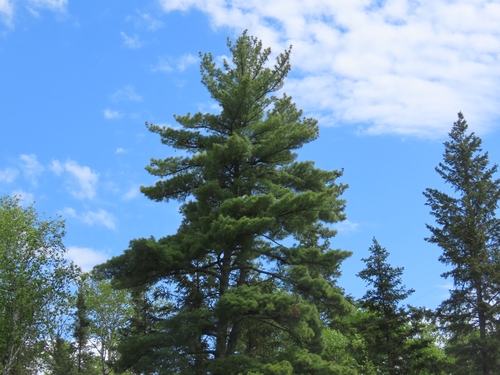
Pinus edulis Engelm., commonly called piñon pine or Colorado piñon, is a small to medium-sized tree.
Mature Size
Mature trees reach 10–20 ft (3.0–6.1 m) in height, with a trunk diameter that rarely exceeds 31 in (80 cm).
Growth Rate
This species grows at an extremely slow rate: under good conditions, it only gains 6 ft (1.8 m) of height over 100 years, for an average annual growth of just 0.72 in (18 mm).
Bark Characteristics
Its bark is irregularly furrowed and scaly.
Needle Morphology
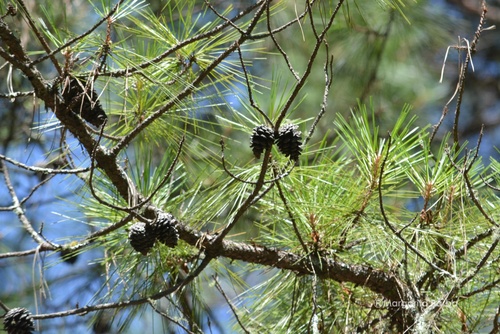
Its leaves, called needles, grow in pairs; they are moderately stout, green, and 3–5.5 cm (1+1⁄8–2+1⁄8 in) long.
Needle Stomata Distribution
Stomata are present on both the inner and outer needle surfaces, with distinctly more stomata on the inner surface that form a whitish band.
Immature Cone Characteristics
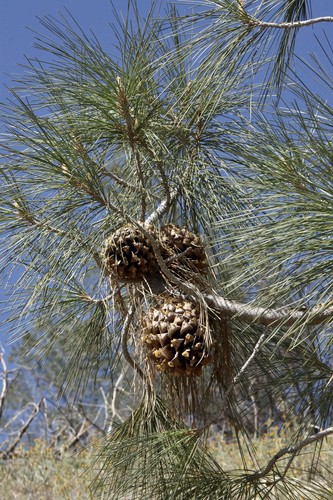
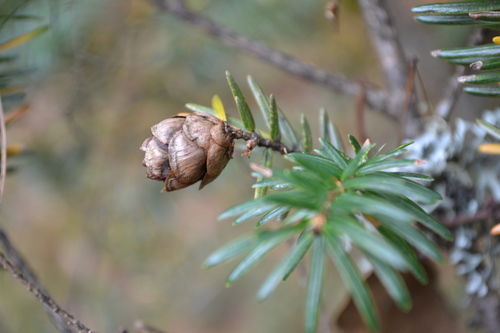
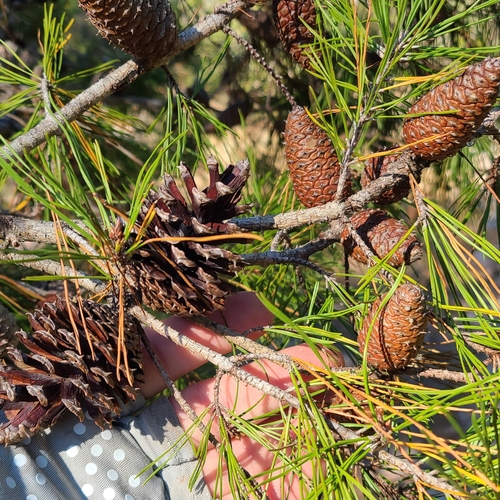
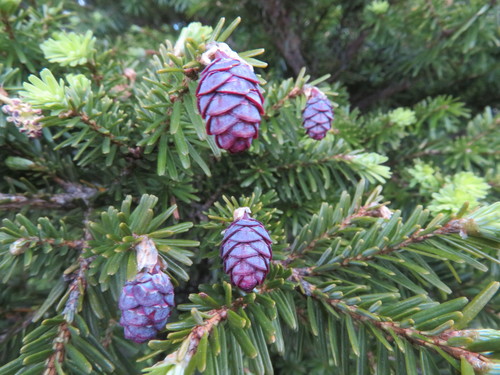
The species produces globose cones that are 3–5 cm (1+1⁄4–2 in) long and broad when closed.
Cone Ripening Timeline and Color
Cones start out green, and ripen to a yellow-buff color after 18–20 months.
Cone Scale Count
They only have a small number of thick scales, with typically 5–10 fertile scales per cone.
Mature Cone Structure
When mature, cones open to 4–6 cm (1+1⁄2–2+1⁄4 in) broad, and retain the seeds on their scales after opening.
Seed Morphology
The seeds measure 10–14 mm (3⁄8–9⁄16 in) long, with a thin shell, a white endosperm, and a vestigial 1–2 mm (1⁄32–3⁄32 in) wing.
Hybridization Range
Along the Mogollon Rim of central Arizona and the Grand Canyon, this species intermixes with Pinus monophylla sbsp. fallax over several hundred kilometers.
Hybrid Needle Traits
This intermixing produces trees that have both single- and two-needled fascicles on each branch.
Needle Count Variability Drivers
The frequency of two-needled fascicles increases after wet years and decreases after dry years.
Needle Anatomy Similarity
The internal anatomy of both needle types is identical, differing only in the number of needles per fascicle.
Taxonomic Classification Note
This anatomy suggests that Little's 1968 designation of this mixed tree as a variety of Pinus edulis is more accurate than its later classification as a subspecies of Pinus monophylla, which was based entirely on the presence of single needle fascicles.
Aromatic Property
Pinus edulis is an aromatic species; essential oil can be extracted from its trunk, limbs, needles, and seed cones.
Aromatic Compounds
Prominent aromatic compounds found across different parts of the tree include α-pinene, sabinene, β-pinene, δ-3-carene, β-phellandrene, ethyl octanoate, longifolene, and germacrene D.
Geographic Distribution
Its natural range covers the U.S. states of Colorado, southern Wyoming, eastern and central Utah, northern Arizona, New Mexico, western Oklahoma, southeastern California, and the Guadalupe Mountains in far western Texas, and also extends into northern Mexico.
Elevation Range
It grows at moderate elevations of 1,600–2,400 m (5,200–7,900 ft), and rarely occurs as low as 1,400 m (4,600 ft) or as high as 3,000 m (9,800 ft).
Native Habitat Community
Within this range, it is widespread and often abundant, forming extensive open woodlands that are typically mixed with junipers as part of the pinyon-juniper woodland plant community.
Colorado Population Size
In Colorado, Colorado pinyon grows as the dominant species across 4.8 million acres (19,000 km², or 7,300 sq mi), making up 22% of the state's forests.
Historical Agricultural Use
This species holds cultural meaning for agriculture in the region: strong piñon wood plow heads were used to break soil for crop planting at the earliest known agricultural settlements in the state.
Elevation Outlier Record
There is one recorded case of a Colorado pinyon growing alongside Engelmann spruce (Picea engelmannii) and limber pine (Pinus flexilis) at nearly 3,170 m (10,400 ft) on Kendrick Peak in the Kaibab National Forest of northern Arizona.
Seed Dispersal Mechanism
In its ecology, Pinus edulis seeds are dispersed by the pinyon jay, which plucks seeds out of open cones.
Pinyon Jay Seed Interaction
Pinyon jays use the seeds as a food source, store many seeds for later use, and some stored seeds are left unused and go on to germinate into new trees.
Other Seed Predators
Seeds are also eaten by wild turkey, Montezuma quail, and a variety of mammals.
Edible Seed Use
The edible seeds of this species, called pine nuts, are widely collected across the tree's range.
Native American Seed Harvest Rights
In many areas, harvest rights for these seeds are held by Native American tribes, for whom the species has immense cultural and economic importance.
Pine Nut Storage
Unshelled pine nuts can be stored for up to a year.
Historical Construction Use
Archaeologist Harold S. Gladwin described 400–900 CE pit-houses built by southwestern Native Americans that were fortified with posts cut from pinyon trunks and coated with mud.
Ornamental and Cultural Use
Colorado pinyon is also occasionally planted as an ornamental tree, and sometimes used as a Christmas tree.