About Picea glauca (Moench) Voss
Species Nomenclature
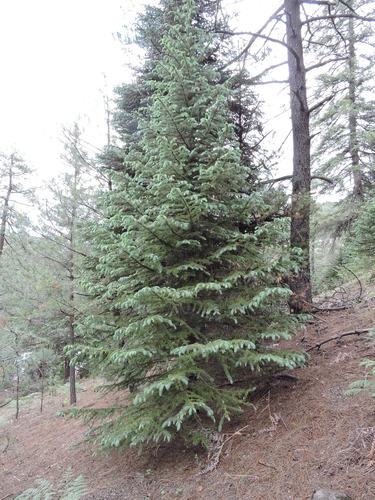
Picea glauca, commonly called white spruce, is a large evergreen conifer.
Mature Tree Size
It normally reaches 15 to 30 meters (50 to 100 feet) in height, but can grow as tall as 41 meters (133 feet), with a trunk diameter of up to 1 meter (3 feet 3 inches).
Bark Characteristics
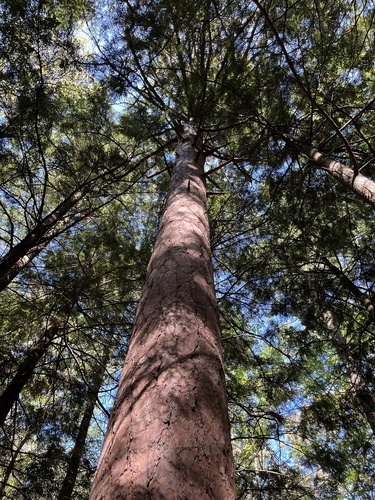
Its bark is thin and scaly, and flakes off in small circular plates that measure 5 to 10 centimeters (2 to 4 inches) across.
Crown Shape
The tree has a narrow crown: conical when young, becoming cylindrical as it ages.
Shoot Morphology
Shoots are pale buff-brown; they are hairless (glabrous) in the eastern part of the species’ range, but often hairy (pubescent) in the west, and have prominent pulvini.
Leaf Shape and Size
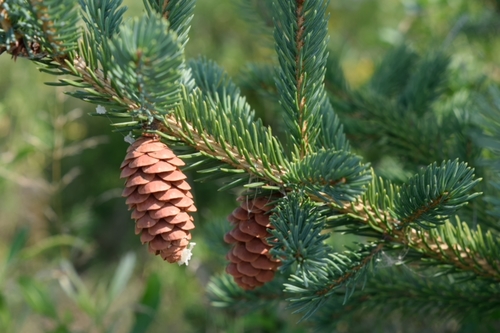
Its leaves are needle-like, 12 to 25 millimeters (1/2 to 1 inch) long, and rhombic in cross-section.
Leaf Color and Stomata
The upper leaf surface is glaucous blue-green (the specific epithet glauca refers to this color) with several thin lines of stomata, while the lower surface is blue-white with two broad bands of stomata.
Cone Structure and Size
Cones are pendulous, slender, and cylindrical, measuring 2.5 to 7 cm (1 to 2 3/4 inches) long and 1.5 cm wide when closed, opening to 2.5 cm broad. They have thin, flexible 15 mm-long scales with smoothly rounded margins.
Cone Maturation
Cones are green or reddish when young, and mature to pale brown 4 to 8 months after pollination.
Seed Morphology
Seeds are black, 2 to 3 mm long, with a slender, tan wing 5 to 8 mm long.
General Distribution Range
White spruce has a transcontinental range across North America.
Canadian Range Extent
In Canada, its continuous range covers almost all of the Boreal, Subalpine, Montane, Columbia, Great Lakes–St. Lawrence, and Acadian Forest Regions, and extends into every Canadian province and territory.
Northern Canadian Range Limits
On the west coast of Hudson Bay, the species reaches the Seal River around 59°N, and its northern limit runs almost directly northwest to near the mouth of the Mackenzie River, around latitude 68°. Collins and Sumner have recorded white spruce growing within 13 km of the Arctic coast in the Firth Valley, Yukon, at approximately 69°30′ N, 139°30′ W.
Western Canadian Range Limits
It reaches within 100 km of the Pacific Ocean in the Skeena Valley, where its range overlaps with that of Sitka spruce (Picea sitchensis). It also almost reaches the Arctic Ocean at latitude 69° N in the District of Mackenzie, with 15 m-tall white spruce growing on some delta islands near Inuvik.
Ecological Niche Comparison
Lafond noted the broad range of ecological conditions that allow four Quebec conifers, including white spruce, to establish, but observed that white spruce has more specific requirements than black spruce.
United States Range Extent
In the United States, white spruce’s range extends into Maine, Vermont, New Hampshire, New York, Michigan, Wisconsin, Minnesota, and Alaska.
Alaskan Range Limits
In Alaska, it reaches the Bering Strait at 66°44′ N at Norton Bay, and reaches the Gulf of Alaska at Cook Inlet.
Isolated Southern Populations
Isolated southern populations have been recorded in southern Saskatchewan, the Cypress Hills of southwestern Saskatchewan and southeastern Alberta, northwestern Montana, south-central Montana, the Black Hills on the Wyoming–South Dakota boundary, the Manitoba–North Dakota boundary, and Shushan, New York.
Northernmost Range Position
White spruce is the northernmost tree species in North America, growing just north of 69°N latitude in the Mackenzie River delta.
Elevation Range
It grows from sea level up to an elevation of 1,520 m (4,990 ft).
Northern Range Climate Correlates
Its northern distribution roughly correlates with the location of the tree line, which matches the 10 °C (50 °F) mean July temperature isotherm and the position of the Arctic front; cumulative summer degree days, mean net radiation, and light intensity also influence its northern limit. White spruce is generally found in regions where the annual growing season is longer than 60 days.
Southern Range Climate Correlates
The southern edge of the zone where white spruce makes up 60% or more of total stand area roughly aligns with the 18 °C (64 °F) July isotherm around the Great Lakes; in the Prairie Provinces, this limit lies north of this isotherm.
Day Length Range
During the summer solstice, day length ranges from 17 hours at the species’ southern limits to 24 hours north of the Arctic Circle.
Cold Tolerance
As one of the hardiest conifers, white spruce in parts of its range can tolerate a mean daily January temperature of −6.7 °C (19.9 °F) and extreme minimum temperatures as low as −56.5 °C (−69.7 °F); minimum temperatures of −50 °C (−58 °F) are common across most of the range, except for the southernmost and southeasternmost parts.
Northern Tree Line Association
Alone, or growing alongside black spruce and tamarack (Larix laricina), white spruce forms the northern boundary of tree-form growth. 15 m-tall white spruce grow at 69°N on islands in the Mackenzie Delta near Inuvik, Northwest Territories. Hustich (1966) described Picea species as forming the northernmost limit of tree growth in North America.
Continental Timberline Zone
The arctic or northern timberline in North America forms a broad transition zone from Labrador to northern Alaska.
Labrador Range Details
In Labrador, white spruce is not abundant and makes up less than 5% of the forest; its range aligns very closely with that of black spruce, but extends slightly further north.
Transcontinental Western Range
White spruce’s range extends west from Newfoundland and Labrador, and along the northern tree limit to Hudson Bay, the Northwest Territories, Yukon, and into northwestern Alaska. Across western Canada and Alaska, white spruce grows further north than black spruce.
Tundra Hardwood Growth
While poplar (Populus), willow, and birch may grow along streams well into the tundra beyond spruce limits, these hardwoods usually only grow as low scrub.
Northern Growth Forms
White spruce characteristically forms fingers of tree-form forest that extend far down northern rivers, and grows as scattered clumps of dwarfed "bush" spruce on the intervening land.
Manitoba Northern Range Records
In Manitoba, Scoggan recorded the northernmost collection of white spruce at latitude 59°48'N, but Bryson et al. found white spruce on the northern edge of continuous forest in central Canada at Ennadai Lake, around 60°45′ N, 101°W, just north of the northwest corner of Manitoba. Bryson et al. noted the forest retained the same general characteristics it had when first described by Tyrrell in 1896.
Northern Flora Climate Drivers
Climate, especially temperature, is an obvious factor shaping the distribution of northern flora.
Isotherm Range Correlation
Halliday and Brown suggested white spruce’s northern limit corresponds very closely with the 10 °C July mean monthly isotherm in Ungava, but the northern limit west of Hudson Bay lies south of this isotherm.
Additional Northern Range Influences
Other climatic factors that have been proposed to influence white spruce’s northern limit include cumulative summer degree days, the position of the Arctic front in July, mean net radiation during the growing season, and low light intensities. Topography, soil conditions, and glaciation may also play an important role in controlling the northern limits of spruce.
Southern Range Complexity
The southern limit of white spruce’s distribution is more complex.
Southern Continuous Range Boundary
East of the main range of coastal mountains in British Columbia, the southern continuous limit of white spruce follows the forest/prairie interface through Alberta, Saskatchewan, Manitoba, the northern parts of Minnesota and Wisconsin, central Michigan, northeastern New York, and Maine.
Historical Southern Range Records
Sargent, and Harlow and Harrar also included Vermont and New Hampshire in its range; while Dame and Brooks excluded New York and states further west, they included Massachusetts as far south as Amherst and Northampton, which they called probably the southern limit of the species in that area. Nisbet described white spruce’s range as extending to Carolina, but he did not recognize red spruce as a separate species and presumably included red spruce within white spruce.
Southern Range Competition
In the southern parts of its range, white spruce faces increasingly strong ecological competition from hardwoods. Some hardwoods reinforce their competitive advantage in growth rate and sprouting through allelopathic inhibition of conifer regeneration. Further southward extension of white spruce’s distribution is prevented by the species’ requirement for cold temperatures.
Climax Forest Role
White spruce is a climax canopy tree in the boreal forests of Canada and Alaska.
Preferred Soil Types
It generally grows on well-drained soils in alluvial and riparian zones, though it also grows on soils of glacial and lacustrine origin.
Understory Composition
Its understory is dominated by feather mosses (Hylocomium splendens, Pleurozium schreberi, Ptilium crista-castrensis) and fork mosses, and occasionally peat moss.
Humus Layer Depth
In the far north, the total depth of moss and underlying humus is normally between 25 and 46 cm (10 and 18 inches), and tends to be shallower when hardwoods are present in the stand.
Soil pH Tolerance
White spruce grows in soils with pH values of 4.7–7.0, though specimens have been found in soils as acidic as pH 4.0 in subalpine fir forests in the Northwest Territories.
Soil Nutrient Requirements
Soil calcium is commonly present where white spruce grows in northern New York.
Soil Order Association
White spruce most commonly grows in the soil orders of Alfisols and Inceptisols.
Northern Latitude Soil Limitations
Soil properties such as fertility, temperature, and structural stability partially determine whether white spruce can grow in extreme northern latitudes.
Northern Succession Dynamics
At the northern limits of its range, white spruce is a climax species alongside black spruce; birch and aspen are early succession species here.
Wildfire Regime
Wildfires typically occur every 60 to 200 years, though they have been recorded occurring as infrequently as every 300 years.
Cultivation Hardiness Zones
White spruce will grow in USDA Growing Zones 3–7, but it is not adapted to heat and humidity and grows poorly in hot climates. The tree reaches its greatest longevity and growth potential in Zones 3–4.
Winter Herbivory
Animals including deer, rabbits, and grouse browse its foliage during winter.
Seed Predators
Its seeds are eaten by small mammals such as the red squirrel and birds including chickadee, nuthatch, and pine siskin.
Wood Quality Comparison
White spruce wood is lower quality than Engelmann spruce wood, but is stronger.
Alaskan Traditional Uses
Native Americans and European settlers in Alaska, where lodgepole pine does not grow, used it to build shelters and as firewood.
Canadian Commercial Wood Uses
The wood is of major economic importance in Canada, where it is harvested for paper production and construction.
Common Decorative Uses
It is also used as a Christmas tree.
Specialized International Wood Use
The wood is exported to Japan, where it is called "shin-kaya" and used to make go boards as a substitute for rare kaya wood.
Bonsai Use
Additionally, Picea glauca var. densata is used for bonsai.
Official Symbol Status
White spruce is the provincial tree of Manitoba and the state tree of South Dakota.
Edible and Culinary Uses
New growth and branch tips of white spruce are used in beer making, gin production, and for flavoring soda, candy, pickles, and preserves.