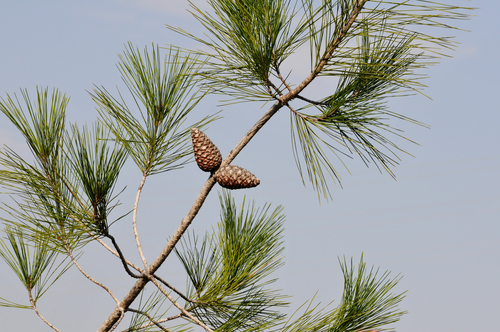
About Pinus brutia Ten.
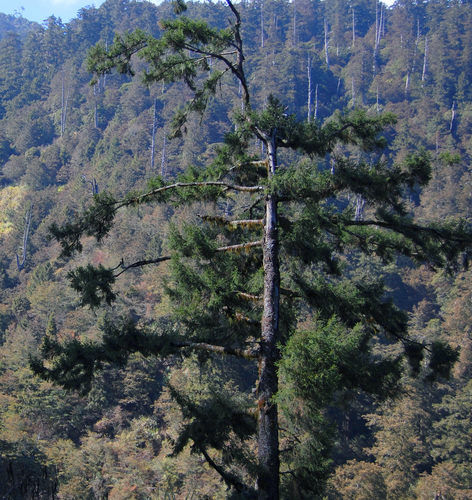
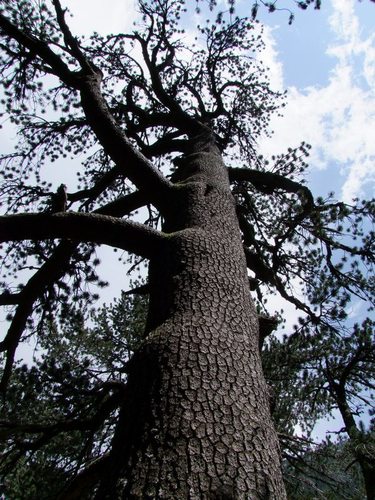
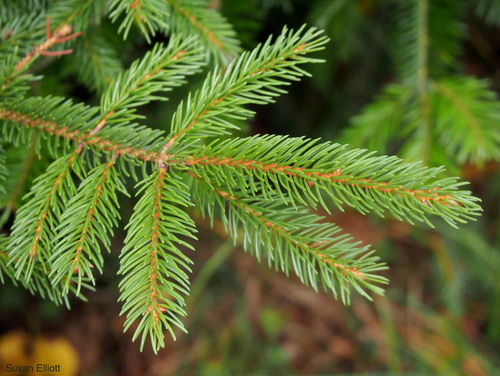
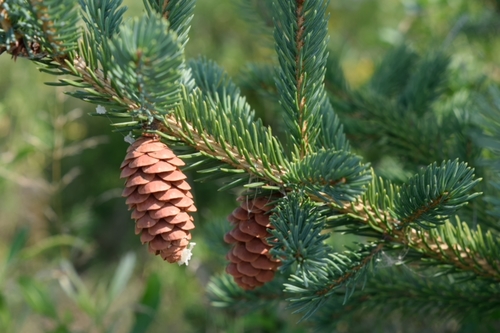
Pinus brutia Ten. is a medium-sized tree that grows to 20–35 metres (66–115 feet) tall, with a trunk diameter of up to 1 m (3+1⁄2 ft), and exceptionally up to 2 m (6+1⁄2 ft). Its young bark is thin and red-orange; mature bark is grey-brown to orange with a fissured to flaky texture. Its leaves are slender, needle-like, 10–18 centimetres (4–7 inches) long, and range from dark green to yellow-green. The needles grow in fascicles of two, and rarely three. Male cones are squat, 15–20 mm (0.59–0.79 in) long. Female cones are short with rigid, woody scales, 5–10 cm (2.0–3.9 in) long and 5–7 cm (2.0–2.8 in) broad. They mature from green to red-orange, most often grow in whorls of 3 to 4, and mature two years after pollination. Occasional specimens have cone structures that are similar to the related species Pinus canariensis. Seeds are most commonly dispersed by wind after the cones open, but some trees have cones that do not open wide enough for wind dispersal, and Krüper's nuthatch may assist these trees with seed dispersal. Most of the species' native range lies within Turkey, and it also extends to southeasternmost Bulgaria, the East Aegean Islands of the Aegean Sea, Crete, Crimea, Iran, Georgia, Azerbaijan, northern Iraq, western Syria, Lebanon, and Cyprus. Its presence in the eastern Mediterranean is hypothesised to date only to the nineteenth century, and is predominantly due to human activity. It is not native to Israel, and was introduced there in the 1930s. It generally grows at low altitudes: most populations occur from sea level to 500 m (1,600 ft) in northern Turkey, and can grow up to 1,200 m (3,900 ft) in the southern part of its range. Pinus brutia is a diagnostic species of the vegetation class Pinetea halepensis. The rare Krüper's nuthatch is largely restricted to forests of Turkish pine (Pinus brutia), depends heavily on it for food, and the ranges of the two species are largely coincident. This species is resistant to the Israeli pine bast scale insect Matsucoccus josephi, and is a major host for Thaumetopoea caterpillars. It covers 175,000 hectares (430,000 acres) in Cyprus, which makes up roughly 90% of all woodland coverage on the island. It forms ectomycorrhizal associations with numerous species of fungi, and its logs and branches are excellent growing substrates for many kinds of decomposing organisms. Pinus brutia is a popular ornamental tree, extensively planted in parks and gardens in hot dry areas such as southern California, Utah, New Mexico, Nevada, Arizona, and central Texas in the United States, where its high tolerance for heat and drought is highly valued. The subspecies P. brutia subsp. eldarica is the most drought-tolerant form, used in Afghanistan, Iran, and more recently in the Southwestern United States. In this region, P. brutia subsp. eldarica is referred to as "Eldarica pine", "Afghan pine", or "Mondell pine", named after Mondell Bennett, a commercial tree grower in New Mexico who popularised the subspecies starting in 1969.