About Picumnus olivaceus Lafresnaye, 1845
Size and Weight
The olivaceous piculet (Picumnus olivaceus Lafresnaye, 1845) measures 8.5 to 10 cm (3.3 to 3.9 in) in length and weighs 10 to 15 g (0.35 to 0.53 oz).
Nominate Male Crown and Face
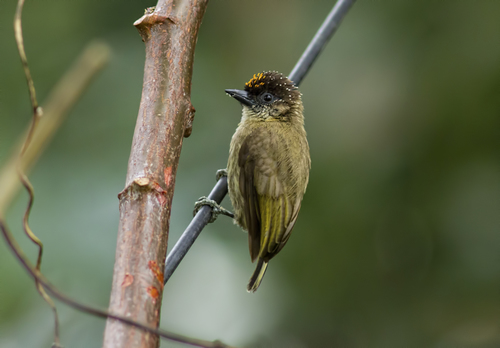
For the nominate subspecies P. o. olivaceus, adult males have a black crown and nape: the front and top crown feathers have red tips, while the remaining crown and nape feathers have white spots. Their face is mostly brown with white feather tips.
Nominate Male Upperparts and Flight Feathers
Their upperparts are olive-brown with a yellow tinge. Their flight feathers are dark brown with yellow to yellow-green edges.
Nominate Male Tail
Their tail is brown; the innermost pair of tail feathers have pale buff or yellowish inner webs, and the outer two pairs have a pale buff or yellowish stripe.
Nominate Male Underparts
Their chin and throat are buff to yellowish white, with a fine darker scaly pattern. Their underparts are yellowish brown on the breast, transitioning to buffish white to dull yellowish on the belly; the belly and flanks have wide, variably sized brownish streaks.
Nominate Male Bare Parts
Their iris is dark brown, their beak is black with a gray base to the lower mandible, the bare skin around the eye is gray to blue-gray, and their legs are gray with a green or blue tinge.
Nominate Female Plumage
Adult females are identical to males except their entire crown has white spots and no red.
Juvenile Plumage
Juveniles are duller and browner than adults, and sometimes have paler, more heavily streaked underparts.
Subspecies P. o. dimotus Characteristics
Other subspecies differ from the nominate in the following ways: P. o. dimotus has a more greenish tinge to the upperparts, is paler and more olive on the underparts, and has yellow-orange tips on the crown feathers.
Subspecies P. o. flavotinctus Characteristics
P. o. flavotinctus has darker, more olive upperparts, more olive underparts, and yellow on the crown.
Subspecies P. o. eisenmanni Characteristics
P. o. eisenmanni has much yellower upperparts, a pale yellowish olive breast and yellow belly, and orange to yellow on the crown.
Subspecies P. o. tachirensis Characteristics
P. o. tachirensis has green-tinged upperparts and orange to yellow on the crown.
Subspecies P. o. harterti Characteristics
P. o. harterti is darker olive overall with yellow to golden color on the crown.
Subspecies P. o. dimotus Distribution
The different subspecies have the following distributions: P. o. dimotus is found in eastern Guatemala, northern Honduras, and eastern Nicaragua.
Subspecies P. o. flavotinctus Distribution
P. o. flavotinctus is found in Costa Rica, Panama, and Colombia's northern Chocó Department.
Subspecies P. o. olivaceus Distribution
P. o. olivaceus is found in Colombia from Sucre Department south in the Andes to Cauca Department, and east to Huila Department.
Subspecies P. o. eisenmanni Distribution
P. o. eisenmanni occurs in the Serranía del Perijá in extreme northwestern Venezuela, and possibly in adjacent northern Colombia.
Subspecies P. o. tachirensis Distribution
P. o. tachirensis is found on the eastern slope of Colombia's Eastern Andes and in adjacent southwestern Venezuela.
Subspecies P. o. harterti Distribution
P. o. harterti ranges from southwestern Colombia south through western Ecuador into northwestern Peru.
Habitat Types
The olivaceous piculet lives in a wide variety of landscapes, including rainforest edges, cloudforest edges, drier forest, more open woodlands, secondary forest, plantations, and gardens. It avoids the interior of mature forest.
Elevation Range
Across most of its range it occurs in lowlands, but it reaches elevations of 500 m (1,600 ft) in Guatemala and Honduras, 1,400 m (4,600 ft) in Costa Rica, 1,600 m (5,200 ft) on Panama's Pacific slope, 2,300 m (7,500 ft) in Venezuela, 1,800 m (5,900 ft) in Colombia, and 900 m (3,000 ft) in Ecuador.