About Veniliornis lignarius (Molina, 1782)
Common Name and Size
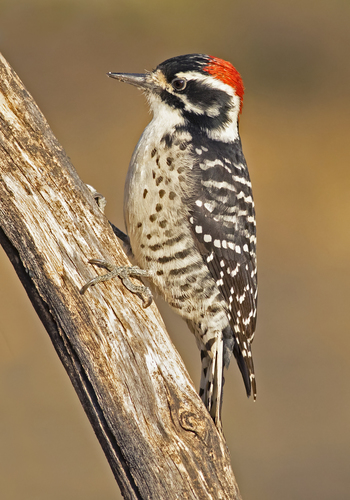
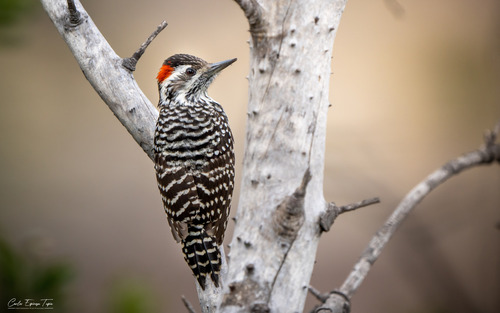
Veniliornis lignarius, commonly called the striped woodpecker, measures 15 to 16 cm (5.9 to 6.3 in) long and weighs 35 to 39 g (1.2 to 1.4 oz). Males and females have identical plumage across most of the body, with differences only on the head.
Adult Head Plumage (General)
For adults of both sexes, the forehead and crown are black, the hindneck is blackish, the face is mostly white, with a blackish stripe that runs back and down from the eye, and a black malar stripe.
Adult Male Head Plumage
Males have streaks or spots on the crown and a red to orange-red nape.
Adult Female Head Plumage
Females have a black nape, in contrast to the male's red nape, and their crown is usually solid black.
Adult Upperparts Plumage
The upperparts of both sexes are brownish black. Northern populations have white scallops on the upperparts, while southern populations have narrow white bars.
Adult Wing and Tail Plumage
Their flight feathers are barred with alternating black and white. The tail is dark brownish black with narrow white or buff-white bars.
Adult Underparts Plumage
Their underparts are white with a yellow or buff tinge, with black streaks on the breast and belly, and black bars on the flanks and undertail coverts.
Juvenile General Plumage
Juvenile striped woodpeckers are duller and browner than adults. They have irregular bars on the upperparts, and heavy streaks and bars on the underparts.
Juvenile Head Plumage
Juvenile males have a red crown, while juvenile females have only a small red patch on the crown.
Population Structure
The striped woodpecker has two separate, disjunct populations.
Northern Population Distribution
One population is found in west-central and southern Bolivia, and extreme northern Argentina.
Southern Population Distribution
The other population is found in central and southern Chile, and southwestern Argentina.
General Habitat
It lives in a variety of landscapes, most of which are semi-open to open forest. These landscapes include moist to humid forests dominated by Nothofagus or Podocarpus, Polylepis woodland, and drier areas with cacti and scattered trees.
Northern Range Habitat
In the northern part of its range, it also occurs in the interior of mature wet forest alongside watercourses.
General Human-Altered Habitat
Across both the northern and southern parts of its range, it can be found in lightly treed pastures, orchards, plantations, and gardens.
Elevation Range
In terms of elevation, it ranges between 1,600 and 4,000 m (5,200 and 13,100 ft) in Bolivia, while it only reaches up to 1,800 m (5,900 ft) in Chile and up to 2,700 m (8,900 ft) in Argentina.