About Philantomba monticola (Thunberg, 1789)
Common Name and Classification
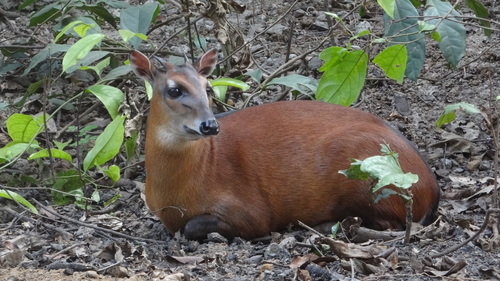
Philantomba monticola, commonly known as the blue duiker, is the smallest duiker species, classified as a small antelope.
General Size Measurements
Its typical head-and-body length ranges from 55 to 90 centimetres (22 to 35 in), it stands 32–41 centimetres (13–16 in) tall at the shoulder, and weighs 3.5–9 kilograms (7.7–19.8 lb). P. m. anchietae is the largest subspecies.
Sexual Dimorphism
The species is sexually dimorphic, with females slightly larger than males.
Head and Facial Features
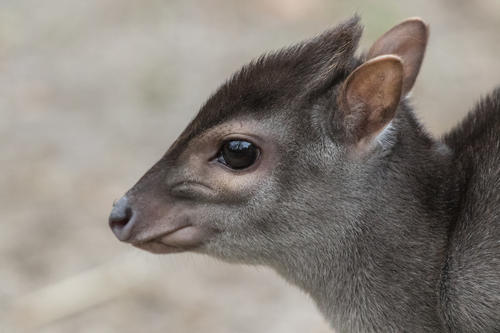
Key physical features of the blue duiker include a flat forehead, large eyes, small ears marked with a line of white, large nostrils, a broad mouth, and agile lips.
Tail Characteristics
Its dark tail measures just over 10 centimetres (3.9 in), and has a distinctive row of white crinkly hairs on both flanks that reflect light effectively. When the blue duiker moves its tail up and down, this feature creates a glowing visible signal in dark forest habitats.
Horn Structure
Blue duikers have short, spiky horns around 5 centimetres (2.0 in) long that are hidden in tufts of fur.
Preorbital Gland Details
Preorbital glands near the eyes hold a row of tiny pores surrounded by a few hairs, which secrete an opaque liquid made of 45 volatile compounds.
Pedal Gland Details
Pedal glands near the hooves produce a pungent, whitish fluid.
Overall Coat Color Variation
Subspecies of the blue duiker show extensive variation in coat coloration, which can range from blue, grey, and brown to black.
Northern Subspecies Base Coloration
Northern subspecies with grey legs have grey to brown coloration, with a posterior stripe marking the transition from the rump to the buttocks.
P. m. congicus Coloration
P. m. congicus has a bright grey to black back, dull grey flanks, and a dark brown stripe marking the transition from the black rump to the lighter buttocks.
P. m. sundevalli Coloration
P. m. sundevalli is similar to P. m. congicus, though the difference between its flanks and rump is less noticeable.
P. m. aequatorialis Coloration
P. m. aequatorialis is paler and browner than P. m. congicus, with a less sharp color transition.
P. m. musculoides Coloration
P. m. musculoides has a fainter stripe and a darker back.
P. m. lugens Coloration
P. m. lugens can be identified by its darker overall coloration: its flanks and dorsal areas are dark grey to brown, its underside is grey, and its rump is black.
P. m. melanorheus Coloration
The small P. m. melanorheus is also distinct, with black dorsal parts, pinkish grey sides, and long thick fur.
Southern Subspecies Base Coloration
In contrast, southern subspecies have reddish tan legs and reddish coats.
P. m. hecki Coloration
P. m. hecki ranges from light fawn to greyish black, with light red flanks, a white underbelly, and a darker reddish fawn rump that creates a visible tone change.
P. m. defriensi Coloration
The paler P. m. defriensi has grey on the middle of its back, red to fawn sides, and a dark rump and tail.
P. m. monticola and P. m. bicolor Coloration
P. m. monticola is light grey to fawn with a reddish rump, and is darker than P. m. bicolor, which has reddish-orange flanks.
P. m. anchietae Coloration
P. m. anchietae is pale grey or brown on the back, with white underparts and a black tail, and has a clear transition from the grey sides and anterior parts to the reddish rump.
P. m. simpsoni Coloration
P. m. simpsoni is distinguished by a facial stripe and white ventral areas, with a rump that is redder than its flanks.
Comparison with Maxwell's Duiker
The blue duiker closely resembles Maxwell's duiker, but Maxwell's duiker is nearly twice as large and heavy, with a larger skull. Maxwell's duiker also has more uniform coloration, while the blue duiker displays two distinct color patterns, and the blue duiker has a simpler opening to its hoof pedal gland than Maxwell's duiker.
Comparison with Walter's Duiker
Walter's duiker is notably lighter in color than the blue duiker, with brown rather than grey flanks.
Habitat Types
The blue duiker can live in a wide variety of forest types, including old-growth, secondary, and gallery forests. It prefers forests because they provide shelter from dense understory and access to forage via the canopy.
Altitude Range and Degraded Habitat Use
It can also be found in patches of degraded and regenerated forests, occurring from sea level up to 3,000 metres (9,800 ft) in altitude.
Geographic Distribution
This duiker is distributed across multiple countries in western, southern, and eastern Africa: Angola, Cameroon, Central African Republic, The Democratic Republic of Congo, Equatorial Guinea, Gabon, Kenya, Malawi, Mozambique, Nigeria, Rwanda, South Africa, South Sudan, Tanzania, Uganda, Zambia and Zimbabwe.
Activity Pattern
The blue duiker is diurnal, meaning it is active during the day.
General Behavior Traits
It is secretive and cautious, and stays mostly within forest fringes.
Territoriality and Pair Ranges
It is territorial, and individuals of opposite sexes form pairs that occupy territories around 0.4–0.8 hectares (0.0015–0.0031 sq mi) in size. Pairs mark their territories using secretions from their preorbital glands, rubbing the glands on trees and logs to leave the secreted fluid.
Vocalizations
As a vocal bovid, the blue duiker makes bird-like chirps to express curiosity. It can produce cat-like yowls when it is distressed. A female that is not in oestrus will avoid a male's mating advances, and may even emit a whistling call.
Sexual Maturity Age
Different studies have reported different ages for when blue duikers reach sexual maturity. Researcher Wilson observed that females reach maturity before 13 months, with a recorded minimum age of eight months, while males take longer to mature, reaching maturity at 11 to 14 months.
Mating System
The species is monogamous, with pairs staying together year-round.
Gestational Period
Estimates of the gestational period range from as short as four months to as long as seven months; the four-month estimate is supported by observations in the Ituri Rainforest, Democratic Republic of the Congo.
Birth Seasonality
Births take place throughout the year, though birth rates may drop during the dry season.
Calf Development and Nursing
A blue duiker calf can move on its own within 20 minutes of birth, is nursed three times a day, and stays hidden most of the time. Nursing intervals become irregular as weaning approaches, and weaning occurs at 2.5 to 3 months old.
Male Post-Birth Behavior
Males visit their mates occasionally, but leave for approximately one month after the calf is born, likely to protect the calf.
Postpartum Oestrus Timing
Postpartum oestrus occurs three to five days after birth.