About Saiga tatarica (Linnaeus, 1766)
Distinctive Head Features
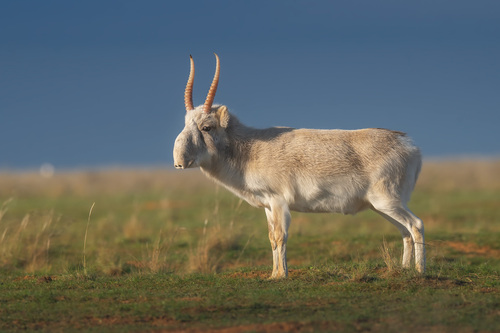
The saiga (Saiga tatarica) has several distinct physical characteristics. Its most prominent feature is a pair of closely spaced, bloated nostrils that face downward; it also has a proboscis, dark cheek markings, and ears measuring 7–12 cm (2.8–4.7 in) long.
Body Size Measurements
Typical head-and-body length ranges from 100 to 140 cm (39 to 55 in), with a short 6–12 cm (2.4–4.7 in) tail, a shoulder height of 61–81 cm (24–32 in), and a body weight of 26–69 kg (57–152 lb).
Seasonal Coat Color
Its coat changes with the seasons. In summer, the coat is yellow to red, fading toward the flanks; Mongolian saigas may develop a sandy coat color. In winter, the coat becomes pale grayish-brown, with a faint brown tint on the belly and neck, and generally white ventral areas.
Coat Length and Moulting
Summer hair is 18–30 mm (0.71–1.18 in) long, while winter hair grows to 40–70 mm (1.6–2.8 in) long, forming a 12 to 15 cm (4.7 to 5.9 in) long mane on the neck. Saigas moult twice a year: once in spring from April to May, and once in autumn from late September or early October to late November or early December.
Male Horn Characteristics
Only males have horns, which are thick, slightly translucent, wax-colored, and marked with 12 to 20 distinct rings. Russian saiga horns are 28–38 cm (11–15 in) long with a base diameter of 25–33 mm (0.98–1.30 in), while Mongolian saiga horns reach a maximum length of 22 cm (8.7 in).
2010s IUCN Conservation Status
By the mid-2010s, saiga populations had declined by as much as 95% over 15 years, leading to their classification as Critically Endangered on the IUCN Red List. The species has since seen substantial population regrowth.
2022–2023 Population Estimates
An April aerial count estimated 1.38 million saigas surviving in Kazakhstan as of 2022. As of December 2023, the global population of mature saiga antelopes is estimated at 922,600–988,500 individuals.
2010 Ural Region Mortality Event
In May 2010, an estimated 12,000 out of the 26,000 saigas in Kazakhstan's Ural region were found dead. While these deaths are currently attributed to pasteurellosis, an infectious disease affecting the lungs and intestines, the underlying trigger has not been identified.
2015 Mass Mortality Outbreak
In May 2015, a similar likely outbreak occurred in three northern regions of Kazakhstan; by 28 May 2015, more than 120,000 saigas from the central Kazakhstan Betpak-Dala population had been confirmed dead, representing over a third of the global population at the time.
Post-2015 Population Recovery
By April 2016, the Betpak-Dala saiga population was already recovering, increasing from 31,000 to 36,000 individuals. An April 2021 survey in Kazakhstan found the population had risen from an estimated 334,000 to 842,000, with the increase partially attributed to government crackdowns on poaching and the establishment of conservation areas.
2022 Population Peak
In 2022, UK charity RSPB reported that partly due to their conservation work and the Kazakhstan government's designation of the Bokey Orda-Ashiozek protected area, the population had reached a peak of 1.32 million.
Pleistocene Historical Range
Saiga was not present in Europe during the Eemian. During the last glacial period, saigas ranged from the British Isles through Central Asia and across the Bering Strait into Alaska and Canada's Yukon and Northwest Territories.
Classical Age Historical Records
By the classical age, saigas were considered a characteristic animal of Scythia, based on historian Strabo's description of an animal called the kolos, which was sized between a deer and a ram and incorrectly thought to drink through its nose.
Andronovo Culture Association
There is considerable evidence that saigas were important to Andronovo culture settlements; illustrations of saiga antelopes appear in cave paintings dated to the seventh to fifth century BC, and saiga bones have been found alongside other wild animal remains near these human settlements.
14th–19th Century Population Trends
Fragmented records indicate abundant saigas across the territory of modern Kazakhstan from the 14th to 16th centuries, with migratory routes covering the entire country, especially high population in the region between the Volga and Ural Rivers. Population size stayed high until the second half of the 19th century, when large-scale horn export began. High prices and demand for horns drove extensive hunting, reducing populations across all regions and shifting migratory routes southward.
18th–1920s Population Decline
Ukrainian saiga populations were completely extirpated in the 18th century. After a rapid decline, saigas were almost entirely exterminated by the 1920s, but managed to recover; by 1950, two million saigas lived in the steppes of the USSR.
Post-Soviet Population Changes
After the collapse of the USSR, saiga populations fell drastically again due to uncontrolled hunting and demand for horns for Chinese medicine. At one point, some conservation groups including the World Wildlife Fund encouraged hunting saigas, as their horn was promoted as an alternative to rhinoceros horn.
Habitat and Herd Behavior
Ecologically, saigas form very large herds that graze in semideserts, steppes, grasslands, and possibly open woodlands. They eat several plant species, including some that are poisonous to other animals.
Movement Capabilities
Saigas can travel long distances and swim across rivers, but avoid steep or rugged terrain.
Mating Season Behavior
The mating season begins in November, when stags fight to access females; the winning stag leads a herd of five to ten females, occasionally up to 50.
Calving and Migration Behavior
In spring, female saigas gather in large groups to give birth. Like Mongolian gazelles, saigas are known for extensive migrations across steppes that let them escape natural calamities.
Natural Predators
Saigas are highly vulnerable to wolves; juvenile saigas are targeted by foxes, steppe eagles, golden eagles, and ravens.