About Raphicerus campestris (Thunberg, 1811)
Species Naming and Initial Comparison
Steenbok, scientifically named Raphicerus campestris (Thunberg, 1811), resemble small oribi.
Shoulder Height and Weight
They stand 45–60 cm (16"–24") at the shoulder, and weigh 7–16 kg (15–35 lb).
Coat Coloration
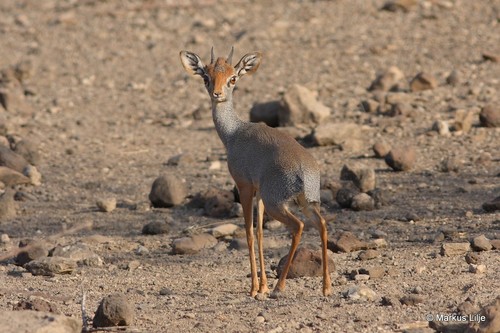
Their coat can be any shade from fawn to rufous, and is typically quite orange.
Underside and Eye Markings
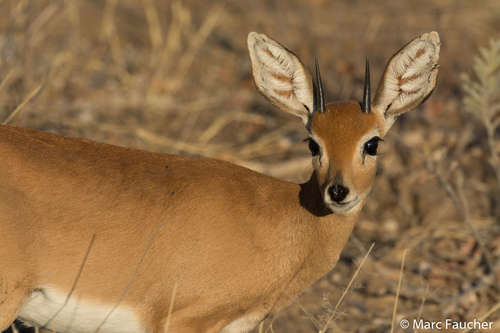
The underside, including the chin and throat, is white; the ring around the eye is also white.
Ear Characteristics
Their ears are large, with "finger-mark" markings on the inner surface.
Male Horn Structure
Only males have straight, smooth, parallel horns that measure 7–19 cm (2.8–7.5 in) long.
Facial Markings
Steenbok have a black crescent-shaped marking between the ears, a long black bridge leading to the glossy black nose, and a circular black scent gland located in front of the eye.
Tail Characteristics
Their tail is only 4–6 cm (1.6–2.4 in) long, so it is not usually visible.
Distribution Clusters
There are two distinct clusters in the steenbok's distribution.
East African Distribution
In East Africa, the species occurs in central and southern Kenya and northern Tanzania; it was formerly widespread across Uganda, but is now almost certainly extinct there.
Southern African Distribution
In Southern Africa, it occurs in Angola, Namibia, South Africa, Eswatini, Botswana, Mozambique, Zambia, Zimbabwe, and is considered to probably be present in Lesotho.
General Habitat Range
Steenbok inhabit a variety of habitats ranging from semi-desert such as the edge of the Kalahari Desert and Etosha National Park, to open woodland and thickets; this includes open plains, stony savannah, and Acacia–grassland mosaics.
Favoured Habitat Type
They are reported to favour unstable or transitional habitats.
Kruger National Park Habitat Preference
At least in the central part of South Africa's Kruger National Park, Steenbok show a distinct year-round preference for Acacia tortilis savannah, and do not tend to migrate to moister areas during the dry season.
Behavior Comparison to Other Ungulates
This differs from the behaviour of many larger African savannah ungulates, including species that live alongside Steenbok during the wet season.
Population Density
The typical population density of steenbok is 0.3–1.0 individuals per square kilometre, and this can reach 4 individuals per km² in optimal habitats.