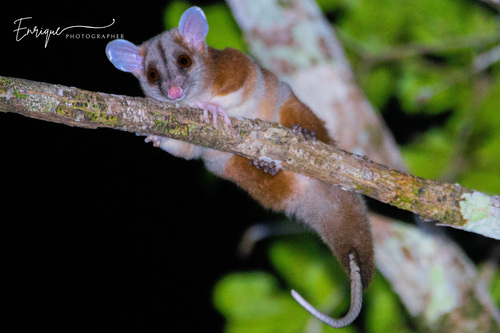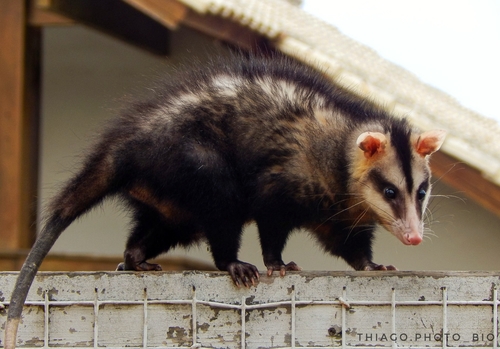
About Philander opossum (Linnaeus, 1758)
Etymology
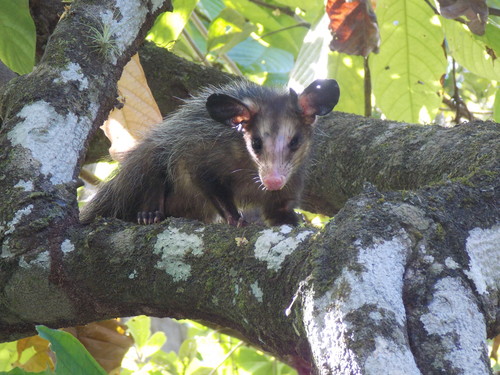
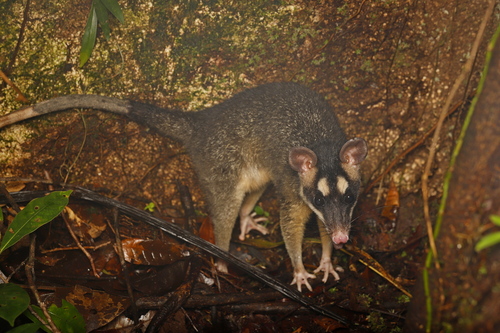
This species gets its common name from the sharply defined white spot located above each of its eyes.
Tail Characteristics
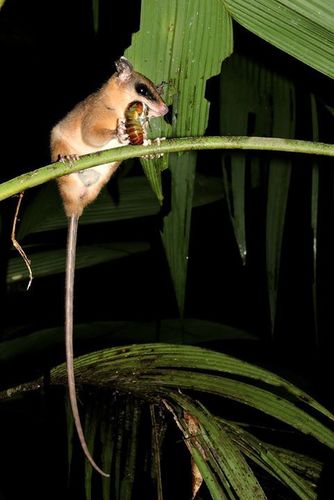
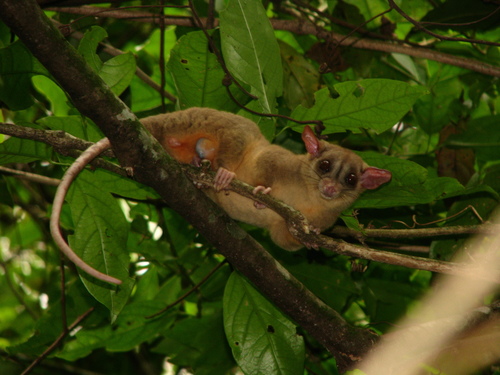
Its prehensile tail is two-toned: the distal section (farther from the body) is pale, while the longer proximal section (closer to the body) is darker gray, and the end of the tail is hairless.
Fur and Ear Features
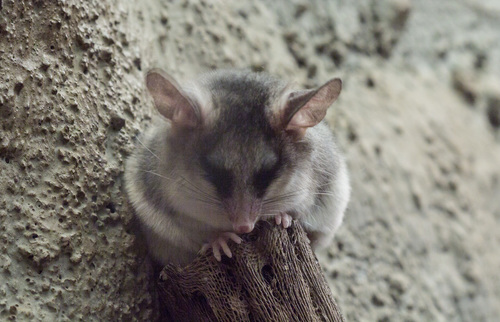
The fur on its back is gray, while the fur on its belly, throat, and cheeks is cream-colored. In adults, the ears are black except for their base.
Weight Range
Wild gray four-eyed opossums weigh between 200 and 674 grams (7.1 to 23.8 oz), while captive individuals can weigh up to 1.5 kilograms (3.3 lb).
Body and Tail Length
Head-and-body length ranges from 22.0 to 33.1 centimetres (8.7 to 13.0 in), and the tail falls in a similar size range, measuring 19.5 to 35.5 centimetres (7.7 to 14.0 in).
Core Distribution
This species lives throughout the Guianas and eastern Amazonia, specifically in Guyana, Suriname, French Guiana, and Brazil.
Distribution in Brazil and Possible Range
In Brazil, it occurs east of the Rio Negro and Rio Madeira rivers. It may also be present in Venezuela.
Mating System
Little is currently known about the mating habits of the gray four-eyed opossum. Because it belongs to the family Didelphidae, it is most likely polygynous, meaning males compete with one another for mates.
Courtship and Pair Bonding
Didelphids do not perform courtship displays, and do not form permanent pair bonds.
Reproductive Seasonality
Reproduction is typically seasonal, with more young born during the rainy season when fruit is abundant. Fewer young are born during the dry season, due to a lack of available fruit.
Litter Size
Average litter sizes range between four and five young, and each female produces between two and four litters per year.
Juvenile Mortality Factors
Many young die while nursing in their mother's pouch, and this death rate is especially high during the dry season. A mother's age is a major factor that determines young survival: many young die when the mother is less than 11 months old.
Gestation and Newborn Traits
The average gestation period for the gray four-eyed opossum is 13 to 14 days, and each newborn weighs about 9 grams (0.32 oz).
Pouch Nursing Period
Young nurse in the mother's pouch until they are 68 to 75 days old.
Post-Weaning Development
After weaning, they remain in their mother's nest for an additional 8 to 15 days, before the mother becomes aggressive and expels them.