About Caluromys philander (Linnaeus, 1758)
Pelage Coloration
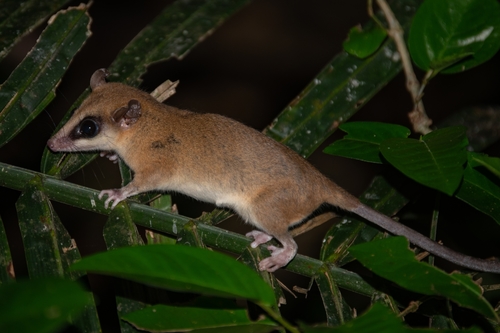
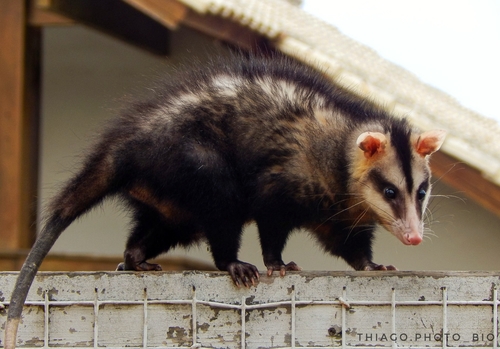
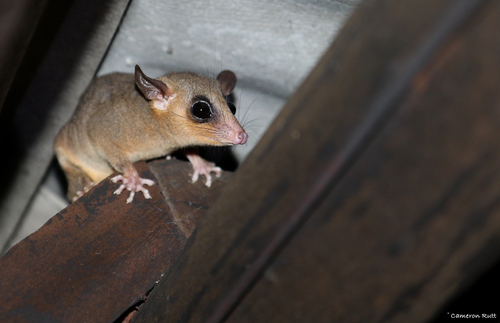
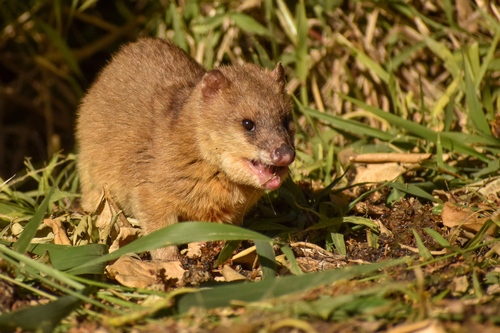
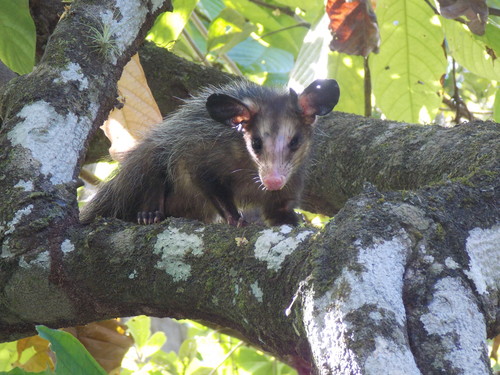
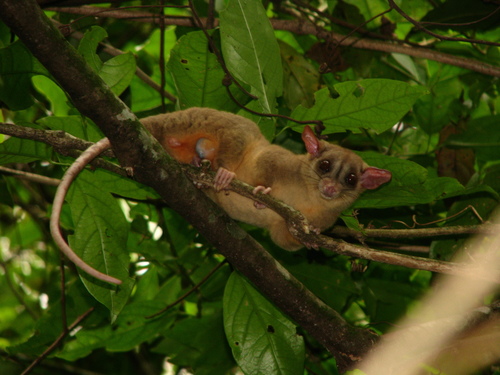
The bare-tailed woolly opossum, Caluromys philander, has a brown to gray coat, a gray head, and an orange to gray underside. Its tail is partially naked, with fur only at the base.
Facial Markings
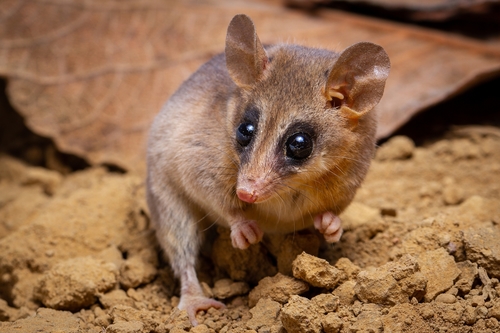
A distinct narrow dark brown stripe runs between the eyes and ears, extending from the tip of the nose to the back of the ears. Wider similar stripes extend out from brown eye rings around each eye, and grayish fur separates these stripes from each other.
Ear Features
The opossum’s ears are large and almost always hairless.
Coat Texture
Its coat is thick, soft, and woolly; the flanks may be grayer than the back.
Furred Tail Base
Dorsal hairs extend 5 to 7 centimeters (2.0 to 2.8 inches) onto the tail, after which the tail is naked, matching the species’ common name.
Naked Tail Features
The tail is dark brown toward its end, spotted with both white and dark brown, and ends in a white or yellowish-white tip.
Geographic Weight Variation
Body size tends to decrease from Venezuela to Suriname: the mean weight is 170 grams (6.0 oz) in Venezuela, and 250 grams (8.8 oz) in Suriname.
Head-and-Body Length
Typical head-and-body length ranges from 16 to 26 centimeters (6.3 to 10.2 inches).
Appendage Measurements
Ears measure 3 to 3.5 centimeters (1.2 to 1.4 inches), the tail measures 25 to 36 centimeters (9.8 to 14.2 inches), and hind feet measure 3.2 to 3.9 centimeters (1.3 to 1.5 inches).
Dental Formula
Its dental formula is 5.1.3.4 / 4.1.3.4, which is typical for didelphids.
Habitat Types
This opossum inhabits subtropical forests, rainforests, secondary forests, and plantations, and prefers dense cover, though it can also be found in tree canopies.
Altitudinal Range
It occurs at altitudes up to 1,200–1,800 metres (3,900–5,900 ft) above sea level.
Geographic Distribution
Its range extends from northern Venezuela eastward to northeastern and southcentral Brazil, and includes Guiana, French Guiana, Margarita Island, Trinidad, and Suriname.
Conservation Status
The IUCN lists the bare-tailed woolly opossum as least concern, due to its wide distribution and presumed large population, though its survival is threatened by deforestation and habitat loss.
Activity Pattern
The bare-tailed woolly opossum is nocturnal, active mainly at night, which makes it difficult to observe or capture.
Research Status
Even so, it is one of the few opossum species that has been successfully studied in detail.
Moonlight Activity Response
Research has found that the opossum’s activity can be affected by how bright moonlight is: male activity drops from new moon to full moon, as moonlight exposure increases, while female activity stays largely unaffected.
Locomotion Adaptations
This opossum is arboreal (tree-dwelling) and a skilled climber.
Prehensile Tail Functions
Studies confirm its prehensile tail acts as an extra limb for movement, prevents falls, and carries leaves to build nests.
Nest Construction
It constructs nests from dry leaves inside tree cavities.
Intraspecific Aggression
Individuals are typically aggressive toward one another, and agonistic interactions are accompanied by hisses, grunts, and even distress calls.
Social Structure
The species is largely solitary; the only observed social interactions are between mothers and their juveniles, and between mating pairs.
Home Range Size
In a primary forest in French Guiana, the mean home range size was calculated as 3 hectares (0.012 sq mi).
Home Range Characteristics
Home ranges of both sexes overlap extensively, and home range size is influenced by environmental factors including forage availability and individual needs.
Vocalizations
Clicks are a common vocalization produced by both young and adult opossums.
Defense Behavior
Like other species in the genus Caluromys, bare-tailed woolly opossums will bite when handled or to escape predators.
Known Predators
Known predators of this species include jaguarundi and margay.
Parasite Host
The bare-tailed woolly opossum serves as a host for the acanthocephalan intestinal parasite Gigantorhynchus lutzi.
Female Maturity
In French Guiana, females successfully mate after they reach one year of age.
Litter Frequency
Females can produce three litters per year when food is not scarce.
Gestation Period
Gestation lasts 25 days, which is the longest gestation period among didelphimorphs.
Post-Birth Development Timeline
Young leave the pouch at three months old, and weaning occurs at four months.
Offspring Growth Rate
A study in French Guiana found that offspring development is slow for the first 40 days, then speeds up over the next 40 days.
Litter Size
Litter size ranges from one to seven.
Offspring Weight
Newborns weigh 200 milligrams (0.0071 oz), and their weight reaches 11 grams (0.39 oz) by weaning.
Post-Pouch Care
After exiting the pouch, offspring stay sheltered in the nest, and the mother visits regularly to nurse them.