About Phalaropus tricolor (Vieillot, 1819)
Physical Traits
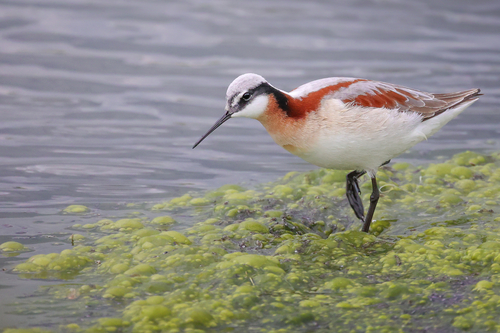
Wilson's phalarope (Phalaropus tricolor) is a dainty shorebird with lobed toes and a straight, fine black bill. It is slightly larger than the red phalarope, with a total length of about 23 cm (9.1 in), with a full length range of 22–24 cm (8.7–9.4 in).
Size Measurements
Its wingspan measures 35–38 cm (14–15 in). Males weigh 30–110 g (1.1–3.9 oz), while females weigh 52–128 g (1.8–4.5 oz).
Sexual Size Dimorphism Study
A study of breeding Wilson's phalaropes in Saskatchewan, Canada, found that females average around 10% larger in standard measurements and around 30% heavier than males: in this study, females weighed 68 to 79 g (2.4 to 2.8 oz), while males averaged 51.8 g (1.83 oz).
Breeding Plumage
Breeding females are predominantly grey and brown on the upperparts, with white underparts, a reddish neck, and reddish flank patches. Breeding males are a duller version of breeding females, with a brown back, and the reddish patches are either reduced or absent.
Juvenile and Winter Plumage
Juvenile Wilson's phalaropes are grey and brown on the upperparts, with whitish underparts and a dark patch running through the eye. In winter plumage, the species is essentially grey above and white below, and the dark eyepatch is always present.
Longevity
The average longevity of Wilson's phalarope in the wild is 10 years.
Halophilic Trait and Migration Habitats
This species is unusually halophilic (salt-loving). During migration, large numbers of Wilson's phalaropes feed at saline lakes including Mono Lake in California, Lake Abert in Oregon, and the Great Salt Lake of Utah, and often share these feeding sites with red-necked phalaropes.
Feeding Behavior
When feeding, Wilson's phalarope often swims in a small, rapid circle to form a small whirlpool. This behavior is thought to help feeding by bringing food up from the bottom of shallow water. The bird then reaches into the outer edges of the vortex with its bill to pluck out small insects or crustaceans caught in the movement.
Reversed Sex Roles
Like the other two phalarope species, Wilson's phalarope has reversed typical avian sex roles: females are larger and more brightly colored than males. Females pursue males, compete for nesting territory, and aggressively defend their nests and chosen mates.
Breeding and Parental Care
After females lay their eggs, they begin their southward migration, leaving the males to incubate the eggs. Three to four eggs are laid in a ground nest located near water, and the young feed themselves.
Population Status
Although Wilson's phalarope is a very common species, its population may have declined in some areas due to the loss of prairie wetland habitat. A small number of staging areas are critically important for the species during migration.