About Gallinago gallinago (Linnaeus, 1758)
Adult Size and Weight
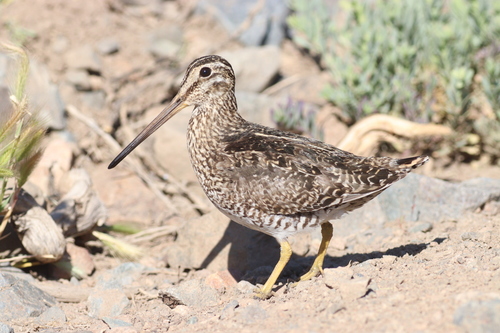
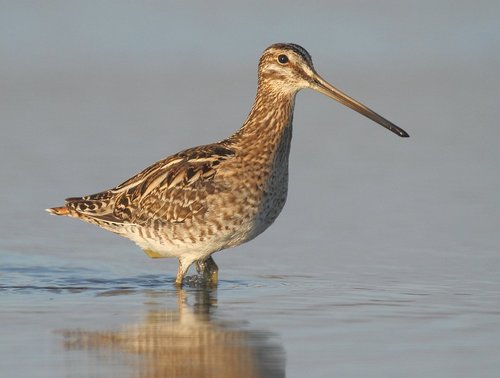
Adults of Gallinago gallinago, the common snipe, measure 25–27 cm (9.8–10.6 in) in length, have a wingspan of 44–47 cm (17–19 in), and weigh 80–140 g (2.8–4.9 oz), with weights reaching up to 180 g (6.3 oz) before migration.
Limb and Bill Morphology
They have short greenish-grey legs and a very long, straight dark bill that is 5.5–7 cm (2.2–2.8 in) long.
Body Plumage
Their body is mottled brown with straw-yellow stripes on the upperparts and pale plumage on the underparts.
Head and Wing Features
They have a dark stripe running through the eye, paired with light stripes both above and below this dark stripe, and their wings are pointed.
Relative Species Distribution
The common snipe is the most widespread species among several similar snipe species.
Taxonomy of Wilson's Snipe
It most closely resembles Wilson's snipe (Gallinago delicata) of North America, which was until recently classified as a subspecies of common snipe (G. g. delicata).
Tail Feather Difference from Wilson's Snipe
The two species differ in the number of tail feathers: common snipe has seven pairs of tail feathers, while Wilson's snipe has eight pairs.
Wing Trait Difference from Wilson's Snipe
The North American Wilson's snipe also has a slightly thinner white trailing edge on its wings, where the white is mostly found on the tips of the secondaries.
Overlapping Breeding Range with Wilson's Snipe
Both species breed in the Aleutian Islands.
Similar Eastern Asian Snipe Species
Common snipe is also very similar to the pin-tailed snipe (G. stenura) and Swinhoe's snipe (G. megala) found in eastern Asia, and identifying these species in this region is complex.
Subspecies Coloration Difference
The subspecies G. g. faeroeensis typically has richer coloration on its breast, upperparts, and head than the nominate subspecies G. g. gallinago.
Breeding Habitat Types
For distribution and habitat, the common snipe breeds in marshes, bogs, tundra, and wet meadows across the Palearctic.
Northern Breeding Range Boundary
The northern edge of its breeding distribution runs from Iceland across the northern British Isles and northern Fennoscandia, reaching around 70°N, and continues through European Russia and Siberia.
Taymyr Peninsula Breeding Range
In this area, it is mostly found on the northern edge of the Taiga zone at 71°N, but extends as far north as 74°N on the east coast of the Taymyr Peninsula.
Eastern Breeding Range Limit
To the east, its breeding range reaches Anadyr, Kamchatka, Bering Island, and the Kuril Islands.
European Southern Breeding Boundary
In Europe, the southern boundary of the breeding distribution runs through northern Portugal, central France, northern Italy, Bulgaria, and Ukraine, with populations scattered very sparsely in the western part of this region.
Asian Southern Breeding Range
In Asia, the breeding range extends south to northern Turkestan, and is found locally in Afghanistan and the Middle East, continuing through the Altai region and further to Manchuria and Ussuri.
Migratory Wintering Ranges
The common snipe is a migratory species: European individuals winter in southern and western Europe and Africa, as far south as the Equator, while Asian individuals migrate to tropical southern Asia to winter.