About Phalacrocorax fuscescens (Vieillot, 1817)
Taxonomy and Morphological Overview
Like other cormorant species, the black-faced cormorant (scientific name Phalacrocorax fuscescens, first described by Vieillot in 1817) is a large aquatic bird, with a long hooked bill, webbed feet, and monochromatic plumage. This is one of the largest cormorants found in south-western Australia.
Plumage Pattern
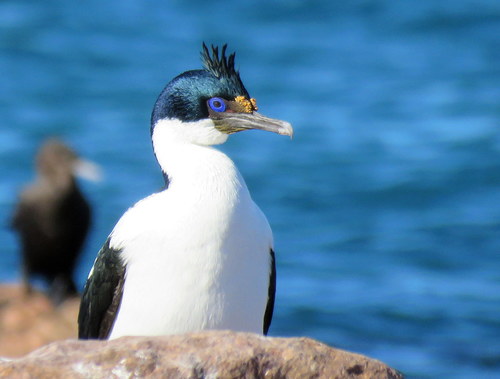
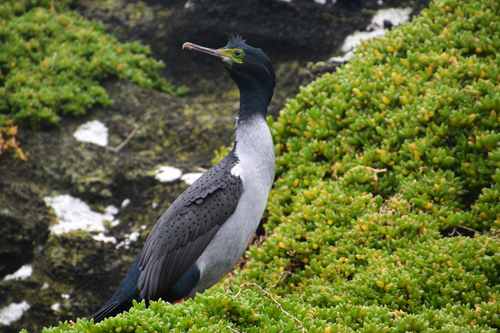
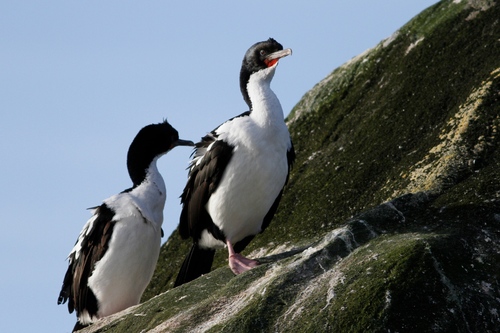
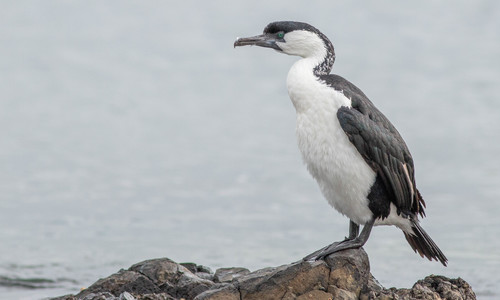
It has pied plumage: the upper half of its body is black and its undersides are white. Its face is naked and black, which gives the species its common name "black-faced"; its tail, feet, and thighs are also black.
Facial and Body Features
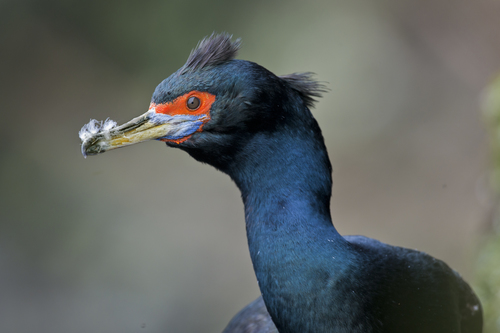
Its back feathers are glossy, its bill is dark grey with a prominent hook at the tip, and it has blue-green eyes. When flying, it holds its head level or lower than its body, and holds its wings in a cross-shape like most cormorants.
Similar Species
Species that look similar to this one include the slightly larger pied cormorant and the slightly smaller little pied cormorant.
Geographic Range
Black-faced cormorants are endemic to the coastal regions of southern Australia and Tasmania. Their total population is estimated to be in the tens of thousands, and they are distributed across Western Australia, South Australia, Victoria and Tasmania, particularly in the Bass Strait and Spencer Gulf.
Population Structure
There are two separate independent populations: one located on the southern coast of Western Australia, and the other on the coasts of Southern Australia, Victoria and Tasmania.
Habitat Range
Unlike other cormorants found around the Australian continent, the habitat of the black-faced cormorant is exclusively coastal and marine. They can be found in coastal waters, inlets, rocky shores, and offshore islands.
Additional Habitat Occurrences
Occasionally, black-faced cormorants can be found in river estuaries. Breeding colonies are usually found on steep cliffs and rocky islands, where the birds build their nests.
Breeding Migration
In the winter, black-faced cormorants leave coastal waters to breed in these colonies. Because the black-faced cormorant is an exclusively marine bird, its behaviours are well-adapted to its coastal marine environment.
Feeding and Anti-predator Behavior
It uses pursuit-diving to capture fish, and nests high on cliffs to avoid predators. Breeding black-faced cormorants nest in pairs or breeding colonies on islands or cliffs.
Breeding Social Structure
They are likely monogamous, similar to other cormorant species. Their nesting sites are located on bare rocks, often close to water.
Nest Construction
Nests are solidly built from driftwood, seaweed, and other plants, with a diameter of 35 to 45 cm. After nest construction, females lay 2 to 3 elongated oval eggs.
Egg Characteristics
The eggs are pale blue-green, and measure 58 x 36 mm.
Breeding Season Variation
The breeding season for black-faced cormorants varies between populations, and has been observed to occur anywhere from June to February.
Bass Strait Breeding Timing
In the Bass Strait, the black-faced cormorant breeds from June to September, with peak egg laying occurring around the end of July; this timing may be to avoid hot summer temperatures that can negatively affect chicks.
Western and Southern Australia Breeding Timing
However, colonies in western and southern Australia breed later in the year, from September to February.