About Percina phoxocephala (Nelson, 1876)
Size
Slenderhead darters (scientific name Percina phoxocephala (Nelson, 1876)) are typically 6–9 centimeters long, and can sometimes reach 10 centimeters.
Head and Body Shape
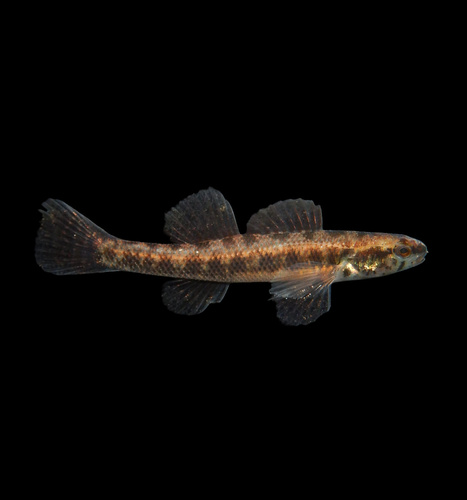
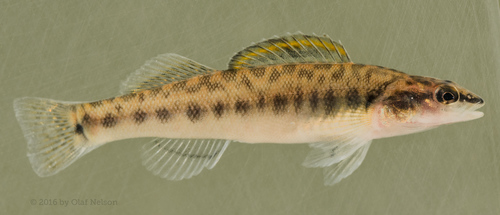
They have a pointed snout and a long, narrow body. Their mouths are subterminal, with the snout projecting only slightly beyond the mouth. Teeth are present on the jaws but are very small.
Dorsal Coloration
The dorsal, or upper, side of the body is light brown, with 14–22 dark blotches running down the center that act as camouflage from predators swimming above the darter.
Ventral Coloration
The ventral, or lower, side is cream colored, which disguises the darter from predators swimming below it.
Lateral Markings
The darter has a row of 11–16 blotches along its sides that are taller than they are wide, connected by a thin lateral stripe.
Dorsal Fin Structure
The two dorsal fins are distinctly separate. The first dorsal fin has a dark brown band near its base and an orange band near its outer edge.
Second Dorsal and Caudal Fin Markings
The second dorsal fin and tail have many small spots that often form rows.
Pelvic Fin Structure
The transparent pelvic fins sit in the thoracic position, and have two spines plus 9–10 fin rays.
Caudal Fin Shape
The caudal fin is square-shaped and slightly forked.
Breeding Male Coloration
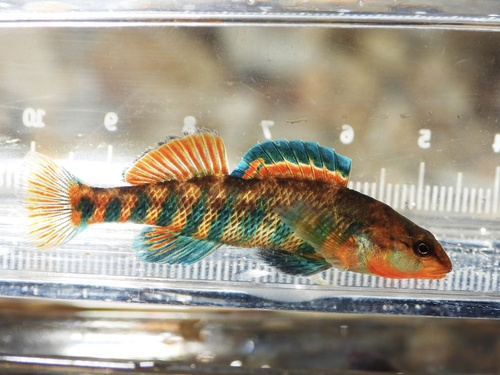
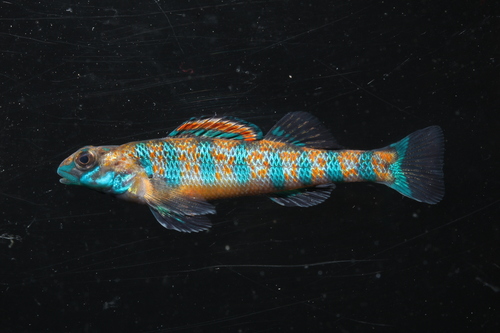
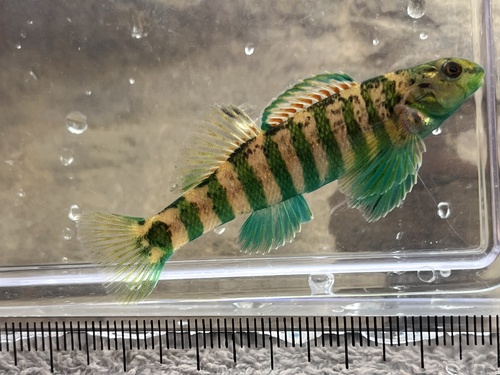
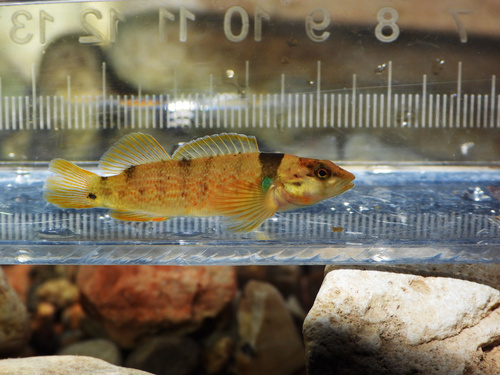
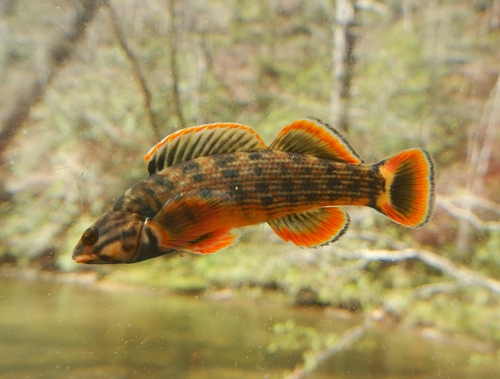
On breeding males, the orange band on the first dorsal fin is more intensely colored and thicker. Males may also develop a dark dusky overall body coloration that often hides most of the blotches on their back and sides.
Scale Count
Slenderhead darters have small scales, with a lateral-line scale count ranging from 60 to 80.
Female Breast Scaling
A female’s breast is mostly naked, with only one or two ctenoid scales.
Male Breast Scaling
The posterior half of a male’s breast is scaled, while the anterior half remains naked.
Conservation Status
The conservation status of this species is Least Concern.
Taxonomy and Distribution
The slenderhead darter is a medium-sized darter and the most widely distributed of the four species in the subgenus Swainia. It is native to North America, found from the central Ohio and Mississippi River basins, west to northeastern South Dakota and the Lake Winnebago system (part of the Lake Michigan drainage) in Wisconsin, and south to the Red River in eastern Oklahoma and northeast Texas.
Habitat Water Conditions
Slenderhead darters live in relatively shallow water with riffles and moderate current.
Substrate Preference
They prefer sand and gravel bottoms with little silt.
Habitat Zone
They are bottom-dwelling fish that inhabit the benthic zone.
Spawning Period
Slenderhead darters spawn between late April and early June.
Sexual Dimorphism in Spawning Males
This species exhibits sexual dimorphism: male pigmentation darkens starting in April, and reaches its peak during spawning. The first dorsal fin becomes orange, and the dorsal rays develop yellow outlines. Older, larger males are darker and can attract more females.
Male Territoriality
Males are territorial and guard patches of swift flowing water that is 15–60 centimeters deep.
Egg Laying Behavior
Females lay their eggs in riffles, burying them in sand or gravel.
Clutch Size
Clutch sizes range from 50 to 1000 eggs, with larger females producing more eggs: one-year-old females lay an average of 83 eggs, and two-year-old females lay an average of 270 eggs.
Juvenile Habitat
Juveniles stay in the spawning habitat for 2–4 weeks after hatching.
Sexual Maturity Age
Slenderhead darters reach sexual maturity at one year of age.