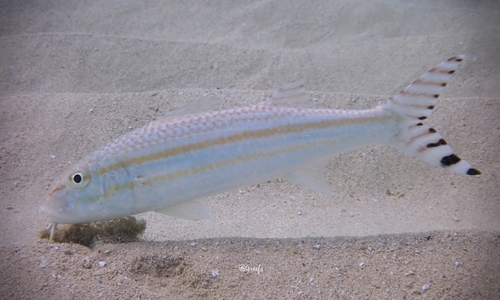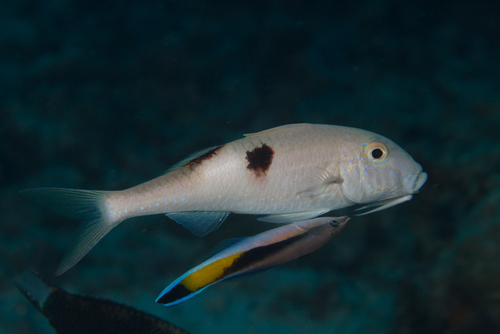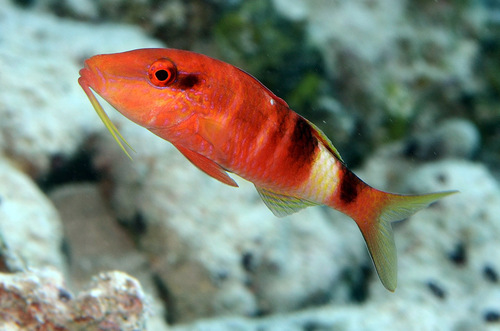
About Parupeneus multifasciatus (Quoy & Gaimard, 1825)
Taxonomy and Common Name
Parupeneus multifasciatus, commonly called moano, is a species of goatfish.
Distinctive Sensory Structure
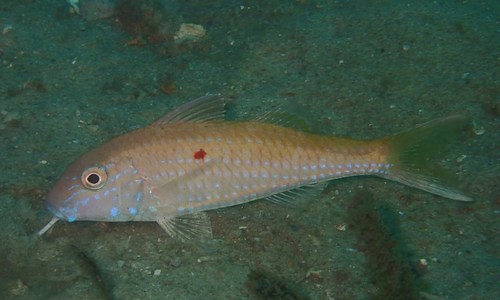
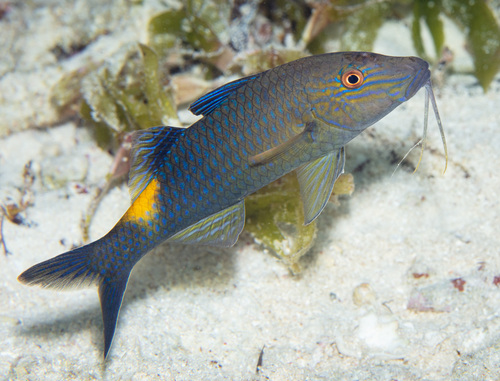
Like other goatfish, this species has characteristic chin whiskers.
Shared Species Morphological Features
Common shared features across the species include yellow or blue accents on the edges of scales, dark spots near the eyes, dark spots around the base of the pectoral fin, and both white and dark bars.
Color Variations
The species has several common color variations: red with black spots, light red with no spots, black with a yellow spot near the tail, and purple-red with yellow and black spots.
Adult Length
Males of the species can reach a total length of 35 centimetres (14 in), while females only reach a standard length of 17.9 centimetres (7.0 in).
Reproductive Size
Individuals reach reproductive size at 7 inches (17.8 cm).
Recorded Weight
The heaviest recorded moano specimen weighed 453 g (0.9987 lb).
Captive Larval Duration
In captive conditions, moano have a pelagic larval duration of 24 to 28 days.
Habitat Preferences
Moano are common reef fish that inhabit shallow water environments, reef flats, and outer reefs.
Depth Range
They spend most of their time in the benthic zone, and can be found at depths ranging from 0 to 161 m (0 to 528 ft).
Geographical Distribution
The species is endemic to three regions: Hawaiʻi, the Marquesas, and the Indo-Polynesian Province.
Human Uses as Food
Moano are game fish that can be prepared and eaten raw, broiled, or baked.
Commercial and Aquarium Use
It is a commercially important species, and is also traded for use in aquariums.