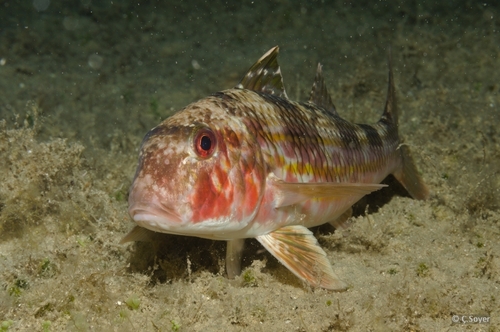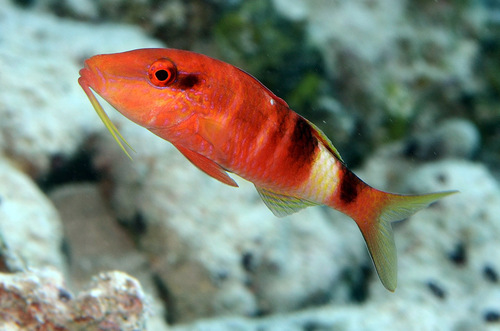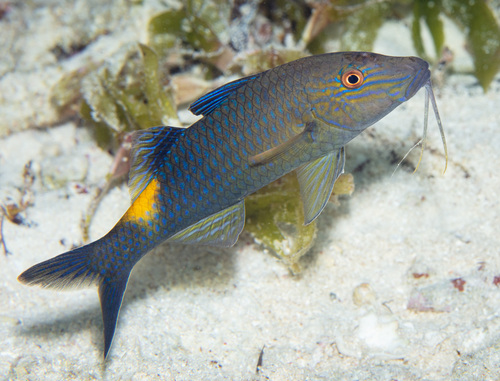
About Parupeneus cyclostomus (Lacepède, 1801)
Size
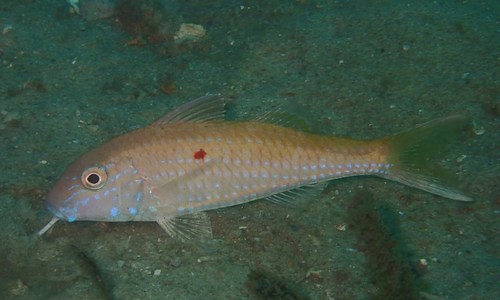
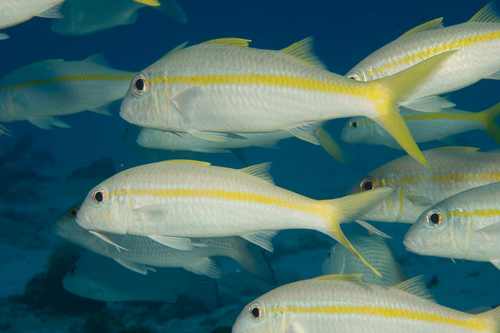
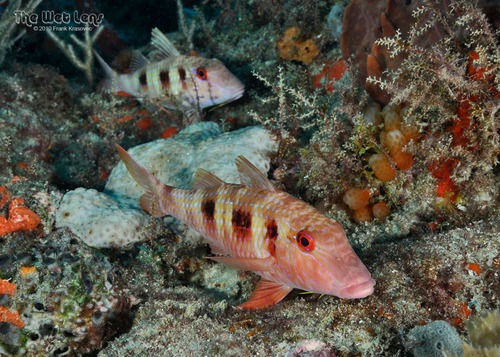
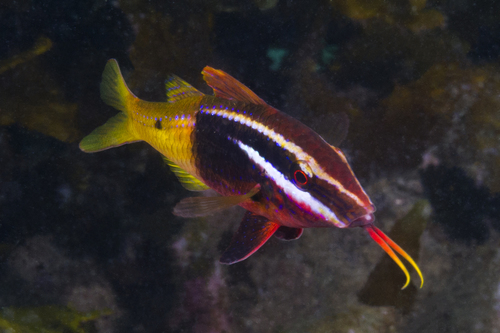
Parupeneus cyclostomus, commonly called the yellow-saddle goatfish, can reach a total length of 50 cm (20 in), though most individuals do not exceed 35 cm (14 in). Size variation may depend on multiple factors, including age, habitat conditions, and resource availability.
Dorsal Spines
This species of goatfish has dorsal spines ranging from 2.79–3.05 centimetres (1.1–1.2 in) long; these spines protect the fish from predators and help it swim efficiently. Along with these spines, goatfish of this species typically have elongated snouts, which bear two characteristic barbels that extend roughly 3 centimetres (1.2 in), but can grow longer than the fish's entire head.
Behavior
Yellow-saddle goatfish is a versatile species whose behavior changes based on age and environment. This fish occurs either solitarily or, when young, in groups, across all areas of coral reefs and detrital bottom areas from 1 to 95 m (0 to 310 ft) deep.
Habitats
It can be found on reef flats, rocky bottoms, lagoons, and seaweed reefs. Juveniles typically form small schools, while adults usually live alone except when hunting.
Mixed Schools
Young goatfish are most abundant in seagrass beds, which serve as an important feeding ground for many juvenile fishes. This species often forms heterotypic schools, meaning it may swim alongside other fish species such as wrasses, other goatfish species, and other reef-dwelling species.
Reef Ecosystems
Forming these mixed-species schools lets goatfish benefit from collaborative hunting and even camouflage. The fish commonly lives in diverse coral reef ecosystems, and thrives in temperate, tropical, and sub-tropical waters. These environments are ideal for yellow-saddle goatfish because they offer ready access to shelter, food, and other members of the species.
Range
The geographic range of Parupeneus cyclostomus covers the Indo-Pacific and Atlantic oceans, extending from the Red Sea to South Africa, the Hawaiian Islands, and the Ryukyu Islands. Its range also includes the islands of French Polynesia and the Ogasawara Islands.
Reef Preference
Goatfish tend to prefer habitats with abundant reef structures, so they are usually absent from areas where reefs are sparse or do not exist at all.
Life Span
Yellow-saddle goatfish typically lives to around five years old, though captive individuals have been reported to live up to eight years. Most individuals reach sexual maturity at around two years of age, but detailed information on their breeding habits is limited.
Reproduction
This species is oviparous, meaning it lays eggs that are fertilized externally, outside the female's body. After the eggs are laid, male goatfish guard the highly buoyant eggs until they are ready to hatch.
Larval Development
Once a yellow-saddle goatfish larva emerges from the egg, it drifts in open water for approximately four to eight weeks. Near the end of this drifting period, the fish begin to develop their characteristic long barbels, which allow them to feed on the bottom. Even so, many individuals at this stage continue to feed on plankton until they complete metamorphosis and transition into their adult form.