About Mulloidichthys dentatus (Gill, 1862)
Mouth Characteristics
Mulloidichthys dentatus has a small, protrusible mouth. Its teeth are small and villiform, and there are no teeth on the roof of its mouth.
Snout and Barbels
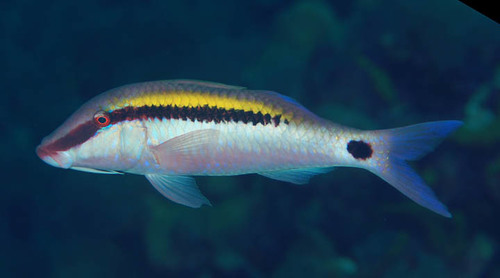
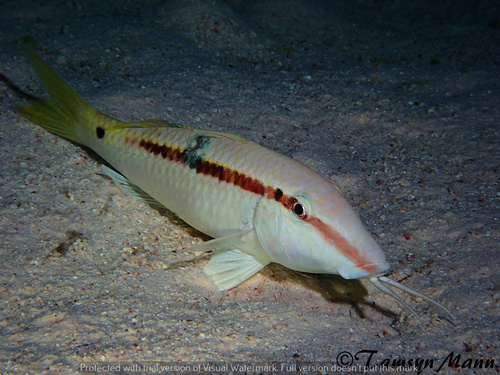
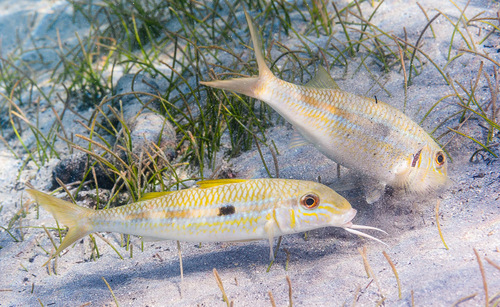
The snout is blunt, and there are two large barbels on the chin.
Scale Count
There are six rows of scales between its two dorsal fins.
Body Coloration
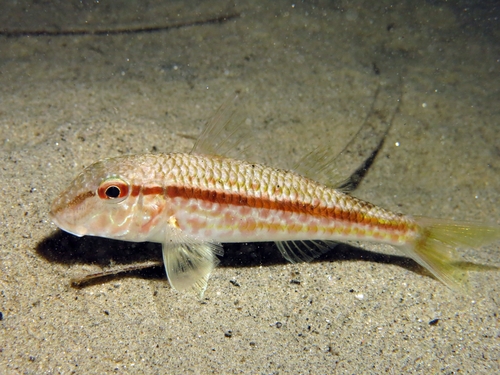
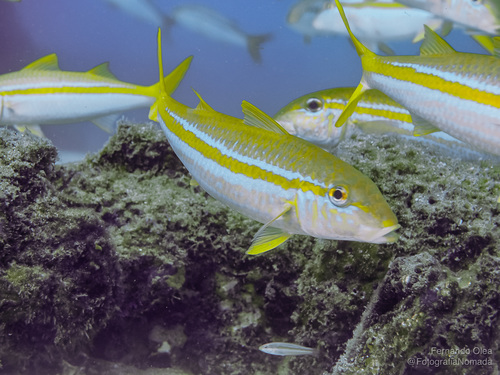
The body is entirely yellow except for two horizontal blue stripes.
Maximum Size
This species reaches a maximum total length of 40 cm (16 inches).
Species Distinction
It is similar in appearance to Mulloidichthys vanicolensis, but differs in having shorter pectoral fins and shorter barbels, as well as fewer gill rakers and fewer pectoral fin rays.
Geographic Range
This species occurs in the Central-Eastern Pacific Ocean, ranging from southern California, USA to Peru, including the Galápagos Islands. It is rare north of the Baja California peninsula.
Depth Range
It inhabits depths from 2 to 110 m (6.6 to 360.9 ft).
Adult Habitat
Adults are primarily found along coasts and around coral reefs, living on sandy, muddy, and rocky nearshore bottoms.
Juvenile Habitat
Juveniles of this species, by contrast, are more commonly found in the open ocean.
Social Behavior
Individuals may occur alone, but the species prefers to form small schools.
Nighttime Color Change
At night, individuals can change their body color to develop red patches.