About Papio papio (Desmarest, 1820)
General Baboon Traits
Baboons are large-bodied primates with clear sexual dimorphism, where females and young rely on males for protection.
Guinean Baboon Naming
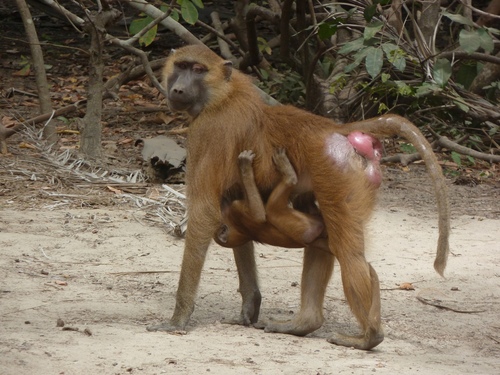
The Guinean baboon, scientifically named Papio papio, is sometimes called the red baboon because its fur has a red tone.
Guinean Baboon Facial & Rump Features
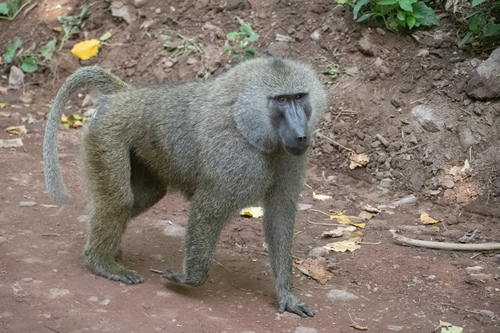
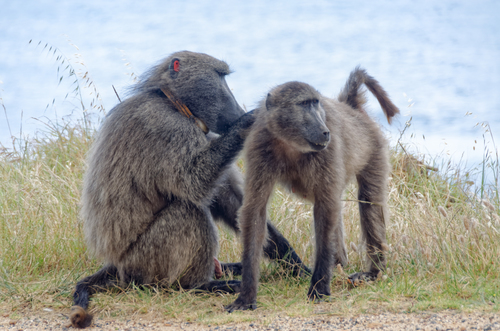
Guinean baboons have no hair on their hindquarters, black faces, and yellow-brown sideburns. Females have pink rumps, while males have a fur mane around their heads and shoulders.
Baboon Dentition & Dimorphism
All baboons have characteristic long molars and broad incisors, and long canines are a visible marker of sexual dimorphism in baboon species. This species also shows sexual dimorphism in body size, meaning males and females have different average body sizes.
Limb Structure & Climbing Ability
Guinean baboons' forelimbs and hindlimbs are almost equal in length, and their hand and foot digits are relatively short and stout, which makes climbing difficult for them.
Guinean Baboon Size & Weight
Papio papio is one of the smallest baboon species, with body weights ranging from 13 to 26 kg (28 to 57 lbs).
West African Distribution
Guinean baboons are generally found in woodland savannas across a broad area of West Africa, including Guinea, Senegal, Gambia, southern Mauritania, and western Mali.
Habitat Types
They are most commonly found in savannas and forests of sub-Saharan Africa, and can also live in grasslands, rain forests, and other open areas.
Seasonal Grouping Behavior
Seasonally, Guinean baboons congregate near permanent water sources, and split into smaller groups during the wet season.
Baboon Range Overlap & Interbreeding
While all baboon species are typically allopatric (having non-overlapping ranges), some ranges do overlap, and occasional interbreeding between species occurs.
Activity Pattern
Guinean baboons are diurnal, spending most of their active time on the ground rather than in trees. They typically sleep in trees, on the terminal ends of branches.
Troop Size
Group size for this species varies widely, ranging from 30 to 200 individuals, though the most common troop size is 30 to 40 individuals.
Male Hierarchy & Sexual Dimorphism Driver
Troops usually have a clear male hierarchy, and there is fierce competition among males for access to females, which is a driver of the species' sexual dimorphism.
Foraging Behavior
Guinean baboons are independent foragers. Females always pair with males for protection while foraging, and females often choose to follow the same male year after year.
Female Fertility Swelling
When female Guinean baboons enter their fertile period, they develop sexual swelling that begins 10 to 12 days before peaking, and remains for about eight days after the peak.
Copulation Signaling Behavior
Females then perform the social behavior of presenting, which signals to males in the group that they are ready for copulation.
Reproduction Timeline
The average gestation period is around six months, and nursing continues until offspring are six to eight months old.
Female Rejection Behavior
If females want to reject a male's advances, they will shriek at him and often climb into a tree.