About Semnopithecus vetulus (Erxleben, 1777)
Scientific Name and Sexual Size Dimorphism
The purple-faced langur, scientifically named Semnopithetus vetulus, typically has males that are larger than females.
Male Body Measurements
Males have a head-body length of 50 to 67.1 cm (19.7 to 26.4 in), and a tail length of 67 to 85.1 cm (26.4 to 33.5 in).
Female Body Measurements
Females have a head-body length of 44.7 to 60 cm (17.6 to 23.6 in), and a tail length of 58.9 to 82 cm (23.2 to 32.3 in).
General Fur Coloration
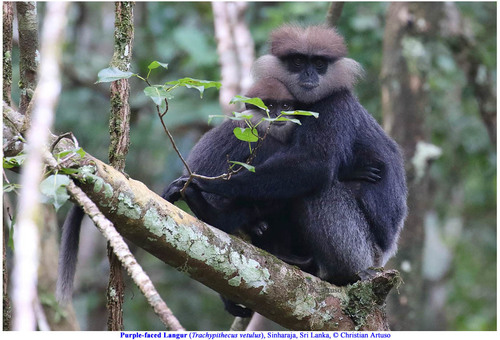
The species' fur generally ranges from blackish to grayish.
Distinctive Body Fur Markings
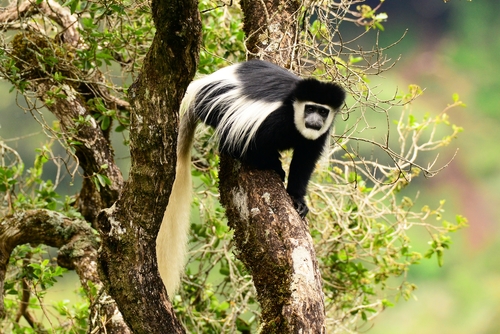
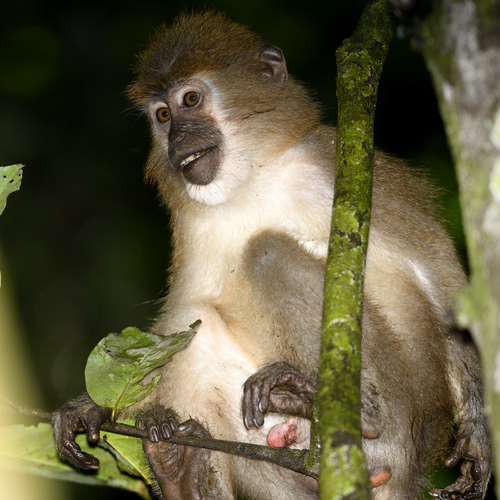
It usually has short whitish to gray fur on its lower body that looks like trousers, paired with purplish-black faces and white sideburns. Part of the back is covered with whitish fur, and the tail has a mix of black and white fur.
Extremity Coloration
The hands and feet are also purplish-black.
Subspecies Size Variation
Body size varies between subspecies.
General Weight Range
Adult purple-faced langurs typically weigh between 3.1 and 11.4 kg (6.8 and 25.1 lb), with an average weight of around 7.08 kg (15.6 lb).
Smallest Subspecies Weight
The smallest subspecies, S. v. nestor, commonly weighs between 3.8 and 6 kg (8.4 and 13.2 lb).
Other Subspecies Weight
Average weights for other subspecies reach up to 7.8 kg (17 lb) for females and 8.5 kg (19 lb) for males, and exceptionally large individuals can weigh up to around 18 kg (40 lb).
Size Comparison to Related Species
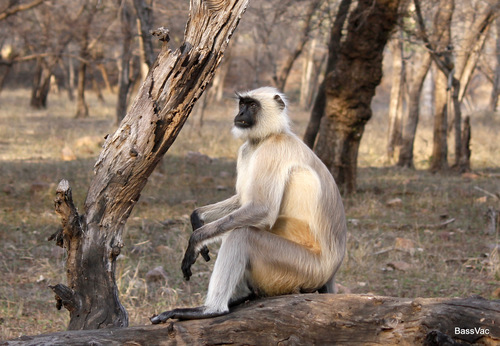
Among primates native to Sri Lanka, the purple-faced langur is generally smaller than the tufted gray langur, though lead males of purple-faced langur groups are often larger than co-occurring tufted gray langurs.
Bear Monkey Subspecies Traits
The subspecies S. v. monitcola, known as the bear monkey, usually has a darker coat and a prominent heavy mustache.
Crown Hair Growth Pattern
For this species, crown hair grows pointing backwards across the whole crown, rather than growing in a radiating pattern.
Crown Hair Comparison to Tufted Gray Langur
It does not have the crest that tufted gray langurs have, and crown hair is no longer than hair on the temples and nape.
Rump Coloration
Purple-faced langurs have a pure white or whitish gray rump.
Native Habitat Range
The purple-faced langur inhabits closed canopy forests in the mountains of Sri Lanka and the country's southwestern "wet zone" region.
Sri Lanka Forest Coverage
Only 19% of Sri Lanka's total area is forested.
Habitat Loss Trend
The species' available forest habitat decreased from 80% coverage in 1980 to approximately 25% in 2001, and currently stands at less than 3%.
Remaining Habitat Location
Its remaining range covers the most densely populated lowland rainforest areas of Sri Lanka.
Habitat Fragmentation Impact
Deforestation has left the langurs' home ranges exposed to direct sunlight.
Group Distribution Pattern
Purple-faced langurs are most often found in small, widely scattered groups.
Human Overlap in Range
Ninety percent of the species' current range overlaps with areas populated by humans.
Current Population Status
Population numbers are critically low both within and between sites.
Threats to Survival
Threats to the species include encroachment on its range from cropland expansion, grazing, agricultural changes, road development, soil erosion, deforestation, poisoning from efforts to prevent crop raiding, and hunting for use as food and in traditional medicine.
Remaining Known Locations
The species' range has shrunk drastically due to human encroachment, but it can still be found in Sinharaja, Kitulgala, Kandalama, Mihintale, Horton Plains National Park in the mountains, and rainforests near the city of Galle.