About Chlorocebus tantalus (Ogilby, 1841)
Common Name and Classification
Chlorocebus tantalus, commonly called the tantalus monkey, is a medium-sized primate.
Facial Markings
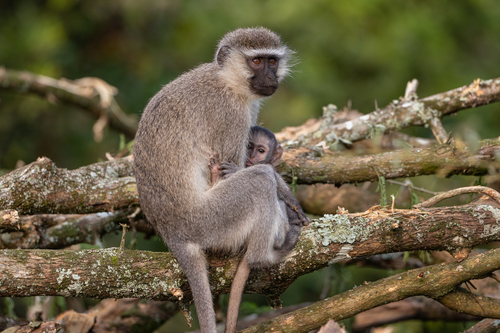
It has a black face and a long tail, with a distinctive undulating white or yellowish browband above its eyes. The cheeks and temples are covered in white long hairs that are swept backwards, and often cover the ears of older individuals.
Dorsal Pelage Coloration
The crown and dorsal surface of the body are grizzled, with a greenish or golden tone.
Underparts, Limb and Tail Coloration
Its underparts are white, while the tail and outer surfaces of the limbs are grey; the tail may also have a whitish tip.
Sexual Dimorphism
Males are larger than females, and males have a bright blue scrotum surrounded by orange hairs.
Native Range
This species is native to tropical central Africa, and its natural range covers Benin, Burkina Faso, Cameroon, Central African Republic, Chad, Congo, Democratic Republic of Congo, Ghana, Kenya, Niger, Nigeria, South Sudan, Sudan, Togo and Uganda.
Habitat and Adaptability
It is a highly adaptable species that can live in open woodland, savannah, forest-grassland mosaic, and riverside forest, and also thrives in secondary forest as well as rural and urban areas.
Typical Troop Size
Tantalus monkeys typically live in troops that average around thirty individuals.
Troop Composition
A typical troop can hold up to ten adult males and eighteen adult females, with varying numbers of juveniles and young. Some adult males travel alone instead of joining a troop.
Social Hierarchy
There is an established social hierarchy within each troop.
Locomotion Habit
These monkeys are semi-terrestrial and spend much of their time on the ground.
Territorial Behavior
Each troop maintains and defends its territory with vocalizations and threat displays, though some groups are less aggressive and will share part of their territory with a neighbouring troop.
Breeding Season Variation
Breeding occurs at different times of the year across different parts of the species' range.
Reproductive Traits
A single offspring is the usual result of each pregnancy, and females give birth to their first offspring when they are around five years old.