About Panthera tigris (Linnaeus, 1758)
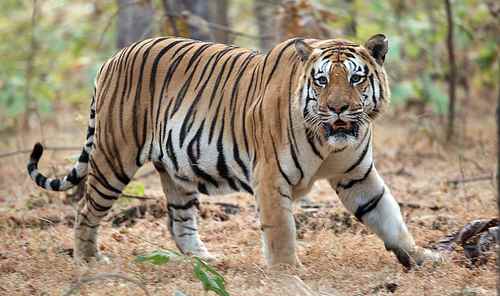
The tiger, Panthera tigris, has typical felid morphology: a muscular body, shortened legs, strong forelimbs with wide front paws, a large head, and a tail approximately half the length of the rest of its body. There are five digits including a dewclaw on the front feet and four on the back feet; all have compact, curved retractile claws that can reach 10 cm (3.9 in) long. The tiger has rounded ears and eyes with round pupils. Its snout ends in a triangular pink tip marked with small black dots, and the number of these dots increases as the tiger ages. The tiger's skull is robust, with a constricted front region, proportionally small elliptical orbits, long nasal bones, a lengthened cranium, and a large sagittal crest. It resembles a lion's skull, but differs in the concave or flattened underside of the lower jaw and its longer nasal bones. Tigers have 30 fairly robust teeth; their somewhat curved canines are the longest among all cats, measuring 6.4–7.6 cm (2.5–3.0 in). The tiger has a head-body length of 1.4–2.8 m (4 ft 7 in – 9 ft 2 in), a 0.6–1.1 m (2 ft 0 in – 3 ft 7 in) tail, and stands 0.8–1.1 m (2 ft 7 in – 3 ft 7 in) at the shoulder. The Siberian and Bengal tiger subspecies are the largest. Male Bengal tigers weigh 200–260 kg (440–570 lb), while females weigh 100–160 kg (220–350 lb). Island tigers are the smallest, likely due to insular dwarfism; male Sumatran tigers weigh 100–140 kg (220–310 lb), and females weigh 75–110 kg (165–243 lb). The tiger is commonly believed to be the largest living felid species, but because tigers of different subspecies and populations vary greatly in size and weight, the average size of a tiger may be smaller than that of a lion, while the largest individual tigers are larger than the largest individual lions.
Historically, tigers ranged from eastern Turkey, northern Iran, and Afghanistan through Central Asia, and from northern Pakistan across the Indian subcontinent and Indochina to southeastern Siberia, Sumatra, Java, and Bali. As of 2022, tigers inhabit less than 7% of their historical range, and are scattered across the Indian subcontinent, the Indochinese Peninsula, Sumatra, northeastern China, and the Russian Far East. As of 2020, India held the largest extent of global tiger habitat at 300,508 km2 (116,027 sq mi), followed by Russia with 195,819 km2 (75,606 sq mi). Tigers mainly live in forest habitats and are highly adaptable. Records from Central Asia show they primarily occupied Tugay riverine forests and hilly and lowland forests in the Caucasus. In the Amur-Ussuri region of Russia and China, tigers inhabit Korean pine and temperate broadleaf and mixed forests, with riparian forests acting as dispersal corridors that provide food and water for both tigers and ungulates. On the Indian subcontinent, tigers live mainly in tropical and subtropical moist broadleaf forests, temperate broadleaf and mixed forests, tropical moist evergreen forests, tropical dry forests, alluvial plains, and the mangrove forests of the Sundarbans. In the Eastern Himalayas, tigers have been documented in temperate forest up to an elevation of 4,200 m (13,800 ft) in Bhutan, 3,630 m (11,910 ft) in the Mishmi Hills, and 3,139 m (10,299 ft) in Mêdog County, southeastern Tibet. In Thailand, tigers live in deciduous and evergreen forests. In Sumatra, they inhabit lowland peat swamp forests and rugged montane forests.
Studies of tiger activity patterns show variation across populations. Camera trap data from Chitwan National Park found tigers avoid locations frequently visited by people and are more active at night than during the day. In Sundarbans National Park, six radio-collared tigers were most active from dawn to early morning, with peak activity around 7:00 a.m. A three-year camera trap survey in Shuklaphanta National Park found tigers are most active from dusk until midnight. In northeastern China, tigers are crepuscular and active at night, with peak activity at dawn and dusk, matching the activity patterns of their prey. Tigers are powerful swimmers that easily cross rivers up to 8 km (5.0 mi) wide, and will immerse themselves in water, particularly on hot days. Due to their large size, tigers are generally less capable of climbing trees than many other cats, but cubs under 16 months old may climb routinely. One adult tiger has been recorded climbing 10 m (33 ft) up a smooth pipal tree.
Tigers generally mate year-round, with most mating occurring between November and April. A tigress is in oestrus for three to six days at a time, separated by intervals of three to nine weeks. A resident male mates with all females within his home range; receptive females signal their status by roaring and marking. Younger transient males are also attracted to receptive females, leading to fights where the more dominant resident male drives the intruder away. During courtship, the male remains cautious of the female until she shows she is ready to mate by positioning herself in lordosis with her tail held to the side. Copulation typically lasts no more than 20 seconds, with the male biting the female by the scruff of her neck. After copulation, the male quickly pulls away, as the female may turn and slap him. Tiger pairs may stay together for up to four days and mate multiple times. Gestation lasts around or over three months. A tigress gives birth in a secluded location, such as dense vegetation, a cave, or under a rocky shelter. Litters can have as many as seven cubs, but two or three cubs are more typical. Newborn cubs weigh 785–1,610 g (27.7–56.8 oz), are blind, and are altricial. The mother licks and cleans her cubs, suckles them, and viciously defends them from any potential threat. Cubs open their eyes between three and 14 days after birth, and their vision clears a few weeks later. They can leave the den after two months, and around this same time they begin eating meat. The mother only leaves her cubs alone to hunt, and does not travel far from the den even when hunting. If she suspects an area is no longer safe, she moves her cubs to a new spot, transporting one at a time by grabbing them by the scruff of the neck with her mouth. In the Sikhote-Alin Biosphere Reserve, tigresses with cubs maximized time spent with their young by reducing their home range, killing larger prey, and returning to the den more quickly than tigresses without cubs. Once cubs started eating meat, the mother brought them to kill sites to optimize their protection and access to food. Over eight years of monitoring in this reserve, only one out of 21 cubs died, and juvenile mortality did not differ between male and female cubs. Six years of tiger monitoring in Ranthambore Tiger Reserve found an average annual survival rate of around 85 percent for 74 male and female cubs; the survival rate rose to 97 percent for both male and female juveniles between one and two years of age. Common causes of cub mortality include predation, floods, fires, the death of the mother, and fatal injuries.
After around two months, cubs can follow their mother, but still hide in vegetation when she hunts. Young tigers bond through play fighting and practice stalking. A hierarchy forms within each litter, where the largest cub, often a male, is the most dominant and eats first at kills. Around six months of age, cubs are fully weaned and have more freedom to explore their surroundings. Between eight and ten months, cubs accompany their mother on hunts. A cub can make its first kill as early as 11 months, and becomes independent as a juvenile between 18 and 24 months of age; males become independent earlier than females. Radio-collared tigers in Chitwan began leaving their natal areas at 19 months of age. Young females reach sexual maturity at three to four years, while males reach sexual maturity at four to five years. The generation length of tigers is around 7–10 years. Wild Bengal tigers live 12–15 years. Data from the International Tiger Studbook 1938–2018 shows captive tigers have lived up to 19 years. Male tigers do not typically take an active role in raising young, but resident males do encounter and interact with the cubs of females within their home range. Males socialize with these cubs and even share kills with them; one male has been recorded caring for cubs whose mother had died. By defending his home range, a resident male protects the females and cubs within it from other males. When a new male takes over a resident male's home range, dependent cubs are at risk of infanticide, as the new male aims to sire his own young with the resident females. A seven-year study in Chitwan National Park found that 12 out of 56 detected cubs and juveniles were killed by new males taking over home ranges.