About Ovis canadensis Shaw, 1804
Common Name Etymology
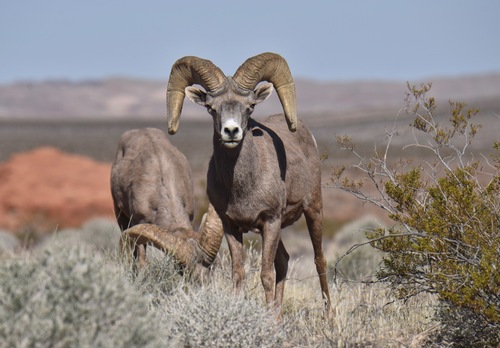
Bighorn sheep (Ovis canadensis Shaw, 1804) get their common name from the large, curved horns that male individuals (called rams) carry. Female bighorn sheep, called ewes, also have horns, though these are shorter and straighter than those of rams.
Coat Coloration
Their coat color ranges from light brown to grayish or dark chocolate brown, with a white rump and white lining along the backs of all four legs.
Male Body Size
Males typically weigh 58–143 kg (128–315 lb), stand 90–105 cm (35–41 in) tall at the shoulder, and measure 1.6–1.85 m (63–73 in) long from nose to tail.
Female Body Size
Females are typically 34–91 kg (75–201 lb), 75–90 cm (30–35 in) tall at the shoulder, and 1.28–1.58 m (50–62 in) long from nose to tail.
Male Cranial Adaptations
Male bighorn sheep have large horn cores, enlarged cornual and frontal sinuses, and internal bony septa. These adaptations protect the brain by absorbing the impact of head-on clashes between rams.
Specialized Glands
Bighorn sheep have preorbital glands on the anterior corner of each eye, inguinal glands in the groin, and pedal glands on each foot. Secretions from these glands may play a role in supporting dominance behaviors between individuals.
Rocky Mountain Subspecies Size
Rocky Mountain bighorn sheep are relatively large: males occasionally exceed 230 kg (500 lb), and females can exceed 90 kg (200 lb).
Sierra Nevada Subspecies Size
In contrast, male Sierra Nevada bighorn sheep weigh only up to 90 kg (198 lb), while females of this population weigh up to 60 kg (132 lb).
Ram Horn Weight
A male ram’s horns can weigh as much as 14 kg (30 lb) — equal to the combined weight of all bones in the ram’s body.
Subspecies Distribution Overview
Different subspecies of bighorn sheep occupy distinct regions. Rocky Mountain and Sierra Nevada bighorn sheep live in the cooler mountainous areas of Canada and the United States.
Desert Subspecies Distribution
Desert bighorn sheep subspecies are native to the hot desert ecosystems of the Southwestern United States and Mexico.
General Habitat Preferences
Overall, bighorn sheep live in alpine meadows, grassy mountain slopes, and foothill terrain near rugged, rocky cliffs and bluffs. They cannot move through deep snow, so they prefer drier slopes where annual snowfall is less than about 150 cm (60 in).
Seasonal Range Elevation
A bighorn sheep’s winter range is usually at a lower elevation than its summer range.
Disease Susceptibility
Bighorn sheep are highly susceptible to certain diseases carried by domestic sheep, including psoroptic scabies and pneumonia.
Habitat-Related Mortality
Additional mortality comes from accidents involving rock falls or falls from cliffs, a hazard of their steep, rugged habitat. They are well adapted to climbing steep terrain to seek cover from predators.
Lamb Predators
Lambs are the most vulnerable to predation; potential predators of lambs include coyotes, bobcats, gray foxes, wolverines, jaguars, ocelots, lynxes, and golden eagles.
Adult Predators
Bighorn sheep of all ages are threatened by black bears, grizzly bears, wolves, and especially mountain lions, which have the agility needed to prey on bighorns in uneven, rocky habitats.
Fire Suppression Predation Risk
Fire suppression can reduce visibility through shrublands, which increases available cover for mountain lions and raises their predation rate on bighorn sheep.
Ecological Indicator Role
Bighorn sheep are considered good indicators of land health, because the species is sensitive to many human-caused environmental problems.
Human Uses
In addition to their aesthetic value, they are considered desirable game animals for hunters.
Feeding Habits
Bighorn sheep graze on grasses and browse on shrubs, particularly in fall and winter, and they seek out minerals at natural salt licks.
Female Foraging Behavior
Females typically spend most of their time foraging and walking, which may help them avoid predators and protect lambs.
Male Foraging Behavior
Males typically eat then rest and ruminate, a pattern that supports more effective digestion and greater body size growth.
Herd Social Structure
Bighorn sheep live in large herds, and do not usually follow a single lead ram, unlike their ancestor the mouflon (the ancestor of domestic sheep), which has a strict dominance hierarchy.
Pre-Rut Dominance Competition
Before the mating season, called the rut, rams compete to establish a dominance hierarchy that determines access to ewes for mating. Most of the characteristic horn clashing between rams happens during this pre-rut period, though limited horn clashing may occur throughout the year.
Ram Sparring Behavior
Bighorn rams engage in a consistent agonistic behavior: two competing rams walk away from each other, turn to face one another, then jump and lunge into headbutts. Rams’ horns are often missing their tips, a condition called brooming, which is a natural result of frequent sparring between males.
Female Dominance Hierarchy
Females have a stable, nonlinear dominance hierarchy that correlates with age. When young females join the herd hierarchy at one to two years of age, they may fight to gain high social status.
Ram Courting Strategies Overview
Rocky Mountain bighorn rams use at least three distinct courting strategies during the mating season.
Tending Courting Strategy
The most common and most successful strategy is tending, where a ram follows and defends an estrous ewe. Tending requires considerable strength and vigilance, and ewes are most receptive to tending males, likely because they recognize these males as the most fit.
Coursing Courting Strategy
A second strategy is coursing, where rams fight for an ewe that is already being tended by another ram. Ewes usually avoid coursing males, so this strategy is rarely effective.
Blocking Courting Strategy
The third strategy is blocking: rams prevent ewes from accessing tending areas before the ewe even enters estrus.
Gestation and Breeding Timeline
Bighorn ewes have a six-month gestation. In temperate climates, the rut peaks in November, and one (rarely two) lambs are born in May.
Lambing Period Timing
Most births happen in the first two weeks of the lambing period. Pregnant Rocky Mountain ewes migrate to alpine areas in spring, likely to give birth in areas that are safer from predation, though these areas are further from high-quality forage.
Lamb Survival Factors
Lambs born earlier in the lambing season are more likely to survive than lambs born later. Late-born lambs may not get sufficient milk, because their mothers lactate when local food quality is lower.
Lamb Development
Newborn lambs weigh 3.6 to 4.5 kg (8 to 10 lb) and can walk within hours of birth. Lambs are weaned when they reach four to six months old.
Lifespan
The typical lifespan of ewes is 10–14 years, while the typical lifespan of rams is 9–12 years.