About Bos taurus indicus Linnaeus, 1758
Body Structure
Cattle are large artiodactyl mammals with cloven hooves, meaning they walk on two toes: the third and fourth digits.
Like all bovid species, they can have unbranched horns that are not shed annually.
Coloration
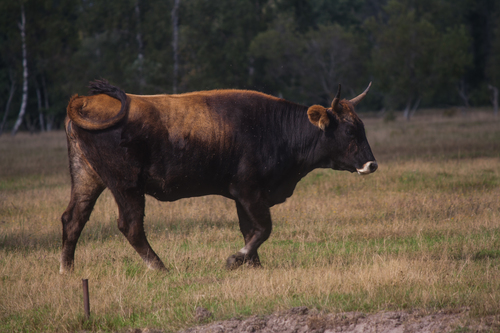
Their coloration varies by breed; common colors are black, white, and red/brown, and some breeds are spotted or have mixed colors.
Sex-based Size Difference
Bulls of the same breed are larger than cows, differing by up to several hundred kilograms.
For example, British Hereford cows weigh 600–800 kg (1,300–1,800 lb), while Hereford bulls weigh 1,000–1,200 kg (2,200–2,600 lb).
Historical Weight Trends
Before 1790, beef cattle averaged only 160 kg (350 lb) net weight, and weights increased steadily after this point.
Breed Size Variation
Cattle breeds vary widely in overall size; the tallest and heaviest breed is the Chianina, where a mature bull may reach up to 1.8 m (5 ft 11 in) at the shoulder and up to 1,280 kg (2,820 lb) in weight.
Lifespan
The natural lifespan of domestic cattle is around 25–30 years.
Slaughter Age
Beef cattle are typically slaughtered at about 18 months of age, and dairy cows are slaughtered at about five years.
Gestation Period
For reproduction, the gestation period for a cow is approximately nine months long.
Offspring Sex Ratio
The ratio of male to female offspring at birth is roughly 52:48.
Udder Structure
A cow's udder holds two pairs of mammary glands, or teats.
Artificial Insemination Use
Cattle farms often use artificial insemination, the process of artificially depositing semen in the female's genital tract.
This method allows farmers to select from a wide range of bulls to breed their cattle.
Estrus Induction
Estrus may also be artificially induced to facilitate the artificial insemination process.
Natural Copulation
Natural copulation lasts several seconds and consists of a single pelvic thrust.
Birthing Behavior
Cows seek out secluded areas to give birth.
Highland Cattle Reproduction
For semi-wild Highland cattle, heifers produce their first calf at 2 or 3 years of age, and birth timing is synchronized with increases in natural food quality.
Calving Metrics
The average calving interval is 391 days, and calving mortality within the first year of life is 5%.
Suckling Frequency
Beef calves suckle an average of 5 times per day, spending a total of around 46 minutes suckling.
Suckling Rhythm
Suckling follows a diurnal rhythm, with peaks at roughly 6am, 11:30am, and 7pm.
Weaning Age
Under natural conditions, calves stay with their mother until weaning at 8 to 11 months.
Calf Maternal Attachment
Heifer and bull calves are equally attached to their mothers during the first few months of life.
Enteric Methane Production
Regarding environmental impacts, the gut flora of cattle produce methane, a powerful greenhouse gas, as a byproduct of enteric fermentation.
Each cow belches out approximately 100kg of methane per year.
Manure Methane Production
Additional methane is produced by the anaerobic fermentation of stored manure.
Cattle Farming Emissions Share
The Food and Agriculture Organization estimates that in 2015, around 7% of global greenhouse gas emissions came from cattle farming.
Methane Mitigation Benefit
Reducing these methane emissions quickly helps limit climate change.
Concentrated Feeding Operation Harms
Concentrated animal feeding operations, in particular, produce large amounts of wastewater and manure, which can cause a range of environmental harms.
These include soil erosion, human and animal exposure to toxic chemicals, the development of antibiotic resistant bacteria, and an increase in E. coli contamination.
Overgrazing Biodiversity Impact
In many regions around the world, overgrazing by cattle has reduced the biodiversity of grazed plants and animals at different trophic levels in affected ecosystems.
Woody Plant Encroachment
A well-documented consequence of overgrazing is woody plant encroachment in rangelands, which significantly reduces the carrying capacity of the land over time.