About Capra pyrenaica Schinz, 1838
Limb Adaptations
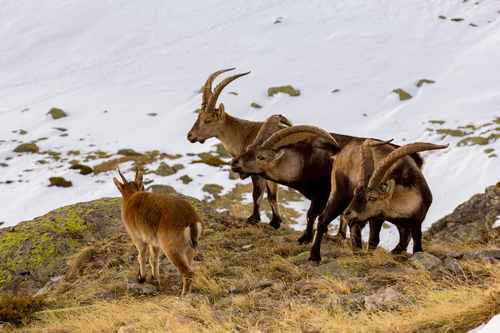
The Iberian ibex, Capra pyrenaica Schinz, 1838, has large flexible hooves and short legs. These physical adaptations let it run and leap across bare, rocky, rough, steep slopes that are out of reach of potential predators.
Horn Morphology
Its horns curve outward and upward, then curve back and inward; their final direction is either up or down, depending on the subspecies. Annual horn growth is mainly influenced by age, but it is also affected by environmental factors and the previous year's horn growth.
Sexual Dimorphism
This species displays sexual dimorphism: males are larger in size and weight, and have larger horns, than females. Female Iberian ibex bones finish ossifying nearly two years earlier than male bones.
Native Range
The Iberian ibex lives on the Iberian Peninsula.
Subspecies Status
Originally, there were four recognized subspecies, but extinctions in the last century have left only two subspecies extant. Both surviving subspecies are found in Spain and northern Portugal, and a small reintroduced population lives in the French Pyrenees.
Extirpation Records
The species has been extirpated from Gibraltar, and is likely extirpated from Andorra.
Social Group Structure
Iberian ibex form two main types of social groups: groups made up only of males, and groups made up of females and young juveniles.
Rutting Season Behavior
Males only interact with females to mate during the rutting season, which falls in November or December. Testes mass reaches its largest size during rutting season, especially for males of ages associated with subordinate status and a coursing reproductive strategy, rather than a mate-guarding strategy.
Winter Grouping
Mixed-sex groups are also common for the rest of the winter.
Birthing Season Group Dynamics
When new births occur during birthing season, yearlings separate from female groups. Males are the first to separate, and they return to all-male groups. Female yearlings eventually go back to their mothers and stay with the female group for the next several years.