About Maurandya scandens (Cav.) Pers.
Taxonomic Identity and Growth Form
Maurandya scandens (Cav.) Pers. is a perennial semi-deciduous vine that can reach 2 to 3 meters in length, and its shoot axes often form adventitious roots. In colder regions, it is semi-deciduous.
Leaf Shape and Margins
Its leaves are alternate, lanceolate to arrow-shaped, with entire margins, and are lobed to coarsely toothed; the lobes and teeth often end in fine points. Leaves are carried on petioles 8 to 42 millimeters long, with hairless leaf blades that measure 11 to 62 millimeters long and 4 to 45 millimeters wide.
Similar Species Distinction
This species has often been confused with Lophospermum scandens, which has longer flowers and larger toothed leaves. It resembles Maurandya barclayana, which differs by having blue-violet flowers and hairy rather than hairless sepals.
Native Habitat and Elevation
Its native range is rocky slopes, canyons, and disturbed areas within tropical and subtropical forests of southern Mexico, found at elevations of 1200 to 2200 meters above sea level. It prefers a medium-humid (mesic) biotope.
Native Range Distribution
Its native range extends north along the calcareous Sierra Madre and south into the volcanic belt. Due to human introduction, the species is now found growing across the world.
Flower Arrangement and Structure
Flowers are hermaphroditic, tubular, fivefold, and occur solitary in leaf axils. They grow from long, glabrous pedicels 30 to 85 millimeters long, and have a wide throat.
Flower Color and Perianth
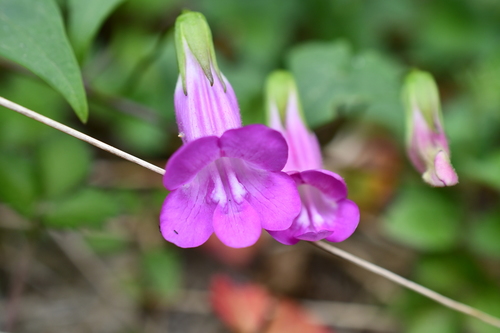
Flowers can be rose pink, violet, indigo blue, or white, and have a double perianth. The ovate-lanceolate calyx segments, with slightly overgrown tips, are 10 to 15 millimeters long, 2 to 4 millimeters wide at the base, and hairless to sparsely covered in glandular hairs.
Corolla and Stamens
The corolla is two-lipped, slightly hairy on the outside, and has short, rounded to indented, spreading lobes. Four short fertile stamens are enclosed within the corolla.
Ovary and Style
The superior two-chambered ovary is usually hairless. The hairless, enclosed, relatively short style is 13 to 16 millimeters long.
Flowering Period
It flowers heavily between spring and summer, with irregular flowering in cool months.
Seed Capsule Characteristics
The resulting seed capsules are asymmetrical, irregularly ovoid, cartilaginous, and many-seeded, measuring 10 to 12 millimeters long, and are split into slightly unequal sections.
Cultivated Cultivars
Cultivated cultivars include Joan Lorraine, which has velvety purple flowers; Snow White, which has white flowers; and Mystic Rose, which has fuchsia flowers.