About Penstemon eriantherus Pursh
Nomenclature
Penstemon eriantherus Pursh is a species of flowering plant in the plantain family, commonly called fuzzytongue penstemon and crested beardtongue.
Distribution
It is native to western North America, distributed across western Canada, and the northwestern and north-central United States.
Growth Form
This species is a perennial herb that grows from a woody caudex and a thick taproot.
Stem Characteristics
It produces several branching stems that reach up to 40 centimeters in height.
Indumentum
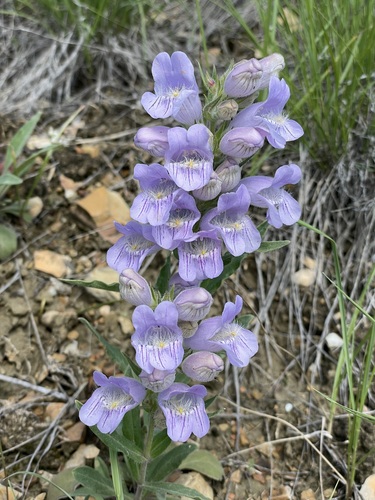
Most of the plant's leafy growth is covered in gray hairs, and its flower cluster can be glandular.
Leaf Characteristics
Its leaves are arranged oppositely along the stems, growing up to 13 centimeters long, and sometimes have slightly toothed edges.
Calyx Structure
Flowers develop within a calyx made up of narrow, pointed sepals.
Corolla Features
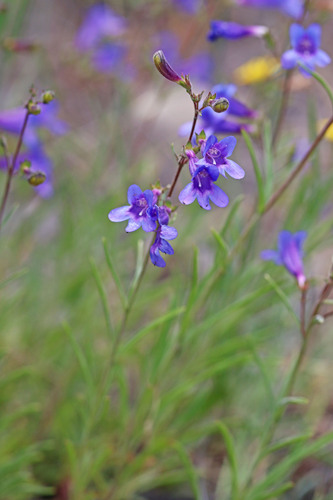
The corolla is up to 4 centimeters long, with a flower mouth up to 1.4 centimeters wide, and its color ranges from lavender to reddish or bluish purple.
Reproductive Morphology
The lower lip of the corolla and the staminode are densely covered in yellowish hairs.
General Habitat
This plant grows in dry, open areas on clay soils.
Washington Plant Communities
In Washington state, it grows in plant communities dominated by antelope bitterbrush (Purshia tridentata) and Indian ricegrass (Oryzopsis hymenoides), purple sage (Salvia dorrii) and bluebunch wheatgrass (Pseudoroegneria spicata), and rabbitbrush (Ericameria nauseosa).
Alternative Habitat
It can also be found growing on rocky soils in sagebrush habitats.
Disturbance Tolerance
Its ability to survive in relatively harsh habitats may help it persist in disturbed areas such as eroded trails.
Intraspecific Varieties
There are 5 recognized varieties of this species: Penstemon eriantherus var. argillosus, which is endemic to Oregon; Penstemon eriantherus var. cleburnei, or Cleburn's penstemon; Penstemon eriantherus var. eriantherus; Penstemon eriantherus var. redactus, or longsac penstemon; and Penstemon eriantherus var. whitedii, or Whited's penstemon, which is endemic to Washington.