About Oroxylum indicum (L.) Kurz
Oroxylum indicum (L.) Kurz is a tree that reaches up to 27 meters (89 feet) in height, with a trunk diameter of 10 to 40 centimeters (3.9 to 15.7 inches) and grey bark. Mature trees have very few branches, and produce large pinnate leaves that are the largest among all dicot tree leaves. The leaf lamina can grow up to 2.2 meters (7 feet 3 inches) in both length and width. Each leaf petiole (leaf stalk) reaches up to 2 meters (6.6 feet) long, and supports four pinnate branches; each branch is approximately 1 meter (3.3 feet) in both length and width, and is borne on its own stalk. All parts of the leaflet stalk develop at once; dead stalks fall off the tree and accumulate near the trunk base, where they look like a pile of broken limb bones.
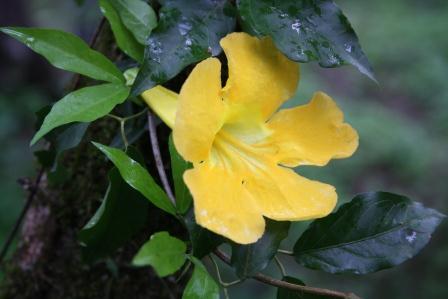
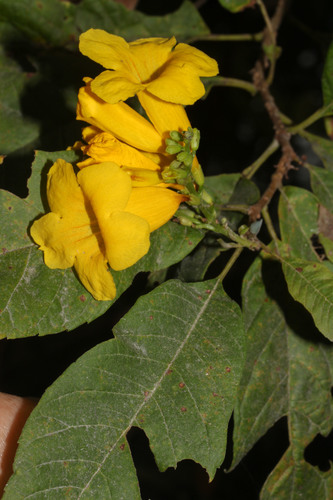
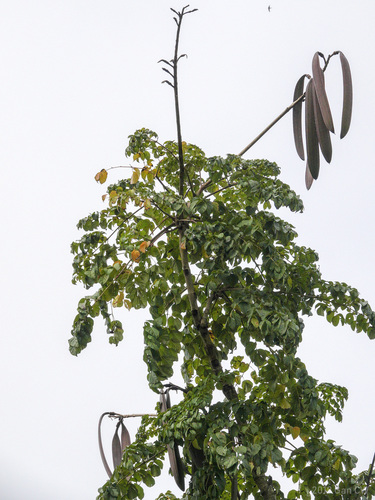
Flowers grow from long pedicels at the end of 2 to 4 centimeter long racemes, and have leathery brown or dirty-violet calyxes. The flowers have a sharp scent, bloom at night, and are pollinated by bats. This species produces enormous seed pods that reach up to 1.5 meters (4.9 feet) in length. These pods hang down from bare branches, and look like swords. The long fruit curves downward, and resembles the wings of a large bird, or dangling sickles or swords at night, which gives the species the common name "tree of Damocles". The seeds are round with papery wings.
Oroxylum indicum is native to the Indian subcontinent, the Himalayan foothills (with part of its native range extending to Bhutan and southern China), Indochina, and the Malesia regions. In Vietnam, the tree is called núc nác, sometimes sò đo, and specimens can be found in Cat Tien National Park. It can be seen in the forest biome of Manas National Park in Assam, India. It is found, grown, and planted in large numbers in the forest areas of Banswara district in the Indian state of Rajasthan. It is included on the list of rare, endangered, and threatened plants of Kerala, in southern India. It is also found in Sri Lanka and Mizoram, India.
Oroxylum indicum forms a relationship with the actinomycete Pseudonocardia oroxyli that lives in the soil surrounding the tree's roots. The fungal species Septobasidium bogoriense causes velvet blight in O. indicum.
This tree is often grown as an ornamental plant for its unusual appearance. Its wood, tannins, and dyestuffs are harvested for use. Oroxylum indicum has edible leaves, flower buds, pods, and stems. In Thailand and Laos, large young pods (called Lin mai or Lin fa in Loei) are eaten; they are first grilled over charcoal, then the inner tender seeds are scraped out and eaten with lap. Among the Bodo people of northeast India, the tree is called karongkandai, and its flowers and fruit are eaten as a bitter side dish served with rice. In Mizoram, its fruit is eaten as a side dish, and water from boiled leaves and bark is used as traditional medicine; the tree is called Archangkawm there, and it is often prepared with fermented or dried fish, with local beliefs that it has medicinal properties. Pods are also eaten by the Chakma people of the Chittagong Hill Tracts of Bangladesh and India, where it is called "Hona Gulo" in the Chakma language. The Karen people use this plant as food: its flower buds are boiled and pickled, and young pods are cut open raw to use the tender inner seeds in various local dishes. In traditional medicine, Oroxylum indicum seeds are used in traditional Indian Ayurvedic and Chinese medicines, and root bark is considered a useful ingredient in compound formulations for Ayurveda and other folk remedies.