About Jacaranda mimosifolia D.Don
Nomenclature and Size
Jacaranda mimosifolia D.Don, commonly known as blue jacaranda, is a tree that reaches a maximum height of 20 m (66 ft).
Bark Characteristics
Its bark is thin, gray-brown, and smooth on young trees, developing a fine scaly texture as the tree matures.
Twig Morphology
Twigs are slender, slightly zigzag in shape, and light reddish-brown in color.
Flower Morphology
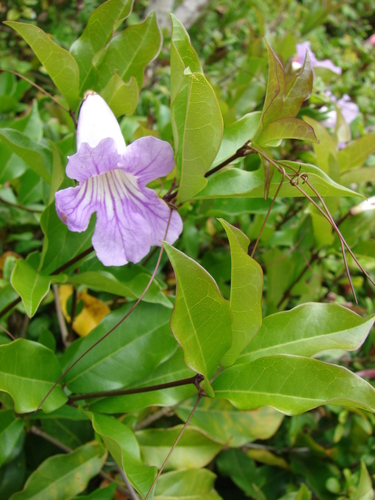
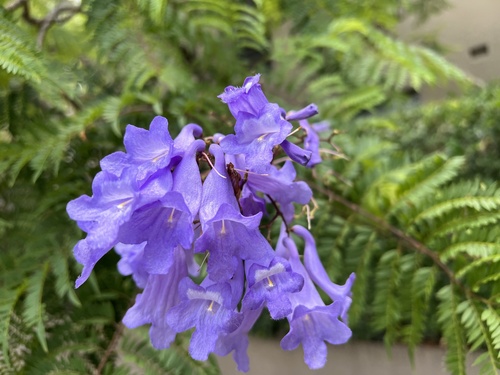
Blue jacaranda produces flowers up to 5 cm (2 in) long, grouped in panicles that reach 30 cm (12 in) across.
Flowering Period
Flowers open in spring and early summer, and remain in bloom for up to two months.
Seed Pod Characteristics
After flowering, the tree produces woody seed pods around 5 cm (2 in) in diameter, which hold many flat, winged seeds; mature pods are typically 5 to 8 cm (2 to 3 in) across.
Pod Uses
The tree’s unusually shaped, tough pods are often collected, cleaned, and used as decorations in Christmas trees and dried floral arrangements.
Leaf Cultivation Rationale
Blue jacaranda is widely cultivated for its large compound leaves, even in regions where it rarely blooms.
Leaf Morphology
Its leaves are up to 45 cm (18 in) long, bi-pinnately compound, with individual leaflets just over 1 cm (0.4 in) long.
Cultivated Variety
A white-flowered form of the tree is available for purchase from nurseries.
Native Range
Jacaranda mimosifolia is native to southern Brazil, Uruguay, Paraguay, northern Argentina (specifically the provinces of Salta, Jujuy, Catamarca, and Misiones), and southern Bolivia.
Native Habitat and Elevation
In its native range, it grows in the Dry Chaco, flooded savannas, and the Southern Andean Yungas of the eastern Andean piedmont and inter-Andean valleys, occurring up to 2600 meters in elevation.
Native Conservation Status
Within its native range, the species is threatened by uncontrolled logging and agricultural land clearing, and it is classified as Vulnerable on the IUCN Red List.
Invasive Range
It is considered an invasive species in parts of South Africa, Namibia, and Queensland, Australia, where it can outcompete native plant species.
Ornamental Cultivation Range
Blue jacaranda has been cultivated as an ornamental in nearly all frost-free regions of the world.
Cold Tolerance
Established mature trees can tolerate brief periods of temperatures as low as −7 °C (19 °F).
Frost Damage Recovery
Even if young trees are damaged by hard frost and experience dieback, they often regrow from the roots into a shrub-like, multi-stemmed form.
Coastal California Cultivation Challenges
When grown directly on the California coast, lack of heat combined with cool ocean winds discourages flowering, leading to stunted growth and poor bloom.
Horticultural Award
This plant has been awarded the Royal Horticultural Society's Award of Garden Merit.
Introduction to South Africa
Jacaranda trees were first introduced to South Africa by Baron von Ludwig around 1829, when he was establishing a botanical garden in Cape Town.
Pretoria Jacaranda Population
Pretoria, South Africa’s administrative capital, is widely known as Jacaranda City due to its large population of jacaranda trees; an estimated 65,000 trees grow in Pretoria and its surrounding areas.
Pretoria Flowering Period
In spring, the blooming trees turn the city blue and purple, with flowering occurring annually in October, far from the species’ native south-central South American range.
South African Invasive Species Management
Amid regional water scarcity, South Africa worked to remove non-native plant species including jacaranda.
South African Planting Policy
Recognizing the tree’s popularity with local residents, the government announced in the early 2000s that it would not remove existing trees, but banned planting new jacarandas.
South African Policy Reversal
This policy was reversed by 2016, and new jacaranda plantings in urban areas are now allowed in some South African provinces.
Introduction to Sydney
The first jacaranda bloomed in Sydney, Australia, around 1850.
Early Sydney Popularity
An 1865 report noted that Sydneysiders traveled to the Botanic Garden to view the tree’s “luxuriant blossom”.
Original Sydney Tree Status
As of 2023, that original tree is over 175 years old, and is protected by ropes to prevent structural collapse.
Australian Popularization
In the early 20th century, Margaret Fell, wife of John Fell, was instrumental in increasing the popularity of jacarandas in Australia.
Grafton Tree Origins
Many of the trees along Grafton’s jacaranda avenue were grown from seed collected from trees grown in the garden at the Fells’ home, ‘Rostrevor’, in Northwood.
Brisbane Cultivation
Jacarandas were first introduced to Brisbane in 1864, and the city now hosts guided tours to popular jacaranda viewing locations.
Grafton Festival
The city of Grafton, on the north coast of New South Wales, holds an annual jacaranda festival in late October and early November.
United States Cultivation Range
In the United States, jacaranda is widely grown in California, the Southwest, southeast Texas, and Florida.
California Introduction
It can be found throughout most of Southern California, where it was introduced by horticulturalist Kate Sessions.
Northern California Cultivation
Trees are also planted as far north as the San Francisco Bay Area and along frost-free coastal regions of Northern California; in San Francisco, they can only be grown in the city’s warmest microclimates, such as Potrero Hill and the Mission District.
US Popular Cultivation Locations
Phoenix, Arizona, and San Diego, California, are well known for their jacaranda trees, and the species also grows in Hawaii.
Buenos Aires Cultivation
It is one of the most common trees in Buenos Aires, the capital city of Argentina.
Mexico City Cultivation
Jacarandas can also be found across much of Mexico City, where they typically reach full bloom in March.
Spanish Mediterranean Cultivation
In Europe, jacaranda is grown along the Mediterranean coast of Spain, where it is prominent in the Valencian Community, the Balearic Islands, and Andalusia; particularly large mature specimens grow in Valencia, Alicante, and Seville, and flowering in this region usually occurs earlier than in the rest of Europe.
Additional European Cultivation Locations
The species is also grown in southern Portugal, most notably in Lisbon; southern Italy, where Naples and Cagliari host many mature specimens; southern Greece, especially Athens; and the islands of Malta and Cyprus.
Southern African Cultivation
Jacarandas are also common in many cities across Southern Africa.
Southern African Introduction Locations
They were introduced to Cape Town, followed by Johannesburg, Windhoek (Namibia), Lusaka (Zambia), Gaborone (Botswana), Nairobi (Kenya), and Harare (Zimbabwe).
South Asian Cultivation
Outside these regions, jacaranda is cultivated in Kathmandu, the capital of Nepal, and in the Indian states of Maharashtra, Madhya Pradesh, Karnataka, Kerala, and Jharkhand.
Israeli Cultivation
It is also a common sight across Israel, mainly in towns and cities of the coastal plain.
Cultural Spring Association
As noted earlier, the trees are most closely associated with spring in Pretoria (South Africa) and Harare (Zimbabwe), the two countries’ respective capitals.