About Campsis grandiflora (Thunb.) K.Schum.
Taxon Identity
Campsis grandiflora (Thunb.) K.Schum. is a deciduous woody vine.
Vine Growth Habit
Its climbing shoots reach 6 to 10 meters in length, and attach to vertical surfaces via sparsely spaced aerial roots that grow into porous materials such as the bark of supporting trees, stone, and building bricks.
Leaf Structure
Leaves are 4–13 cm long, and are imparipinnately compound, with 7–9 leaflets per leaf. Leaflet petioles measure 5 mm, and can reach up to 10 mm.
Leaflet Morphology
Leaflets range in shape from oval-ovate to oval-lanceolate, measuring 3-6 cm, sometimes up to 9 cm, long by 1.5-3 cm, sometimes up to 5 cm, wide. Leaflet surfaces are smooth, with a broadly wedge-shaped base, serrated edges, and an extended pointed tip.
Leaf Venation
Venation is palmate, with 6-7 secondary veins on each side of the midrib.
Inflorescence Structure
Inflorescences are short panicles that form at the ends of shoots, with an inflorescence axis 15–20 cm long.
Calyx Morphology
The calyx is bell-shaped, approximately 3 cm long, and dissected to half its height. Calyx lobes are lanceolate, around 1.5 cm long.
Corolla Morphology
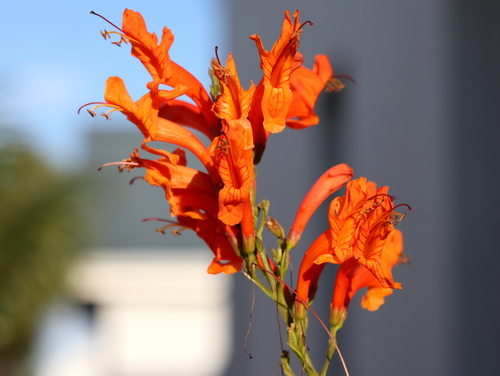
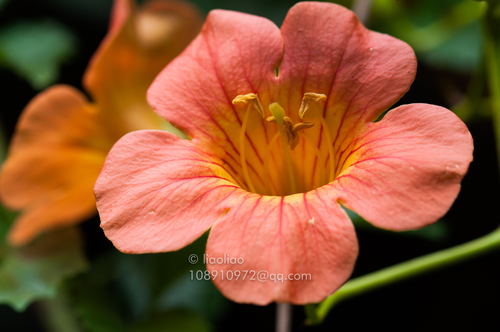
The corolla is red on the outside and orange-red on the inside, around 5 cm long, with rounded corolla limb lobes.
Flowering Period
Flowering occurs from May to August: the most active flowering wave comes at the start of this period, with individual inflorescences appearing sporadically later.
Stamen Morphology
Stamens are shorter than the corolla limb; filaments are 2–2.5 cm long, anthers are set perpendicular to filaments and are yellow.
Pistil Morphology
The pistil is linear, about 3 cm long; the stigma is compressed and divided into two lobes.
Fruit Morphology
The fruit is a capsule pod with a rounded end, 7-12 cm long.
Seed Morphology
Seeds are flat, each bearing two membranous wings.
Chromosome Count
Chromosome counts for this species are 2n = 36, 38, and 40.