About Ophisops elegans Ménétries, 1832
Taxonomic Introduction
Ophisops elegans Ménétries, 1832 has the following distinguishing characteristics.
Head Morphology
Its head is moderately sized and weakly depressed.
Upper Head Scales
Upper head scales are smooth or slightly rugose; the nostril is lateral, located between an upper nasal and a lower nasal, and followed by one or two postnasals; the frontonasal is single.
Supra-Ocular Scales
There are four supra-ocular scales, with the first and fourth very small, and the two main supra-oculars separated from the supraciliaries by a row of granules.
Occipital and Subocular Scales
The occipital scale is small, and is either in contact with or separated from the interparietal; the subocular scale borders the lip, normally sitting between the fourth and fifth upper labial scales.
Temporal and Tympanic Scales
Temporal scales are small and smooth; there are usually two large supratemporal scales bordering the parietal, plus one large tympanic shield.
Gular Fold and Collar
A gular fold may be visible, while the collar is absent or weakly defined.
Dorsal and Mid-Body Scales
Dorsal scale size is variable, and is as large as or larger than the lateral scales; there are 30 to 40 scales around the mid-body, including the ventral scales.
Preanal Plate
There is a more or less enlarged postero-median preanal plate.
Hind Limb Length
The hind limb reaches approximately the ear in males, and the shoulder or slightly beyond in females.
Femoral Pores
There are 7 to 12 (usually 9 to 11) femoral pores on each side.
Tail Length
The tail is approximately twice as long as the combined length of the head and body.
Dorsal Coloration
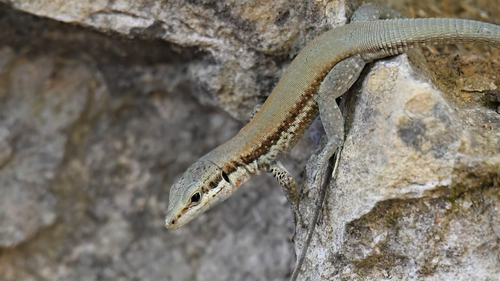
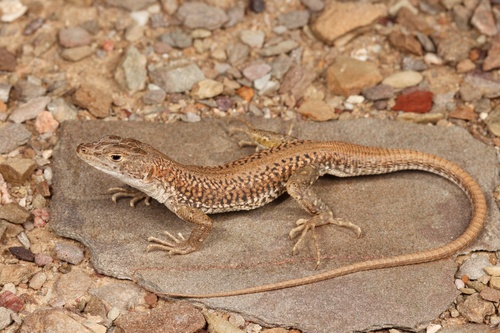
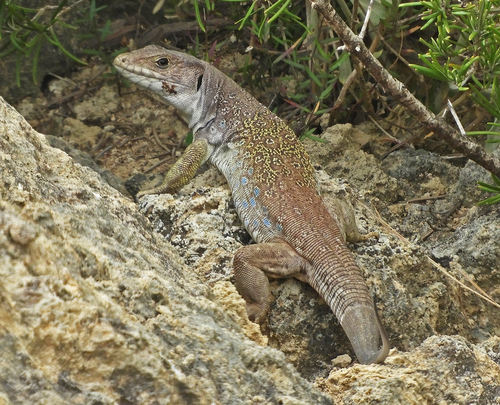
The upper body is olive or bronzy, with black spots that usually form longitudinal rows, and sometimes form a network.
Lateral and Ventral Coloration
There are often one or two light longitudinal streaks on each side of the body, and the lower body surfaces are white.
Body Size
From snout to vent, the lizard measures 2 inches (5 cm), and the tail measures 4 inches (10 cm).
Species Distribution
Ophisops elegans is found in eastern Georgia, Armenia, Azerbaijan, southeastern Bulgaria, northeastern Greece (including Lesbos, Limnos, Chios, Samos, Samothraki, Agathonisi, and Psara), Romania, Cyprus, Turkey, Algeria, Libya, Egypt, western Syria, Lebanon, Israel, western Jordan, Iraq, Iran (Kavir Desert), northern Pakistan, and northwestern India.
Recognized Subspecies
Recognized subspecies of Ophisops elegans are: O. e. basoglui from southern Anatolia; O. e. blanfordi from Pakistan; O. e. centralanatolia from central Anatolia; O. e. ehrenbergi from Kalymnos, Lesbos and surrounding areas; O. e. elegans from Turkey, including Anatolia; O. e. macrodactylus from western Turkey and Greece, including Lesbos and surrounding areas; and O. e. schlueteri from Cyprus.
Type Locality
The type locality of the species is Baku, Azerbaijan.
Habitat and Altitude Range
The preferred natural habitats of Ophisops elegans are grassland, shrubland, and forest, at altitudes ranging from 400 to 2,000 m (1,300 to 6,600 ft).
Reproduction Mode
Ophisops elegans is oviparous.