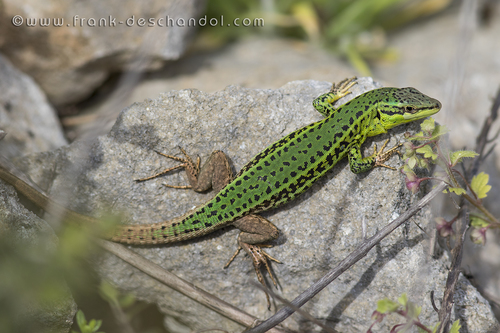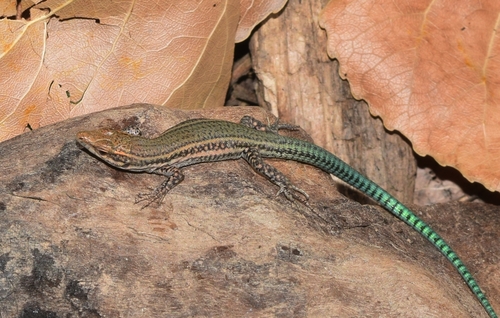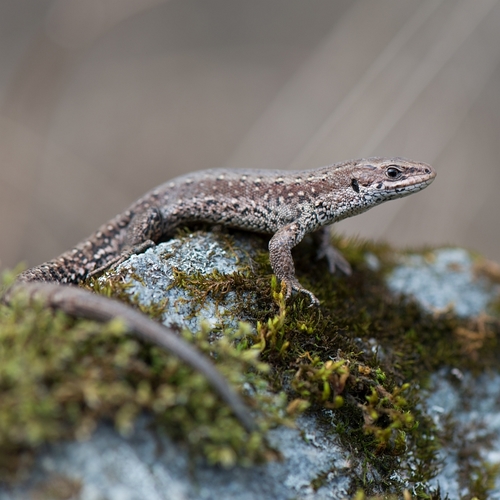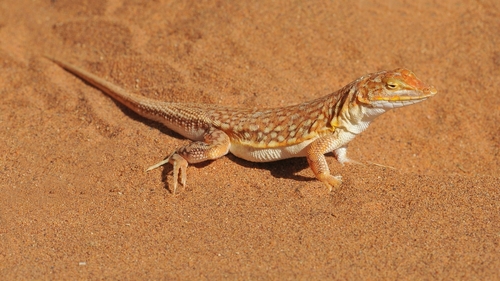
About Gallotia galloti (Oudart, 1839)
Sexual Size Dimorphism
Male Gallotia galloti are larger than females.
Male Length Measurements
Large mature males can reach a total snout-to-tail length of up to 40 centimetres (16 inches), while adult males of the G. galloti palmae subspecies reach a maximum length of only 30 centimetres (12 inches).
Male Coloration
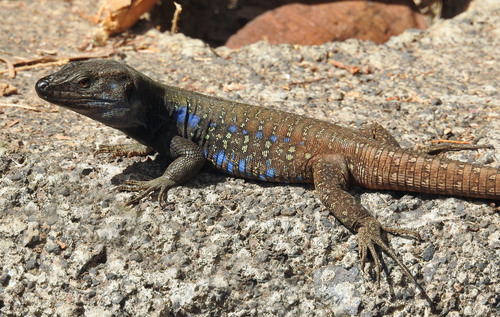
Adult males of all G. galloti subspecies have characteristic pale blue patches along the head and flanks, and sometimes also have blue spots on the body.
Clade Size Comparison
G. galloti is one of the smaller species in the Gallotia western clade; the giant species in this clade (G. auaritae, G. bravoana, G. goliath, G. simonyi, and G. stehlini) can grow to up to twice the length of G. galloti.
General Distribution and Habitat Preference
G. galloti is distributed across all habitats of the western Canary Islands, ranging from sea level up to 3,000 metres (9,800 ft) in altitude, and it prefers dry, sunny locations.
Tenerife Form Altitudinal Distribution
The northern form of G. galloti occurs at lower altitudes on north-facing slopes, while the southern form occurs above the pine forest on north-facing slopes and on southern slopes of Tenerife.
Genomic Differences Between Forms
A recent genomic study has found differences in nuclear DNA between the northern and southern forms, though these differences are only detected in a small number of genetic loci.
Subspecies Conservation Status
Because it has a very limited occurrence area, the subspecies G. g. insulanagae is classified as a vulnerable taxon.
Subspecies Population Status
However, its population is currently considered safe, as its habitat is fairly inaccessible and is protected within the Parque Rural de Anaga (Blanco & González 1992).