About Notocitellus adocetus (Merriam, 1903)
Species Naming and Relative Comparison
Notocitellus adocetus, commonly called the tropical ground squirrel, is smaller than its close relative the ring-tailed ground squirrel (Notocitellus annulatus).
Distinguishing Physical Features
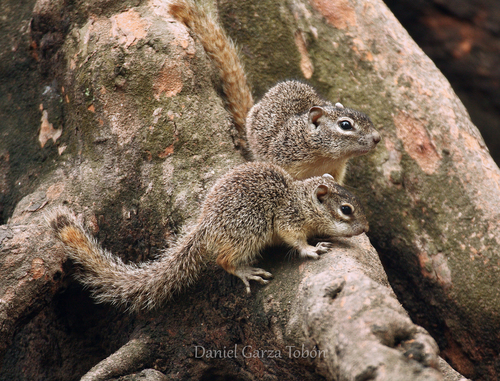
It has more rounded ears, a shorter broader snout, paler overall colouring, and an unringed tail.
Dorsal Fur Coloration
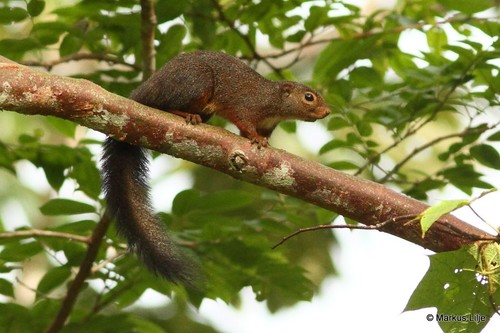
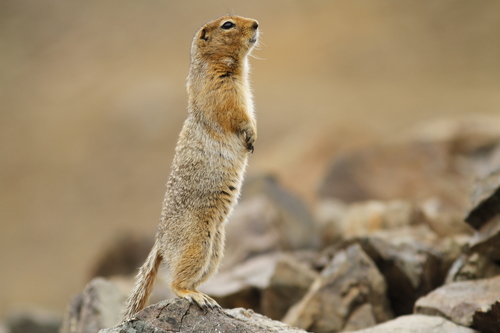
Cinnamon brown fur is interspersed with many black hairs, and the head, upper back, and bushy tail are darker than the rest of the animal’s coat.
Ventral and Facial Markings
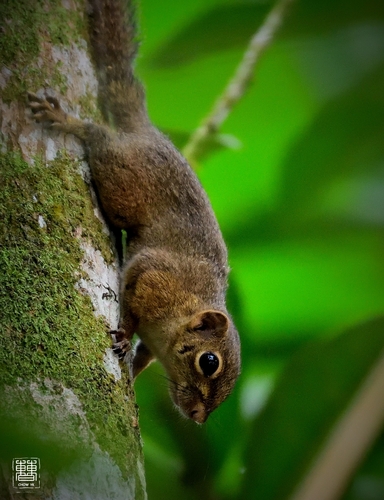
The underparts and inner surfaces of the limbs are yellowish, and faint pale streaks are present both above and below the eye.
Body Size Measurements
Females measure 168 mm (6.6 in) from head to body, with a 132 mm (5.2 in) tail; males are slightly larger.
Geographic Endemic Range
This ground squirrel is endemic to Mexico, where it occurs in the states of State of Mexico, Guerrero, Jalisco, and Michoacán.
Altitudinal Distribution
Most of its range lies within the Trans-Mexican volcanic belt, at altitudes up to about 3,000 m (10,000 ft).
Natural Habitat Characteristics
Its typical habitat is arid rocky areas including canyons and cliffs with sparse vegetation, mesquite, barrel cacti, and deciduous woodland.
Agricultural Habitat Adaptation
Parts of its native habitat have been converted to low-intensity agricultural use, and this species has adapted to the land use change by feeding on crops.
Activity Pattern
The tropical ground squirrel is a social, diurnal species that is active for most of the year.
Burrow Characteristics
It digs complex burrows up to 60 cm (24 in) deep, positioning them under walls or rocks, or at the base of trees.
Primary Diet Components
It is omnivorous, but its diet consists mainly of seeds and fruits, particularly those of Acacia, Prosopis, Prunus, and Crescentia.
Agricultural Feeding Habits
It also consumes green shoots, and on agricultural land it feeds on maize, sorghum, and beans.
Foraging Behavior
Most foraging occurs in the morning between 9:00 and 11:00; the squirrel stuffs gathered food into its cheek pouches and carries it back to the burrow to eat later.
Aestivation Behavior
When food is scarce during the hottest part of the year, this species may enter a short period of aestivation.
Breeding Timing
Populations living on farmland may breed year-round, but populations in deciduous woodland likely breed between May and June, before the wet season begins.
Population Dynamics
Population size fluctuates substantially from year to year.
Human Interaction Behavior
In remote areas, the tropical ground squirrel is shy, but populations living near humans become habituated and bolder.
Antipredator and Vigilance Behavior
Individuals will scamper away when humans approach, watch human activity while perched on walls, or take shelter in crevices and peer out.
Captive Diet
While it feeds mainly on seeds and fruits in the wild, captive individuals can eat corn, meat, lettuce, tortillas, and bread.
Feeding Posture
When feeding, it sits on its haunches and uses its front feet to push food into its mouth.