About Heliosciurus rufobrachium (Waterhouse, 1842)
Common Name and Taxonomic Classification
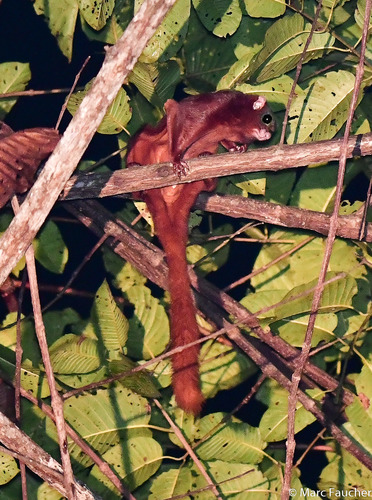
Heliosciurus rufobrachium, commonly known as the red-legged sun squirrel, is a medium-sized squirrel species.
Size and Sexual Dimorphism
On average, individuals measure 24 centimetres (9.4 in) from head to body and weigh 353 grams (12.5 oz), with males being slightly larger than females.
Distinctive Physical Features
This species has large eyes, small rounded ears, and a tail that is roughly equal in length to the combined length of the head and body.
Coloration
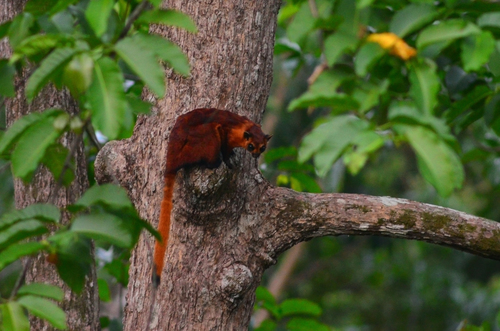
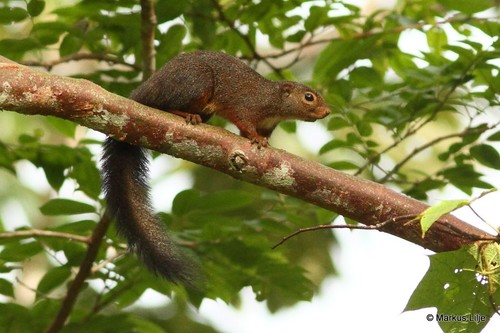
Its body fur ranges from dark brown to grey, while the limbs and muzzle are reddish, and the tail is black.
Female Reproductive Morphology
Females have three pairs of teats: two located on the chest, and four positioned much further back on the rear abdominal region.
Brain Size Comparison
Compared to other similar-sized African squirrels, the red-legged sun squirrel has a slightly smaller brain than expected.
Geographic Range
The red-legged sun squirrel ranges across sub-Saharan Africa, occurring from Senegal and Gambia in the west to Kenya in the east, and is not found south of the Congo River.
Primary Habitat Types
It occupies habitats that contain large climbable trees, including moist primary and secondary forests, plantations, areas of savannah with isolated trees, and gardens.
Additional Recorded Habitat
It has also been recorded in Avicennia mangrove swamps in Sierra Leone.
Recognized Subspecies
Currently, 21 subspecies are recognised: H. r. rufobrachium from Bioko, H. r. arrhenii from Rwanda, H. r. aubryi from Gabon, H. r. benga from Equatorial Guinea, H. r. caurinus from Gambia, H. r. coenosus from western Democratic Republic of the Congo, H. r. emissus from northern Cameroon, H. r. hardyi from Côte d'Ivoire, H. r. isabellinus from Nigeria, H. r. keniae from western Kenya, H. r. leakyi from eastern Kenya, H. r. leonensis from Sierra Leone, H. r. lualabae from central Democratic Republic of the Congo, H. r. maculatus from Ghana, H. r. medjianus from northeastern Democratic Republic of the Congo, H. r. nyansae from Uganda, H. r. obfuscatus from southern Nigeria, H. r. occidentalis from Senegal, H. r. pasha from northern Democratic Republic of the Congo, H. r. rubricatus from central-eastern Democratic Republic of the Congo, and H. r. semlikii from eastern Democratic Republic of the Congo.
Activity Pattern and Foraging Strata
The red-legged sun squirrel is diurnal, and forages in the upper and middle tree storeys of large trees.
Core Diet Components
Its diet is primarily made up of fruits and seeds, but it also consumes some green vegetation and arthropods.
Foraging Behavior for Arthropods
It spends much of its foraging time moving along branches and probing crevices to find insects and their larvae.
Captive Feeding Observations
In captive settings, these squirrels have been observed catching and eating birds introduced into their enclosures, and also consuming bird eggs.
Social Behavior
Individuals are usually seen alone or in pairs, but the species is considered gregarious, as they have been observed grooming one another and resting side by side.
Nest Construction
They build nests inside holes in tree trunks and branches, lining these cavities with twigs that still have their green leaves attached.
Breeding Pattern
Breeding occurs twice per year, and each litter typically produces two young.