About Urocitellus parryii (Richardson, 1825)
Fur Coloration Base
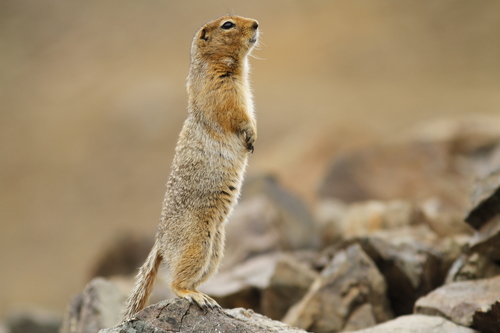
Urocitellus parryii, commonly known as the Arctic ground squirrel, typically has beige-tan fur with lightly spotted backs. Like related prairie dogs, it has a shorter face and smaller ears than most arboreal squirrels, an adaptation to its burrowing lifestyle. It also has a dark tail and distinct white markings around its eyes.
Annual Molting Cycle
Arctic ground squirrels go through an annual molt cycle each short boreal summer to prepare for cold weather, a seasonal coat change also seen in other Arctic species including Arctic foxes, Arctic hares, snowshoe hares, stoats (ermine), and rock ptarmigan. Their summer coats have reddish and yellow coloring along the cheeks and sides of the body. In fall, these red patches are shed and replaced with fur that has a more silvery tone.
Winter Coat Function
The lighter winter coat helps Arctic ground squirrels camouflage against snow-covered ground to evade predators such as snowy owls and foxes. On average, Arctic ground squirrels measure approximately 39 cm (15 in) in total length. It is hard to provide an average body mass, as the species experiences dramatic seasonal changes in weight.
Adult Body Weight
Adult females typically weigh close to 750 g (26 oz), while adult males are nearly 100 g (3.5 oz) heavier. The Arctic ground squirrel is distributed across western northern North America and the Russian Far East. Its range extends from the Arctic Circle in western Northern Canada, covering Yukon, northern British Columbia, and the Northwest Territories, west into Alaska, the Alaska Peninsula, and the Aleutian Islands archipelago, and across into Siberia (the Russian Far East) including the Kamchatka Peninsula.
Subspecies Distribution
The U. p. lyratus subspecies, native to St. Lawrence Island, is found only on that namesake island in the Bering Sea, while the U. p. kodiacensis subspecies is found only on Kodiak Island. This species evolved on and inhabits the North American Arctic tundra.
Preferred Habitat Types
Preferred habitats vary by subspecies, and most commonly include hillsides, mountain slopes, riparian areas such as river flats, river banks, and lake shores, and tundra ridges. Arctic ground squirrels favor sandy soil because it is easy to dig for burrows and has better drainage than richer, heavier soils.
Burrowing Requirements
They dig shallow tunnels and burrows in spots where permafrost will not block their digging. More southerly subspecies usually live in open meadows and open tundra habitats.
Mating Season Behavior
During mating season, male Arctic ground squirrels fight in aggressive male-male encounters to win mating rights. The species lives individually in separate burrow systems.
Mating Timing
Mating takes place between mid-April and mid-May after winter hibernation, with the exact timing varying based on latitude. Litters are typically sired by multiple males as a result of male-male competition for access to females.
Reproduction and Pup Development
Gestation lasts approximately 25 days, and produces a litter of 5 to 10 hairless pups that each weigh around 10 g (0.35 oz). Pups are weaned after six weeks, and then go through rapid growth to prepare for the coming winter.