About Petaurista petaurista (Pallas, 1766)
Taxonomic Identity
The red giant flying squirrel, also known as the common giant flying squirrel, scientific name Petaurista petaurista, is a rodent species belonging to the squirrel family Sciuridae.
Distribution and Habitat
It inhabits a wide range of forest types, plantations, and more open habitats with scattered trees across Southeast Asia, extending north to the Himalayas and southern and central China.
Size Status
This is one of the largest arboreal squirrels.
Coloration
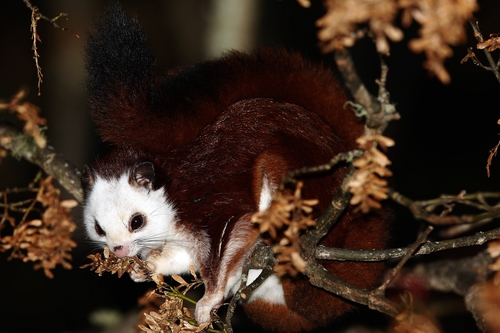
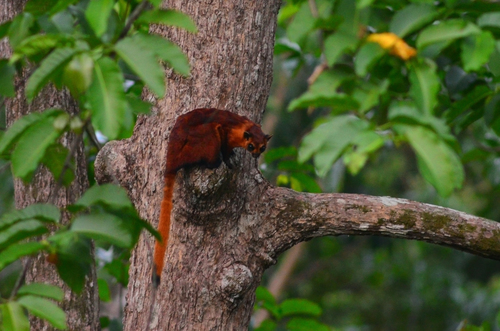
All populations have at least some reddish-brown fur on their upper body and pale fur on their underparts, but there is significant geographic variation in overall coloration.
Taxonomic Uncertainty
While the taxonomic position of populations in the Sundaic region is generally agreed upon, there is considerable uncertainty about the classification of other populations.
These uncertain populations have variously been included in this species, assigned to other species, or recognized as distinct separate species.
Activity Pattern
Like other flying squirrels, the red giant flying squirrel is mostly nocturnal.
Gliding Ability
It cannot fly like a bat, but it is able to glide long distances between trees by spreading its patagium, the stretch of skin between its limbs.
Diet
It is a herbivore.
Reproduction
Females produce one young per litter, and two young are rarely produced.
Conservation Status
Although local populations have declined due to habitat loss, and to a lesser extent hunting, the species remains common overall and is not considered threatened.
Overall Size
The red giant flying squirrel is among the largest flying squirrels and the longest squirrels.
Morphometric Measurements
It has a head-and-body length of 28.5–55 cm (11 in – 1 ft 9.5 in), a tail length of 34–63 cm (1 ft 1.5 in – 2 ft 1 in), and weighs approximately 990–3,200 g (2.2–7.1 lb).
Sexual Size Dimorphism
Within any given region, males are generally somewhat smaller than females, at least in terms of weight.
Geographical Appearance Variation
Its appearance varies considerably based on subspecies and location.
Subspecies Classification
Broadly, it can be divided into several subspecies groups.
Some of these groups have variously been treated as part of this species, as part of other species including the Indian giant flying squirrel (P. philippensis), the red and white giant flying squirrel (P. alborufus), or the spotted giant flying squirrel (P. elegans), or recognized as separate species of their own.
Historical Taxonomy
Up until the 1980s, some authorities even classified the Indian giant flying squirrel itself as a subspecies of the red giant flying squirrel.