About Nephrurus levis De Vis, 1886
Species Naming & Head Morphology
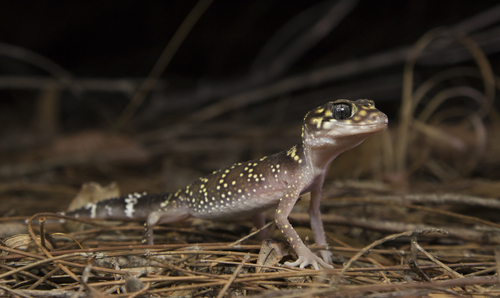
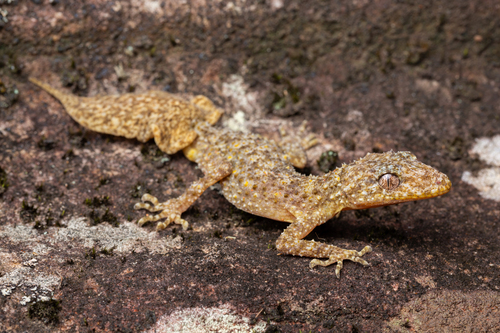
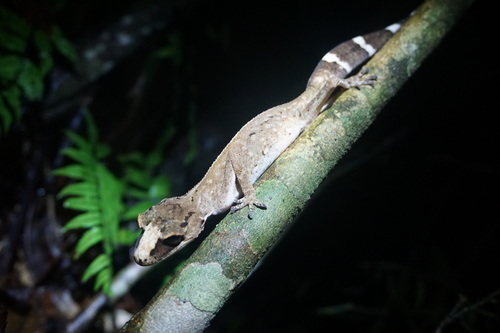
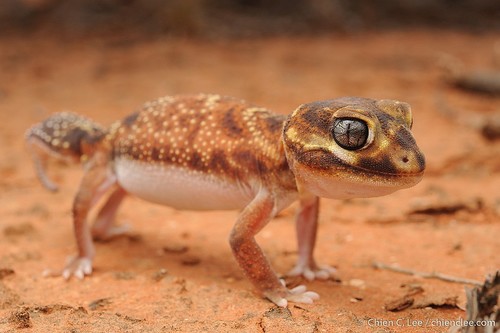
Nephrurus levis De Vis, 1886 is a robust, medium-sized gecko with a large triangular head.
Tail Morphology
It has a short, flattened, carrot-shaped tail that ends in a knob. This tail can be shed through autotomy to distract predators, but unlike many other lizards, this species only has one cleavage point at the base of the tail, meaning the entire tail must be sacrificed when it is shed.
Limb Structure
It has long slender limbs, non-retractile claws on its digits, and the outermost digit is opposable.
Sensory Organ Morphology
This gecko has vertically slit ears located at the widest part of its head, and very large eyes with vertical pupils.
Dorsal Coloration
On its dorsal side, its base colour generally ranges from pinkish-grey to purplish-brown, with a unique pattern of darker and lighter spots, bars, or lines.
Ventral Coloration
Its underbelly is white.
Skin Tubercles
The body and tail of N. levis are covered in pale and dark tubercles that often form bands.
Etymology of Species Epithet
The species epithet levis, meaning smooth, refers to the smoothness of this species' skin compared to N. asper, whose epithet asper means rough.
Snout-Vent Length
Generally, N. levis measures 8–10 centimetres (3.1–3.9 in) from snout to vent.
Original Tail Length
An original, undropped tail is usually around 2 centimetres (0.79 in) long.
Sexual Dimorphism & Lifespan
Males are typically smaller than females, and both sexes can live up to 15 years in captivity.
General Distribution
Smooth knob-tailed geckos are distributed across the arid interior of Australia. They occur in all Australian mainland states and territories except Victoria and the Australian Capital Territory.
South Australia Range
They are widespread across South Australia, ranging as far south as Adelaide.
Range Extremes
Their range extends as far north as Tennant Creek in the Northern Territory, as far east as Bourke in New South Wales, and as far west as Western Australia's coastline.
Habitat Types
The smooth knob-tailed gecko occupies a wide range of habitats, including arid areas, semiarid areas, open woodland, arid scrubs, spinifex-covered deserts, sand-plains, and dune-fields.
Breeding Season
The species' breeding season falls between October and March, the warmer months of the year.
Clutch Frequency
Females can produce 6 or 7 clutches of eggs per breeding season.
Mating Receptivity Behaviors
When ready to breed, receptive females display specific behaviours that allow males to mate with them. Non-receptive females will either stand their ground and attack males, or run away from approaching males.
Egg Deposition Interval
After mating, egg deposition occurs roughly 4 to 6 weeks later, though this interval can take up to 9 weeks.
Egg Incubation Period
Eggs then take approximately 6 to 8 weeks to hatch.
Clutch Size
Most clutches contain 2 eggs, single-egg clutches are rare.