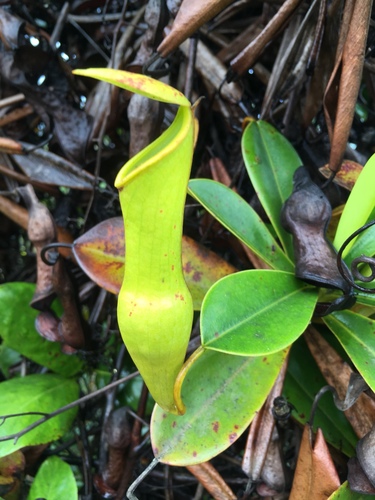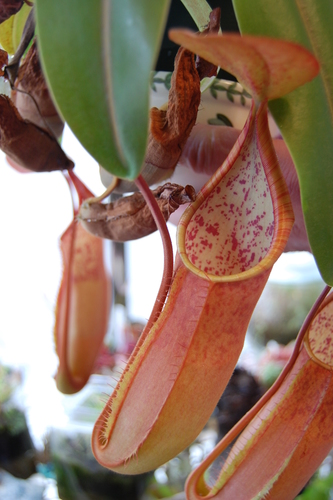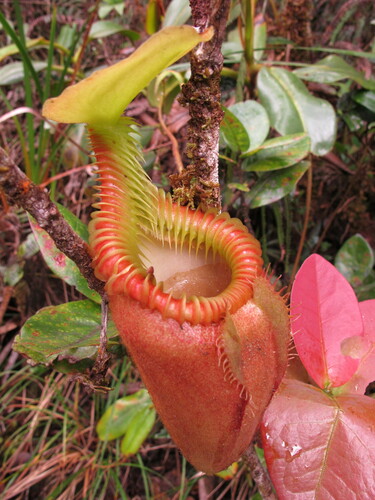
About Nepenthes villosa Hook.fil.
Taxon Naming and Growth Habit
Nepenthes villosa Hook.fil. is a weak climbing pitcher plant that rarely grows taller than 60 cm (24 in), though its stem can reach 8 m (26 ft) in length and 10 mm (0.4 in) in diameter. Its cylindrical internodes grow up to 10 cm (4 in) long.
Leaf Characteristics
Leaves are coriaceous (leathery) and petiolate (stalked). The leaf blade (lamina) is spathulate to oblong, reaching up to 25 cm (10 in) long and 6 cm (2.4 in) wide, with an emarginate apex. The petiole is grooved, up to 10 cm (3.9 in) long, and has an amplexicaul sheath that wraps around the stem.
Leaf Veins and Tendrils
One to three longitudinal veins sit on either side of the leaf midrib, and tendrils can grow up to 50 cm (20 in) long.
Pitcher Shape and Size
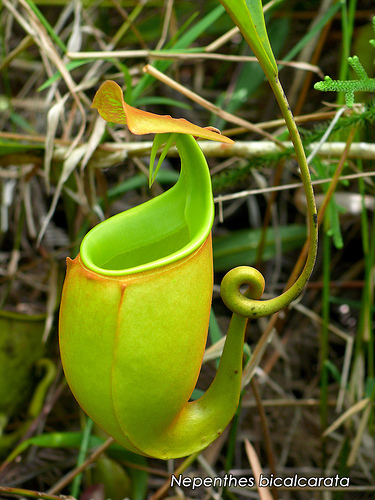
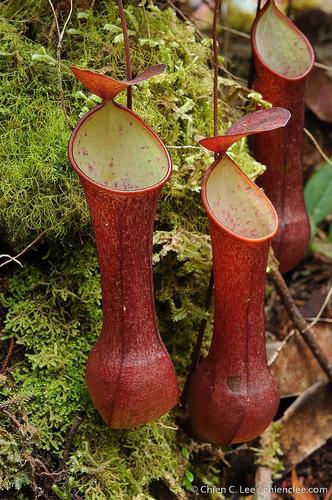
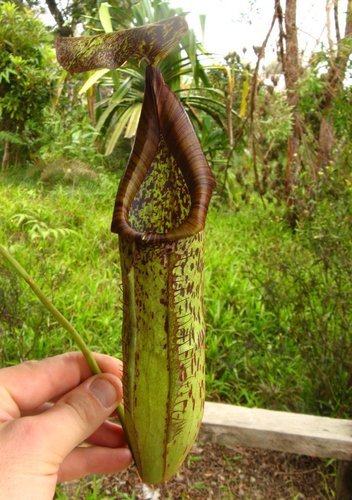
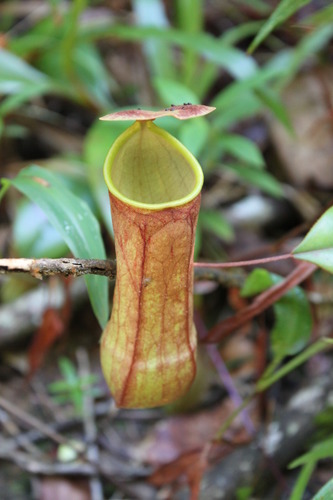
Lower and upper pitchers of N. villosa are very similar in shape, ranging from urceolate (urn-shaped) to ovate. Pitchers can grow up to 25 cm (10 in) high and 9 cm (3.5 in) wide.
Pitcher Wings
A pair of fringed wings, up to 15 mm wide, runs down the front of the pitcher, though these may be reduced to ribs on aerial upper traps.
Pitcher Mouth and Inner Glands
The pitcher mouth is oblique and elongated into a neck at the rear. Glands on the pitcher's inner surface are overarched, occurring at a density of 200 to 1,300 per square centimeter (30 to 200 per square inch).
Pitcher Peristome
The peristome (rim of the pitcher) is cylindrical in cross-section, up to 20 mm (0.8 in) wide, and bears well-developed ribs and teeth.
Pitcher Lid and Spur
The pitcher lid (operculum) is heart-shaped with a pointed apex, and has a pair of prominent lateral veins. An unbranched spur, up to 20 mm (0.8 in) long, grows at the base of the lid.
Inflorescence Structure
This species has a racemose inflorescence. The inflorescence peduncle can be up to 40 cm (16 in) long, while the rachis reaches 20 cm (8 in) in length.
Inflorescence Parts
Pedicels are filiform with small bracts, growing up to 15 mm (0.6 in) long. Sepals are round to elliptic, reaching up to 4 mm (0.2 in) long.
Pollen Morphology
A study of 490 pollen samples from two herbarium specimens collected at 1,800–3,400 m (5,900–11,200 ft) found a mean pollen diameter of 37.2 μm, with a standard error of 0.2 and coefficient of variation of 6.7%.
Indumentum
The entire plant is covered in a dense covering of long, brown hairs.
Endemic Range
In terms of ecology, Nepenthes villosa is endemic to the upper slopes of Mount Kinabalu and neighbouring Mount Tambuyukon in Sabah, Borneo. It generally grows at 2,300–3,240 m above sea level, a higher elevation than any other Bornean Nepenthes species; only New Guinea's N. lamii grows at greater elevations.
Mount Kinabalu Distribution
On Mount Kinabalu, N. villosa is common along the Mesilau Trail, between Pondok Magnolia and the junction with the old summit trail, and grows almost all the way up to the Laban Rata rest house; a particularly large population is reported at around 3047 m elevation.
Mount Tambuyukon Distribution
On Mount Tambuyukon, an altitudinal inversion has been observed: N. villosa is more common at much lower elevations of 1600–1900 m, and is replaced by N. rajah closer to the summit. The exposed uppermost slopes of Mount Tambuyukon get very hot during the day, which may explain why N. villosa cannot colonize these areas. Plants from Mount Tambuyukon typically produce slightly more elongated pitchers.
Habitat Vegetation
N. villosa often grows in mossy forest and sub-alpine forest dominated by species from the Dacrydium and Leptospermum genera, especially Leptospermum recurvum. It has also been recorded growing among shrubs, grass, and boulders in open areas.
Habitat Microclimate and Soil
In these open areas the soil can become relatively dry, but relative humidity is usually close to 100% because the slopes are often shrouded in clouds. Like many Nepenthes from the Mount Kinabalu area, it is restricted to ultramafic soils.
Legal Protection Status
While many plants grow along Mount Kinabalu's summit trail and are easily accessed by climbers, all known populations of this species grow inside Kinabalu National Park, so collection of wild plants is illegal. In 1997, Charles Clarke suggested a revised conservation status of Conservation Dependent based on this situation.
Population Threats
Clarke noted that N. villosa "has a secure future", but added that climber activity has had a significant impact on populations growing along the summit trail, and the number of plants has declined in recent decades.
Population Survey Data
A 2002 study counted 1,180 individual N. villosa in eleven 0.01-hectare plots at elevations between 2,610 m (8,560 ft) and 2,970 m (9,740 ft) on Mount Kinabalu. This count made up 94% of all pitcher plants recorded in the plots, with the remaining 6% being N. × kinabaluensis.
Cultivation Research
Regarding cultivation, in 2004 professional horticulturist Robert Sacilotto published a summary of measured tolerances for six highland Nepenthes species, including N. villosa, based on experiments run between 1996 and 2001.
Cultivar Origin
Most N. villosa plants in cultivation today descend from a particularly vigorous tissue culture clone introduced by Phill Mann of Australia, later sold by Sri Lankan plant nursery Borneo Exotics.