About Nepenthes albomarginata Lobb ex Lindl.
Species Identity
Nepenthes albomarginata Lobb ex Lindl. is a climbing pitcher plant.
Stem Characteristics
Its stem can grow up to 4 metres (13 ft) long and reach 5 millimetres (0.20 in) in diameter. Internodes are cylindrical in cross section and grow up to 15 centimetres (5.9 in) long.
Leaf Texture and Shape
Leaves have a coriaceous texture; the leaf blade (lamina) is lanceolate-shaped, reaching up to 25 centimetres (9.8 in) long and 2 centimetres (0.79 in) wide. The leaf blade has an acute apex, with a base that gradually tapers and clasps the stem.
Leaf Petiole and Veins
A defining characteristic of this species is that its leaves completely lack a petiole. Longitudinal veins on the leaves are indistinct, and leaf tendrils grow up to 20 centimetres (7.9 in) long.
Lower Pitcher Shape and Size
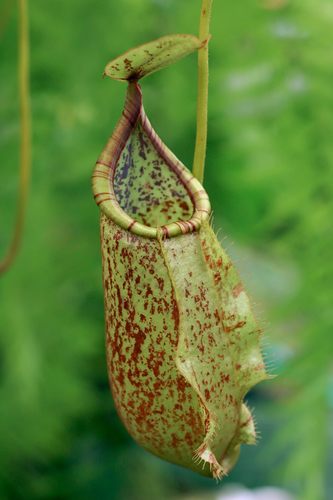
Rosette and lower pitchers are bulbous in their basal third and cylindrical above. These pitchers are relatively small, reaching only 15 centimetres (5.9 in) high and 4 centimetres (1.6 in) wide.
Lower Pitcher Wings and Mouth
A pair of fringed wings, up to 5 millimetres (0.20 in) wide, runs down the front of each pitcher. The pitcher opening (mouth) is round and rises into a short neck at the rear.
Peristome Structure
The peristome (ribbed rim of the mouth) is cylindrical in cross section, up to 2 millimetres (0.079 in) wide, and bears indistinct teeth. The inner portion of the peristome makes up approximately 34% of its total cross-sectional surface length.
Peristome Trichomes
A dense band of short white trichomes sits directly below the peristome; this band may be absent from pitchers that have caught termites. The glandular region of the pitcher covers the bulbous portion of the inner surface.
Pitcher Lid and Spur
The pitcher lid (operculum) is suborbicular and has no appendages. An unbranched spur no longer than 3 millimetres (0.12 in) is inserted near the base of the lid.
Upper Pitcher Features
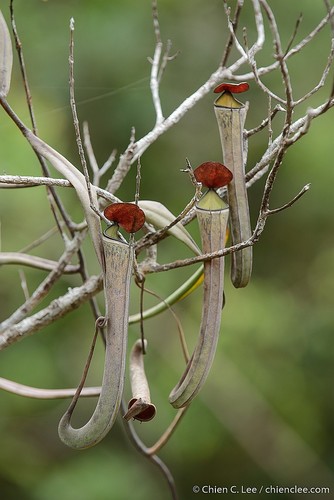
Upper pitchers are similar to lower pitchers in most features, but they are cylindrical to funnel-shaped along their entire length and have a pair of ribs instead of wings.
Inflorescence Type
This species produces a racemose inflorescence, which is typically longer on male plants than on female plants.
Inflorescence Stem Dimensions
The peduncle of the inflorescence grows up to 25 centimetres (9.8 in) long, while the central rachis can reach up to 40 centimetres (16 in) in length.
Flower Peduncles and Sepals
Partial peduncles bear one or two flowers, grow up to 30 millimetres (1.2 in) long, and do not have a bract. Sepals are obovate to oblong in shape and grow up to 4 millimetres (0.16 in) long.
Pollen Characteristics
A study of 120 pollen samples taken from a Bornean herbarium specimen collected at 0–30 metres (0–98 ft) altitude found the mean pollen diameter to be 31.8 μm (0.00125 in), with standard error 0.4 and coefficient of variation 6.2%.
Hair Covering
Most parts of the plant are covered in a dense covering of very short, stellate white hairs, though the underside of the leaf blade bears a dense covering of longer hairs.
Species Distribution
Nepenthes albomarginata is widespread across Borneo, Peninsular Malaysia, and Sumatra, and also occurs on smaller islands including Nias and Penang.
Altitudinal Range
It grows from 0 to 1200 m above sea level.
Habitat Types
Its most typical habitat is kerangas forest, but it has also been recorded growing in the summit vegetation of lowland peaks.
Substrate Preferences
It is found growing on both peat and limestone substrates.