About Neotoma floridana (Ord, 1818)
Common and Scientific Name
This species, commonly called the eastern woodrat, has the scientific name Neotoma floridana (Ord, 1818).
Size Measurements
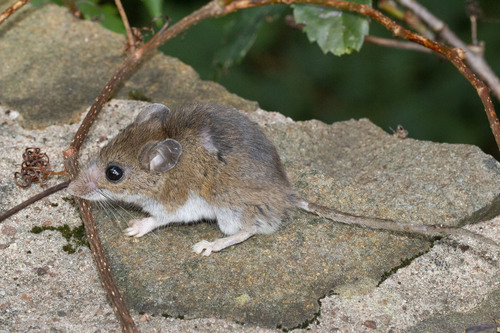
It is a medium-sized rodent with an average length of 21.2 centimeters (8.3 inches) and average weight of 245 grams (0.540 pounds), and can grow up to 17 inches (43 cm) long. It has a short, stocky body and an exceptionally long tail that measures 15–20 centimeters (5.9–7.9 inches).
Coat Coloration
Its coat is soft, gray-brown pelage that is darker on its dorsal side, with white bellies and white feet. The sexes look similar, although males tend to be slightly larger than females.
General Distribution
The eastern woodrat's distribution covers the Southeastern and Midwestern United States. Its range extends as far south as the Tennessee River and Central Florida, with central populations in Kentucky and Tennessee.
Northern Distribution
Northern populations occur in Kansas, central Missouri, and southern Illinois. It is also found along the Appalachian Mountains all the way to New York, and in some western locations and Piedmont areas of Maryland.
Broad Habitat Types
It can be found in woodlands, prairies, mountains, swamps, and lowland hardwood forests as far west as Colorado. Disjunct populations occur in Nebraska and Key Largo, Florida.
Additional Habitat Locations
It is also found in marshes, coastal plains, and grasslands. Geographically, its habitat ranges latitudinally from central Florida to southeastern New York, and longitudinally from Connecticut to eastern Colorado.
Reintroduction Efforts
Reintroduction projects took place in northeastern states such as Illinois during the 2010s. Though it has a wide range, the species has low population density and is considered uncommon.
Population Trend
Its overall population has been decreasing since 1982. The primary cause of this decline in the southeastern United States is habitat destruction from human development of coastal plains.
Fossil Record
Fossil remains of the species have been recovered from late Pleistocene deposits in southeastern New Mexico, several hundred miles southwest of its nearest current range.
Hibernation Behavior
The eastern woodrat does not hibernate, even at the northern extremes of its range. The species inhabits wooded areas, swamps and hedges, and different recognized geographic subspecies have different reported habitat preferences.
Nest Placement Locations
Nests can be located in and around rocky bluffs, upland woods, swamps, hammocks, dry scrub pine, grasslands, abandoned buildings, marshes, and refuse piles. In Texas, they are mostly found around brush piles; in Kansas, they are often found around hilltop limestone, the base of trees, standing hollow trees, and under root tangles along gullies.
Regional Nest Observations
They have recently been found around willow trees in Florida. Eastern woodrats prefer habitats that let them quickly cover and escape from predators.
Nest Construction Materials
Nests are constructed from a wide variety of materials, including sticks and branches, rocks, dry dung, tin cans, and glass shards, and are lined with dry grass, crushed bark, bird feathers, rotting wood, acorn fragments, and loose soil. Individuals carry smaller items in their mouth and drag larger items, depending on the item's size.
Nest Structural Features
While nests only have one visible entrance, they contain multiple escape routes. Each nest structure holds up to 2 individual nests, and usually only one eastern woodrat occupies each home.
Nest Size Dimensions
Nest structures can be up to 4 meters (13 feet) in length, 2 meters (6.6 feet) in width, and more than 1 meter (3.3 feet) in height. Their shape depends on location, and may be pyramidal, conical, or domed if sufficient structural support is available.
Nest Elevation
Nests may be found up to 8 meters (26 feet) above ground in trees or vines, but are normally located at ground level. These nest structures provide effective shelter from temperature fluctuations and rain.
Nest Occupation
Individual eastern woodrats stay in one location for their entire lives, and multiple generations can inhabit the same nest. Unoccupied nests are frequently taken over by other animals, including rabbits, mice, snakes, amphibians, and various invertebrates.
Territoriality
Eastern woodrats are typically solitary, and there is usually a buffer zone between individual territories. Females have smaller territories than males, averaging around 0.17 hectares (0.42 acres).
Territory Size
Male territories average around 0.26 hectares (0.64 acres), and the species-wide average territory area is 662 square meters (7,130 square feet). Because they are solitary, eastern woodrats usually do not stray more than 21 meters (69 feet) from their nests unless they are sexually active or seeking preferred food.
Intraspecific Aggression
Eastern woodrats are aggressive towards other members of their species. Older individuals will chase and fight younger woodrats, and the species only becomes social during breeding season.
Breeding Season Timing
The timing of the breeding season depends on climate: populations in warmer climates such as Florida and Georgia can reproduce year-round, while populations at higher latitudes such as Kansas and Nebraska breed from early spring to mid fall. The female estrous cycle lasts between 3 and 8 days, and gestation lasts between 32 and 38 days.
Litter and Reproductive Frequency
Each litter produces one to six young, and females can become pregnant again just one week after giving birth. Females can have up to three litters per year, with two litters being normal.
Sexual Maturity
Females can sometimes reproduce in their first year, as they reach sexual maturity earlier than males. Only females care for the young.
Mating Behavior
When females and males encounter each other, they fight. If the male wins, copulation occurs; if the female wins, the male is usually killed during the fight.
Neonatal Characteristics
Pups are born with closed eyes, a limited amount of hair, and are immediately attached to the mother's teat. Most of their pelage has grown in by day 8.
Juvenile Development Milestones
On the 15th day after birth, their hair is fully grown and their eyes are fully open. Young are weaned after 3–4 weeks and become independent after 70–90 days.
Growth and Mating Age
Juveniles continue growing until they are about 8 months old, and females can start mating as young as 5 months old. In captivity, eastern woodrats have been recorded to live up to 8.6 years; the average lifespan in the wild is 3 years.
Survival Rates
Most eastern woodrat deaths occur within the first year of life. One field study in Kansas tracked 27 individuals: six survived to adulthood, and only three lived long enough to reproduce.