About Brachyurophis australis (Krefft, 1864)
The eastern shovel-nosed snake, also called the coral snake in this description, is scientifically known as Brachyurophis australis (Krefft, 1864).
Snout Features
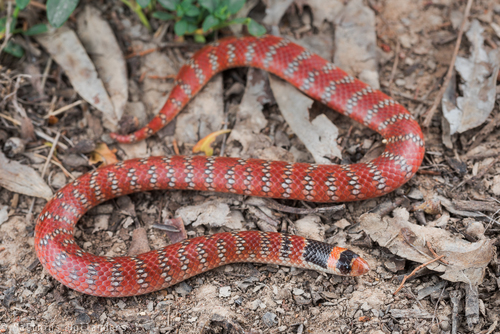
It is a small snake with an upturned blunt snout.
Dorsal Coloration
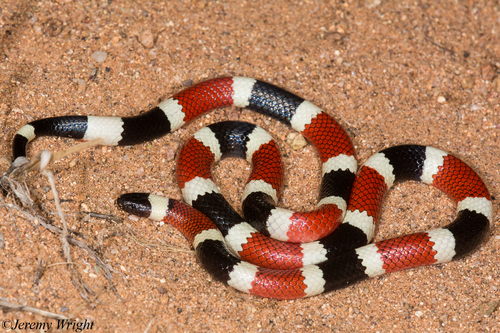
The dorsal surface of its body ranges from pink or orange to reddish-brown, marked with irregular narrow cross-bands that are cream-colored with dark edges.
Head and Nape Markings
It has two large dark bands: one across its head, and the other across its nape.
Ventral Coloration
Its underside is whitish.
Size
On average, this species reaches 30 centimetres (12 inches) in length, with a maximum recorded length of 45 centimetres (18 inches).
Distribution States
Brachyurophis australis is distributed across eastern Australia, occurring in South Australia, Victoria, inland New South Wales, and Queensland.
Range Extent
Its range extends from central to eastern South Australia, north-western Victoria, and most of New South Wales east of the Great Dividing Range, stretching north into Queensland as far as Townsville.
Coastal Distribution
It can also be found along the coast in north-eastern New South Wales and south-eastern Queensland.
Habitat Preferences
This snake prefers habitats including open woodland, grassland, and arid scrub associated with mulga, brigalow, and mallee plant communities, growing on heavy clay, rocky, or sandy soils.
Behaviour
It is a burrowing species, and can typically be found under rocks, logs, or leaf litter during the day.
Reproduction
The eastern shovel-nosed snake is oviparous, and lays clutches of 4 to 6 eggs per reproductive event.