About Micruroides euryxanthus (Kennicott, 1860)
Adult Size
Adults of Micruroides euryxanthus reach a total length of 11–24 inches, which equals 28–61 centimeters.
Body Color Pattern
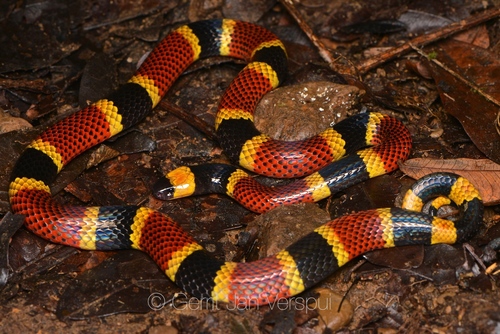
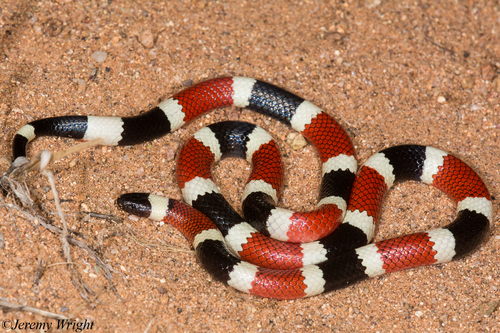
This species has a color pattern made up of broad alternating red and black rings, which are separated by narrower rings of white or yellow. The markings become paler as they approach the belly.
Head Markings
The head is black, with this black color extending all the way to the posterior border of the parietal scales.
Dorsal Scale Features
Its smooth dorsal scales are arranged in 15 rows at midbody.
Ventral and Subcaudal Scales
It has 214–241 ventral scales, a divided anal plate, and 21–34 divided paired subcaudal scales.
Differences from Micrurus fulvius
Micruroides euryxanthus resembles Micrurus fulvius, but can be distinguished by several features: its white or yellow rings are broader than those of M. fulvius, it has fewer black rings on the tail, usually only 2, and the first body ring (the first ring behind the white or yellow ring on the back of the head) is red, while this ring is black in Micrurus fulvius.
Habitat and Elevation Range
This species occurs in arid and semiarid regions across a range of habitat types, including both plains and lower mountain slopes, at elevations from sea level up to 5,800 ft (1,800 m). In Arizona, it is abundant in rocky upland desert.
Geographic Distribution
Its geographic range extends from central Arizona and southwestern New Mexico, United States, to Mazatlán in southern Sinaloa, Mexico. Isolated populations are also found in the Chocolate Mountains of La Paz County, western Arizona, and on Tiburón Island in the Gulf of California.
Reproductive Traits
Like all other New World coral snakes in the genera Leptomicrurus and Micrurus, Micruroides euryxanthus is oviparous. Adult females can lay up to 3 eggs, and each hatchling measures 18–20 cm (7–8 in) in total length.