About Pseudonaja textilis (Duméril, Bibron & Duméril, 1854)
Body and Head Shape
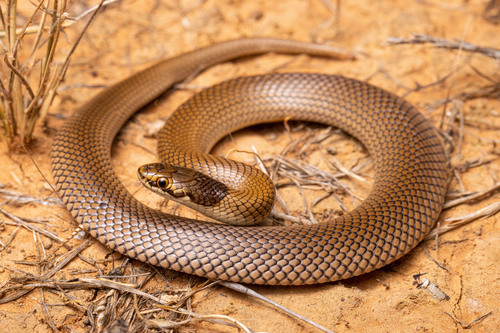
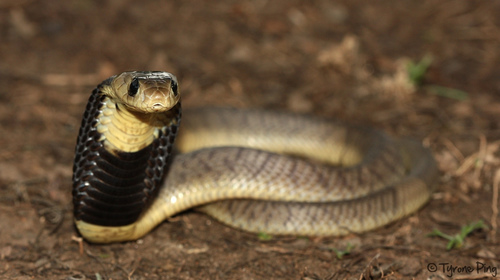
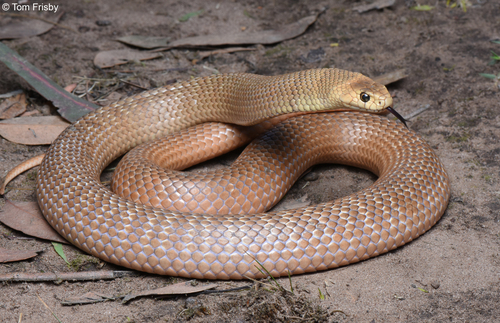
The eastern brown snake (scientific name Pseudonaja textilis) has a slender to average body build, with no visible distinction between its head and neck. When viewed from above, its snout looks rounded.
Size Measurements
Most individuals reach a total length of 1.5 m (4.9 ft), some large specimens grow to 2 m (6.6 ft), and the maximum recorded total length for the species is 2.4 m (7.9 ft). Evidence shows that snakes from northern populations are generally larger than those from southern populations.
Upper Body Coloration
Adult eastern brown snakes vary widely in color. Their upper body ranges from pale to dark brown, and sometimes appears in shades of orange or russet; the pigment is richer on the posterior section of the dorsal scales.
Geographic Color Variation
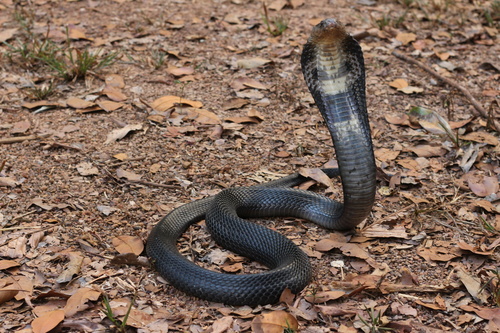
Eastern brown snakes from Merauke have tan to olive upper bodies, while those from eastern Papua New Guinea are very dark grey-brown to blackish.
Fang Characteristics
Compared to other Australian venomous snakes, the eastern brown snake has small fangs that average 2.8 mm (0.11 in) long, and reach up to 4 mm (0.16 in) in larger specimens; its fangs are spaced 11 mm (0.43 in) apart.
Head and Tongue Features
This species has a dark tongue, a blackish iris with a paler yellow-brown or orange ring around the pupil.
Underbody Coloration
Its chin and underbody are cream or pale yellow, and sometimes fade to brown or grey-brown closer to the tail.
Underbody Markings
Orange, brown, or dark grey blotches often appear on the underbody, and are more prominent on the anterior portion. Ventral scales often have dark brown edges along their posterior margins.
Juvenile Head Markings
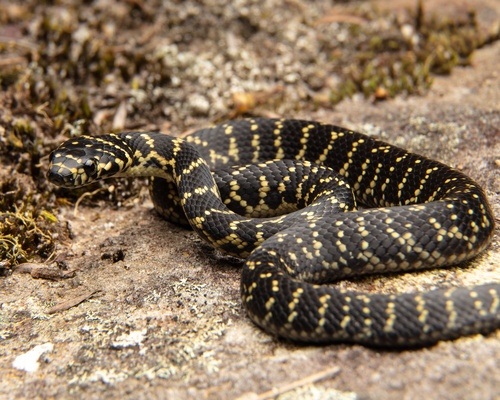
Juvenile eastern brown snakes vary in markings, but most have a black head, a lighter brown snout, a lighter band behind the head, and a black nuchal band.
Juvenile Body Markings
Their bodies may be solid brown, marked with many black bands, or have a reticulated pattern; all darker markings fade as the snake ages. Snake clutches from colder areas tend to produce a higher proportion of young snakes with banded body markings.
Similar Species Distinction (Underparts)
This species can be distinguished from the dugite (Pseudonaja affinis) and peninsula brown snake (P. inframacula) by its yellowish underparts; the related species have entirely brown bodies or brown bodies with grey underparts.
Similar Species Distinction (Mouth Interior)
The eastern brown snake has flesh-pink skin inside its mouth, while the northern brown snake and western brown snake have black mouth skin.
Similar Species Distinction (Adult Head)
Large eastern brown snakes are frequently confused with mulga snakes (Pseudechis australis), which share much of their habitat, but can be told apart by the eastern brown snake's smaller head.
Similar Species Distinction (Juveniles)
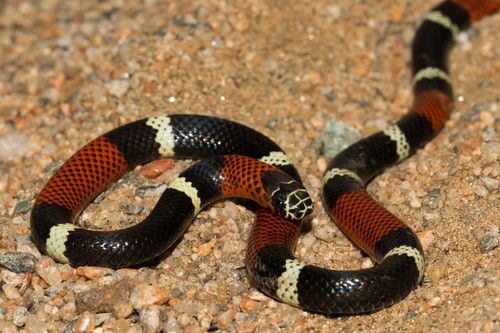
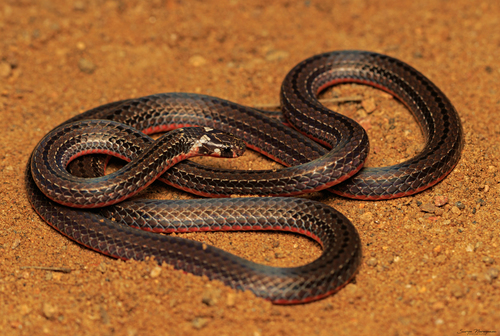
Juvenile eastern brown snakes have head markings similar to red-naped snakes (Furina diadema), grey snakes (Hemiaspis damelii), Dwyer's snakes (Suta dwyeri), and curl snakes (Suta suta).
Australian Distribution
The eastern brown snake is found along the east coast of Australia, ranging from Malanda in far northern Queensland, along the coasts and inland ranges of Queensland, New South Wales, and Victoria, to the Yorke Peninsula in South Australia.
Disjunct Distribution
Disjunct populations live on the Barkly Tableland and MacDonnell Ranges in the Northern Territory, the far east of the Kimberley in Western Australia, and in disconnected areas of New Guinea: these include northern Milne Bay Province and Central Province in Papua New Guinea, and the Merauke region of South Papua, the Indonesian section of New Guinea.
Common Range Areas
It is common in southeastern Queensland between Ipswich and Beenleigh.
Habitat Types
The eastern brown snake occupies a wide variety of habitats, ranging from dry sclerophyll (eucalypt) forests and heaths of coastal ranges, to savannah woodlands, inner grasslands, arid scrublands, farmland, and drier areas that are intermittently flooded.
Preferred and Absent Habitats
It is more common in open habitats, including farmland and the outskirts of urban areas. It is not found in alpine regions or on Phillip Island.
Human Proximity Habitat
Because it feeds mainly on rodents, it is often found near houses and farms.
Shelter Locations
These areas also provide shelter in the form of rubbish and other cover; the snake can hide under sheets of corrugated iron, inside buildings, under large rocks, in burrows, and in ground cracks.
2023 Tennis Tournament Incident
In December 2023, an eastern brown snake interrupted play at the Brisbane International tennis tournament. Play was paused for 40 minutes while a professional snake catcher removed the animal.
Reproduction Basics
Eastern brown snakes generally mate starting in early October, during the Southern Hemisphere spring, and they are oviparous.
Male Mating Combat
Males take part in ritual combat with other males to gain access to females. The sight of two males wrestling has been compared to a plaited rope. The most dominant male mates with females in the local area.
Egg Clutch Characteristics
Females lay clutches of 10 to 35 eggs, and each egg typically weighs 8.0 g (0.28 oz).
Nesting Locations
Eggs are laid in a sheltered spot, such as a burrow, or the hollow inside a tree stump or rotting log. Multiple females may even share the same nesting location, such as a rabbit warren.
Egg Development Temperature
Ambient temperature affects the rate of egg development: eggs incubated at 25 °C (77 °F) hatch after 95 days, while those incubated at 30 °C (86 °F) hatch after 36 days.
Maturity and Lifespan
Eastern brown snakes can reach sexual maturity by 31 months of age, and have been recorded to live up to 15 years in captivity.