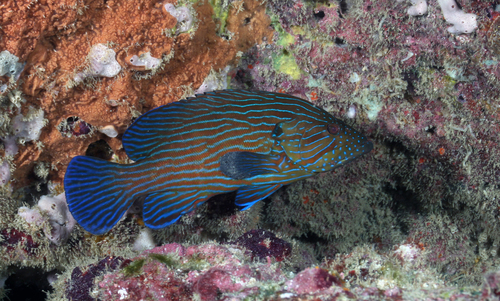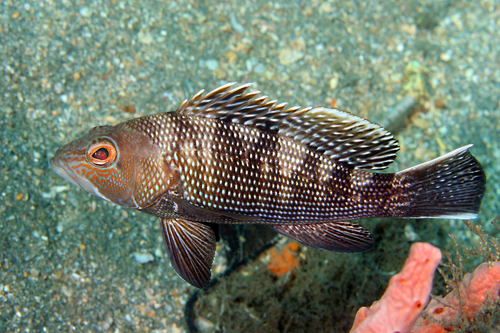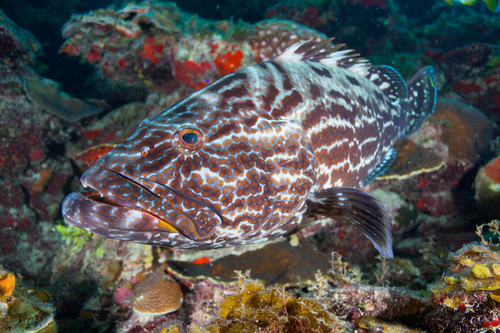
About Mycteroperca bonaci (Poey, 1860)
Body Shape
Mycteroperca bonaci has an oblong, laterally compressed body, with a standard length 3.3 to 3.5 times its body depth. Its preopercle is evenly rounded, with no incisions or lobes at the angle.
Dorsal and Anal Fins
The dorsal fin has 11 spines and 15-17 soft rays, while the anal fin has 3 spines and 11-13 soft rays; both fins have rounded margins.
Caudal Fin
The caudal fin is truncate to emarginate, and may become convex when spread widely.
Overall Body Coloration
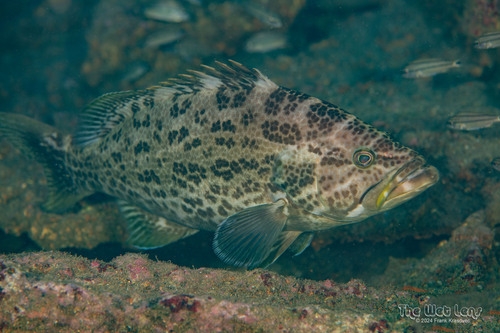
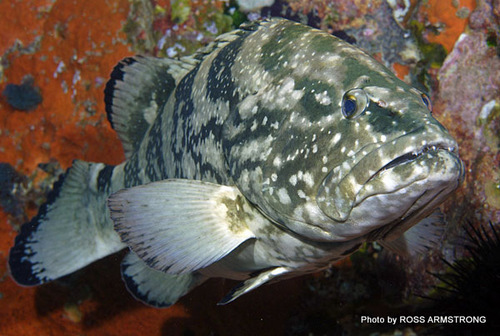
The overall body color of this species is olive gray, marked with dark blotches and brassy hexagonal spots across the head and flanks.
Fin Coloration
Its pectoral fins are sooty brown, fading to orange toward the margin. The soft-rayed portion of the dorsal fin, the anal fin, and the forward edge of the pelvic fin all have a dark margin.
Size and Weight
This fish reaches a maximum total length of 150 centimetres (59 in), with individuals more commonly around 70 centimetres (28 in), and has a maximum published weight of 100 kilograms (220 lb).
Species Distribution
Mycteroperca bonaci is found in the western Atlantic Ocean. Its range extends from Cape Canaveral, Florida and Bermuda south to the Bahamas, and into the Gulf of Mexico as far north as Alabama, along the coast from southern Texas through Mexico and past Cuba.
Caribbean and South American Range
It occurs throughout the Caribbean Sea, and along the coast of South America as far south as Santa Catarina, Brazil, with its range also including the Brazilian islands of Trindade and Fernando de Noronha. There is a gap in its distribution along the northern coast of South America between Paramaribo, Suriname and Maranhão, Brazil.
Vagrant Records
Records of this species in United States waters as far north as Massachusetts refer to juvenile individuals, which are considered vagrants.
Habitat and Depth Range
This species lives over rocky bottoms and coral reefs, at depths between 10 and 30 metres (33 to 98 ft). However, in the eastern Gulf of Mexico it is normally found at depths greater than 30 metres (98 ft).
Social Behavior
It is typically a solitary species.
Diet
Adult individuals feed mainly on fish, including grunts, snappers and herrings, while juveniles feed on crustaceans.
Feeding Aggregations
Black groupers have been documented forming seasonal feeding aggregations along the outer continental shelf off Brazil; these aggregations coincide with spawning aggregations of the fish species the groupers prey on.
Reproductive Biology
This species is a monandric protogynous hermaphrodite, and forms spawning aggregations that have been reported in the Gulf of Mexico and Caribbean Sea. Females reach sexual maturity at around 5 years old, at a length of roughly 82.6 centimetres (32.5 in).
Sex Change Traits
Individuals change sex to male when they are around 15 years old, at a mean length of 121.4 centimetres (47.8 in).