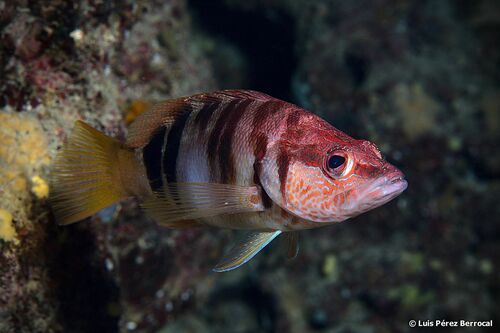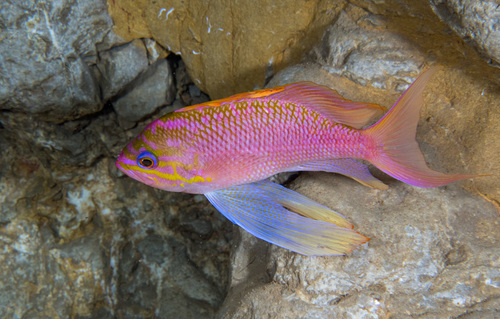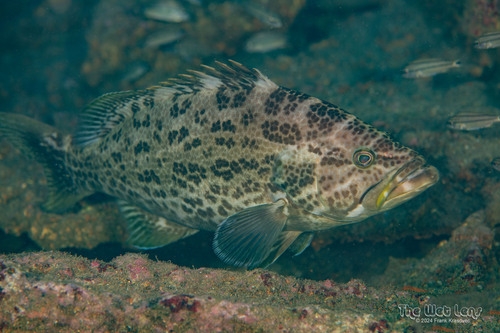
About Mycteroperca phenax Jordan & Swain, 1884
Common Name & Body Shape
Mycteroperca phenax, commonly called the scamp grouper, has an elongated, robust, laterally compressed body. Its body depth is equal at the origin of both the dorsal fin and the anal fin, and its standard length measures 3.0 to 3.4 times its body depth.
Preopercle Structure
The preopercle is angular, with a distinct bony lobe at its serrated angle.
Fin Structure
The dorsal fin has 11 spines and 16 to 18 soft rays, while the anal fin has 3 spines and 10 to 12 soft rays; the membranes between the dorsal fin spines are incised, and the caudal fin is concave.
Color Phase Count
Four distinct color and pattern phases have been described for this species.
First Color Pattern Phase
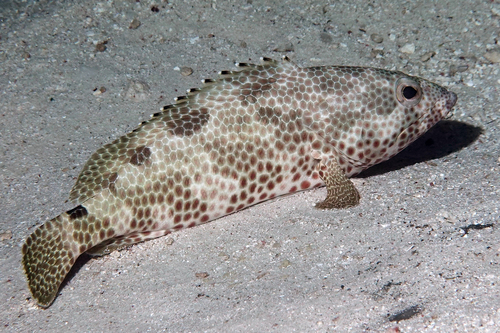
In the first phase, the background color of the head and body is pale brown, and the body is almost entirely covered in small dark red-brown spots (one per scale). These spots often cluster into paw-print shaped markings, which form saddle-like blotches along the back and elongated blotches on the flanks.
First Phase Fin Coloration
The spots extend onto the dorsal and anal fins; the pectoral fin has a dark inner margin and a whitish outer margin, and the caudal fin is dark with a pale margin.
Second Color Pattern Phase
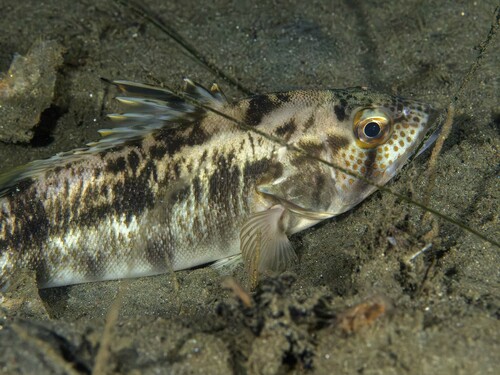
The second color phase is pale brown, with clusters of dark brown cat's paw-shaped spots on the upper body.
Third Color Pattern Phase
The third phase occurs in large adults, which have a silvery grey head and anterior body marked with dark reticulations, while the posterior two-thirds of the body are dark. This phase has a small number of white spots on the abdomen, at the base of the caudal fin, and above the anal fin, plus black margins on the pectoral fins and a dark tail with a pale edge.
Fourth Color Pattern Phase
The fourth color phase is bicolored: it is pale brown on the anterior body, and changes abruptly to dark starting at the soft-rayed portion of the dorsal fin. Juveniles do not develop the bicolored phase.
Size & Weight
This species reaches a maximum total length of 107 centimeters (42 inches), though most individuals are around 30 centimeters (12 inches) long, and the maximum published weight for the species is 14.2 kilograms (31 pounds).
Western Atlantic Distribution
Scamp grouper are distributed in the western Atlantic Ocean, ranging from North Carolina south along the southern Atlantic coast of the United States into the Gulf of Mexico, and as far south as Belize, but they are absent from most of the West Indies. They are also found along the Caribbean coast of South America from Colombia to Tobago.
Vagrant Occurrences
Juveniles are occasionally recorded as far north as Massachusetts, and one vagrant individual has been caught in the Azores.
Depth Range
This species occurs at depths ranging from 0 to 100 meters (0 to 328 feet).
Habitat By Life Stage
Adults inhabit rock ledges and high-relief rocky bottoms, typically at depths greater than 30 meters (98 feet), while juveniles live in shallower reefs and may enter estuaries and mangroves.
Temperature-Driven Migration
When bottom water temperatures drop below 8.6 °C (47.5 °F), adult scamp grouper migrate from deep water to shallower water.
Reproductive Biology & Spawning Aggregations
Scamp grouper are protogynous hermaphrodites that form small, short-lived spawning aggregations, which can number from ten to a few hundred individuals. These aggregations form over high-relief offshore reefs along the edge of the continental shelf, and spawning occurs from February to July in United States Atlantic waters and the Gulf of Mexico, peaking between March and mid-May.
Oculina Reef Abundance
Scamp grouper are the most numerous grouper species in areas of living Oculina reefs between 70 and 100 meters (230 and 330 feet) deep off Florida's eastern coast.
Habitat Preference & Predation Avoidance
It has been suggested that scamp grouper prefer areas of high topographic complexity because they are relatively small, and can use overhangs, ledges, and caves to shelter from predators such as sharks and the greater amberjack (Seriola dumerili).
Diet
They feed on fishes, benthic crustaceans, and octopuses.