About Cephalopholis formosa (Shaw, 1812)
Taxonomic Name
Cephalopholis formosa (Shaw, 1812) has a body that is between two and a half to just under three times as long as it is deep.
Preopercle Structure
It has a rounded, finely serrated preopercle with a fleshy lower edge.
Lateral Line Scale Count
There are 47 to 51 scales in the lateral line.
Fin Ray Counts
The dorsal fin has 9 spines and 15 to 17 soft rays, while the anal fin has 3 spines and 7 to 8 soft rays.
Caudal Fin Shape
The caudal fin is rounded.
Body Scale Type
The scales across the body, including on the abdomen, are ctenoid.
Body Coloration
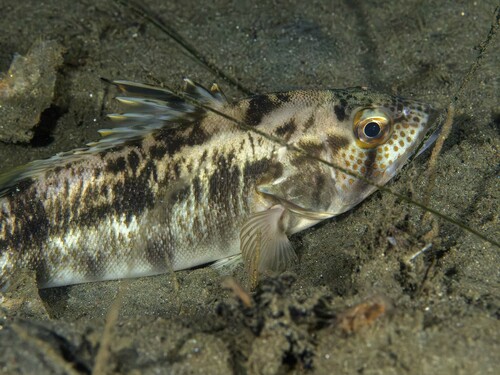
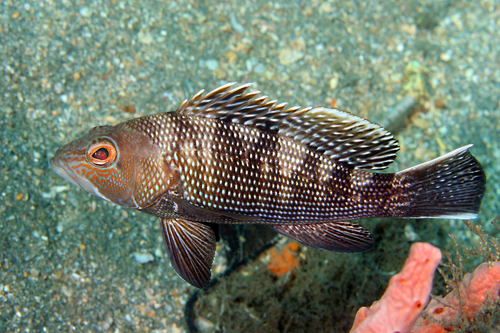
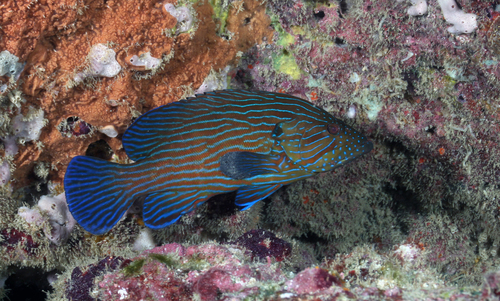
The body is colored dark brown to yellowish brown with thin blue stripes.
Head and Chest Markings
Small black and blue spots are present on the lips, snout, lower part of the head, and the chest.
Maximum Length
This species reaches a maximum total length of 34 centimetres (13 in).
General Distribution Habitat
Cephalopholis formosa occurs in shallow coastal waters of the mainland and continental islands of the eastern Indian Ocean and Western Pacific Ocean.
Oceanic Island Distribution
The only oceanic islands where it is found are the Lakshadweep Islands.
Range Extent
Its range extends from the Lakshadweep Islands and Sri Lanka eastward to the Philippines, northward to Honshu, Japan, and southward to Australia, where it has only been recorded from the Northwest Shelf of Western Australia.
Misidentification Records
Records of this species from the Mascarenes are probably misidentifications of Cephalolophis polleni, while records from the Great Barrier Reef probably refer to C. boenak.
Additional Distribution Record
C. formosa has also been recorded in the Persian Gulf.
Habitat and Depth Range
Cephalopholis formosa inhabits shallow waters over silty or dead reefs, at depths between 10 and 30 metres (33 and 98 ft).
Feeding Behavior
It is a solitary, predatory species that feeds on other fishes and crustaceans.