About Morus serrator (G.R.Gray, 1843)
Species Naming
This species, the Australasian gannet with the scientific name Morus serrator (G.R.Gray, 1843), has the following physical description.
Adult Body Size
Adult Australasian gannets measure 84–91 cm (33–36 in) in length, weigh an average of 2.3 kg (5.1 lb), and have a wingspan of 170–200 cm (67–79 in). The two sexes are generally similar in size and appearance, though a 2015 field study conducted at the Pope's Eye and Point Danger colonies found females were 3.1% and 7.3% heavier at each site respectively.
Sexual Dimorphism
Females also have a slightly larger ulna and a smaller bill.
Adult Plumage
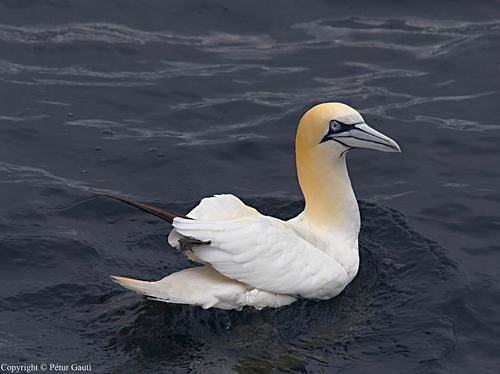
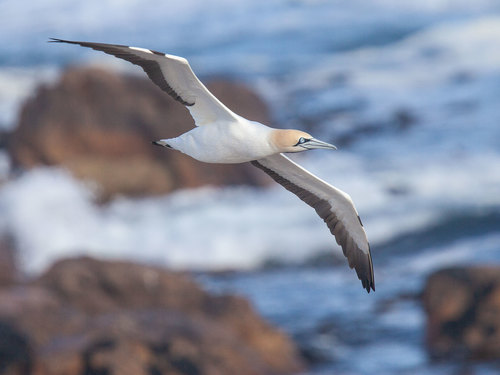
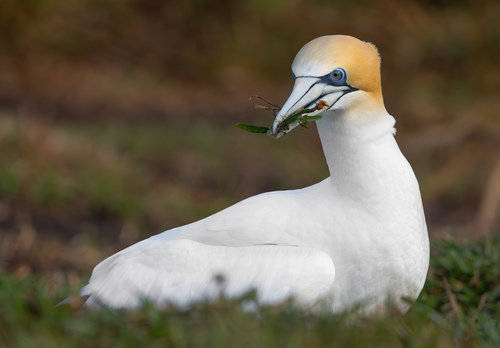
Adult plumage is white, with black flight feathers on the wings and black central tail rectrices. Some individuals have more extensive black plumage across their tail feathers. There is a sharp boundary between the light and dark portions of the plumage.
Plumage Function
Black primary feathers are more resistant to wear, which may explain the dark plumage of the wings.
Head Features
The head and hindneck have a buff-yellow tint; this colour is more prominent on the head and becomes more pronounced during the breeding season. Adults have light grey irises surrounded by a pale blue eye ring, with bare black skin on the face that blends into the bill.
Bill Characteristics
The adult bill is pearly grey with dark grey or black edges, and a black groove that runs the entire length of the upper mandible.
Limb Characteristics
The four-toed feet are dark grey and connected by a membrane of the same dark grey colour. Light green lines run along the ridges of the toes and continue upward along the front of the legs.
Fledgling Appearance
Fledgling Australasian gannets are overall brownish-grey with white speckles. They have dark brown bills, dark bare facial skin and dark eyes, and dark grey legs and feet.
Plumage Maturation
Australasian gannets take 2 to 5 years to develop full adult plumage. During this period, the upperparts and underparts gradually whiten and the crown and nape gain buff colouration, though there is wide variation in the age at which mature plumage is achieved.
Similar Species Distinction
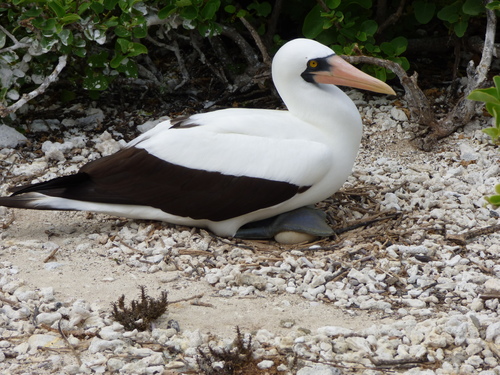
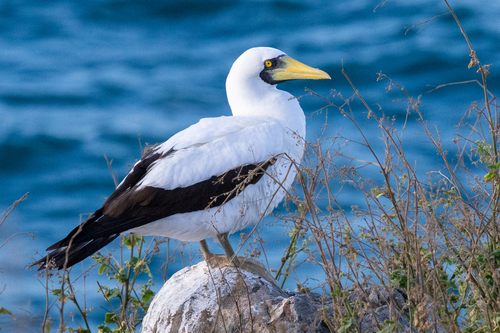
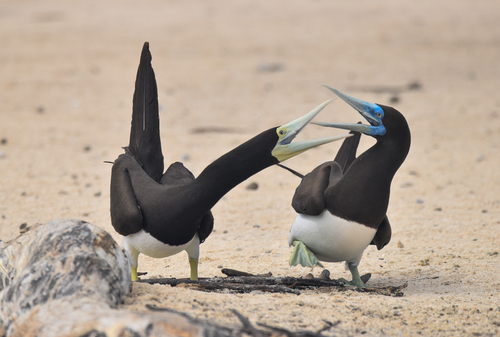
This species is distinct, and is only likely to be confused with species that do not usually share its range. The Cape gannet is a rare vagrant to Australasian waters and has an all-black tail, while masked boobies and red-footed boobies are generally limited to tropical waters.
Booby Comparison
Though both booby species have mostly white plumage, they lack the buff head colouring of the Australasian gannet and have white tails. The masked booby has a blue-black face and less black on the wings, while the red-footed booby has red feet.
Overall Distribution
Regarding distribution and habitat, the Australasian gannet occurs from Steep Point in Western Australia, along the southern and eastern Australian coastline to the area around Rockhampton in Queensland, as well as the North and South Islands of New Zealand, and Lord Howe and Norfolk Islands.
Marine Habitat
When at sea, it is generally restricted to waters over the continental shelf, and may enter harbours, bays and estuaries, particularly during stormy weather.
Juvenile Dispersal
In May and June, young gannets from New Zealand colonies disperse north and west, mainly flying north around the North Island and, to a lesser extent, traveling via Cook Strait. They generally reach as far north as southeastern Queensland and Rottnest Island in Western Australia.
Vagrant Records
Gannets that wander far are occasional visitors to Marion Island and the Crozet Islands in the southern Indian Ocean, and have even reached South Africa where they have interbred with Cape gannets.
Immature Movement
Some immature gannets spend 3 to 4 years in Australian waters before returning to New Zealand, while others remain in New Zealand waters.